Bill pushes to protect sexual offence survivors’ right to education amid implementation debate

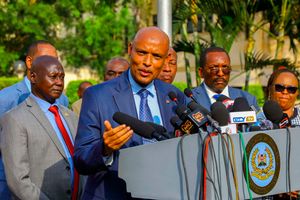
Kisii woman representative Doris Donya Aburi on August 22, 2023. She has sponsored the Sexual Offences (Amendment) Bill, 2023.

What you need to know:
- Proposed law seeks to guarantee survivors’ education, but confusion over implementation roles raises concern nationwide.
- Survivors’ right to education gains legal backing as debate grows over which office leads implementation.
A proposed law is seeking to strengthen protection for survivors of sexual offences by anchoring their right to education in policy and practice, even as debate continues over which government office should take the lead in implementing it.
The Sexual Offences (Amendment) Bill, 2023, sponsored by Kisii woman representative Doris Donya Aburi, introduces provisions requiring the government to promote awareness of sexual offences and to establish programmes that safeguard the education of survivors, including those affected by teenage pregnancy.
At the centre of the proposed amendments is the role of the Cabinet Secretary. The Bill defines the Cabinet Secretary as the one responsible for legal affairs and mandates the office to spearhead nationwide education and information campaigns on sexual offences. It also requires the office holder, in consultation with the Cabinet Secretary for Education, to develop programmes that ensure survivors remain in school.


Review by Legal Affairs committee
The National Assembly’s Departmental Committee on Justice and Legal Affairs has already reviewed the bill, including conducting public participation in October 2024 and March 2025. Recommending its approval, the committee proposed amendments, particularly on clarifying who should be responsible for executing the interventions.
During public participation, institutions raised concerns about the ambiguity surrounding the office tasked with implementation. The Kenya National Commission on Human Rights, the government’s watchdog, argued that the reference to the Cabinet Secretary for legal affairs is problematic, noting that Executive Order No. 2 of 2023 does not clearly assign such a mandate.
It instead proposed that the role be assigned to either the Cabinet Secretary for Interior and National Administration or the one in charge of Gender, Culture, the Arts and Heritage. The commission further noted that Kenyan courts have consistently held that the Attorney General is not a Cabinet Secretary, hence cannot perform functions explicitly reserved for Cabinet Secretaries under legislation.
Similarly, the Office of the Attorney General recommended deleting the reference to “Cabinet Secretary for legal affairs” and substituting it with the Cabinet Secretary responsible for gender. The office argued that the State Department for Gender and Affirmative Action is better positioned to coordinate efforts addressing sexual and gender-based violence, given its focus on prevention, protection, advocacy and empowerment.
In its observations, however, the parliamentary committee noted that the Sexual Offences Act currently defines the Cabinet Secretary as the one responsible for legal affairs and public prosecutions, yet prosecution is constitutionally a function of the Director of Public Prosecutions.
The committee said the amendment seeks to align the law with the Constitution, while acknowledging that key functions under the Act have continued to be performed despite the absence of a clearly designated Cabinet Secretary for legal affairs.
Beyond the legal and administrative questions, the sponsor of the Bill has framed the proposed changes as a response to gaps in awareness, stigma and systemic barriers that continue to lock survivors, especially girls, out of school. The legislator emphasised the need for early, school-based awareness, noting that minors are often the primary targets for sexual offences.
“Equipping children with information could help prevent abuse and improve responses when it occurs,” Doris said in a phone interview on March 25, 2026.
She pointed to common misconceptions that undermine justice, including the tendency of families to prioritise silence or informal settlements over reporting cases. In some instances, she said families encourage survivors to bathe immediately after an assault, inadvertently destroying critical forensic evidence.
The bill also seeks to challenge harmful social norms that stigmatise survivors, particularly those who become pregnant. Doris criticised practices where families accept compensation instead of pursuing justice and shaming survivors instead of perpetrators. “People who should be ashamed are the perpetrators, not the victims,” she said, calling for an end to survivor-blaming and informal arbitration of sexual offences.
She highlighted the urgency of reforming the school environment. She noted that teachers play a critical role in either supporting or excluding survivors, especially girls who return to school after pregnancy. She called for an end to stigma within schools, where learners are often treated as outcasts or labelled as “parents” rather than supported as children whose education must continue.
But even as the Bill seeks to guarantee re-entry into school, stakeholders warn that policy alone will not be enough without deliberate investment. Winnie Wadera, a young mother’s life skills trainer, said many families are forced to choose between supporting a girl’s education and meeting the immediate needs of childcare.
“So now the question becomes, do we focus on your education or do we split the little resources in your childcare and upkeep?” she said. “The government will draft a policy saying all girls must go back to school, but what happens with the resources?”
She argues that if the state is serious about returning young mothers to school, it must back the policy with targeted funding to support both the girls and their families, at least in the early years of a child’s life. “I believe there are enough resources in this country to support these girls. If there is intention, some funds can be set aside, maybe for up to two years, then families can take over,” she said.