From laws to leadership: Australia’s gender equality journey offers Kenya a roadmap forward
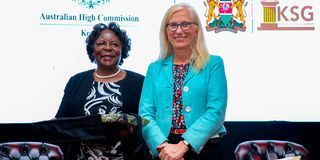
Australian High Commissioner Jenny Da Rin (right) with the Presidential Technical Working Group on GBV adviser, Dr Nancy Baraza, during a public dialogue to mark International Women’s Day at the Kenya School of Government in Lower Kabete on March 4, 2026.

What you need to know:
- Global gender equality remains distant, but Australia’s reforms show progress is possible through deliberate policy choices.
- Kenya can draw lessons from Australia’s journey in enforcing laws and strengthening gender equality institutions.
One of the activities held to commemorate this year’s International Women’s Day was the public dialogue hosted by the Institute for Gender and Social Development of the Kenya School of Government on March 4 with a presentation from Australian High Commissioner Jenny Da Rin.
The presentation noted that according to UN Women, no country has closed the legal gender gaps. In fact, “in 2026, women only have 64 per cent of the legal rights that men hold.” At this rate, “it will take 286 years to close gender gaps in legal protection and remove discriminatory laws, and 140 years to achieve equal representation in workplace leadership.” This dramatises the work to be done.
“When I was born six decades ago in Australia, women had to give up their public service job when they married. They didn’t have secure property rights. Women couldn’t get a bank loan without a male guarantor. Employers were legally permitted to pay women less than men. Maternity leave? No such thing existed. Childcare? That was women’s work. Higher education was for a privileged few, and careers? Women were encouraged to be nurses and teachers, not doctors, lawyers, engineers or diplomats”.


A daunting journey ahead
This has drastically changed. Australia was one of the first nations to grant women the rights to vote and stand for election, in 1902. But “it took another 123 years for women to achieve (almost) equal representation in the Australian federal parliament,” coming in 2025 when they “occupied 49.6 per cent of both houses and were majority in the Upper House (56.6 per cent)”. In 2025, “Australia formed its first ever majority women-led federal government with a cabinet of 12 women and 11 men.” Women have also been governor general (current), prime minister and leaders of the opposition in parliament.
Getting women into legislative spaces was achieved through “sustained effort and campaigning by women” and lobbying. For instance, the Women’s Electoral Lobby in 1972 “brought the demands of the women’s movement to government”. One result was that in 1973, the first women’s adviser to the prime minister was appointed, making “Australia the first government in the world to create this position”. Kenya did this only in May 2023.
In Australia, this step snowballed into the establishment of the women’s affairs section in the Department of Prime Minister and Cabinet, which evolved into the office for women” that “works across government to place women and gender equality at the centre of policy and decision-making through gender-responsive budgeting and gender impact analysis”. Women in politics mobilised around a set of issues of particular concern to them, diversified the policy agenda, made processes more inclusive and improved the laws.
In 2012, Australia enacted the Workplace Gender Equality Act, which requires employers with over 100 employees to annually report on the gender composition of the workforce, equal remuneration, flexible working arrangements, consultation, sexual harassment, and gender-based harassment/discrimination.
The women in leadership strategy launched in 2015 has helped to build a culture, workforce and leadership that is inclusive, equitable and diverse. In diplomatic circles, for instance, women’s share increased from 27 per cent in 2015 to 52 per cent in 2025 for heads of mission and post, with six in nine ambassadors in Africa being women. Australia also sets annual targets in reducing gender disparities, which creates pressure to comply.
But these do not mean Australia is perfect. According to the Workplace Gender Equality Agency report of 2026, more than 50 per cent of employers still have a gender pay gap larger than 11.2 per cent in favour of men. However, it has come down from a high of 18.6 per cent 10 years ago.
Like Kenya, Australia suffers from “rigid attitudes and behaviours around gender”. The statistics on gender-based violence are also telling. One in three women has experienced physical violence since the age of 15; one in five has experienced sexual violence since the age of 15; women are three times more likely than men to experience violence by an intimate partner; and one in two has experienced technology-facilitated abuse at least once in their lifetime.
In response, the National Plan to End Violence against Women and Children 2022–32 was developed, backed by over $2 billion for implementation. The amended Fair Work Act, 2009, introduces an entitlement to 10 days paid family and domestic violence leave and expressly prohibits workplace sexual harassment. Online GBV is also a concern in Australia. But it has responded by being the first country globally to enact a nationwide ban on social media for children under 16.
Key lessons were that: law must be enforced; structures of compliance are mandatory; activism and reporting ensure visibility of gender gaps; and women in leadership positions can drive policy change. The bottomline? Gender equality is achievable.
The writer is a lecturer in Gender and Development Studies at South Eastern Kenya ([email protected]).


