Black female footballers praised for strength, white players for intelligence: Study
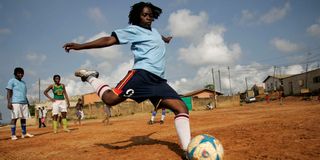
Players of the all-female '113' soccer team take part in a training session in Cabinda on January 22, 2010.

What you need to know:
- Research shows sports commentators praise black women footballers mainly for athleticism while white players receive recognition for intelligence.
- Study finds racial stereotypes influence football commentary, shaping perceptions of black women athletes’ skills and emotions.
For black female professional footballers, racism has become a distressingly regular part of the game. Earlier this year, England defender Jess Carter told the BBC that the racist abuse she received online during the 2025 Euros made her fearful to leave her hotel room.
Black sportswomen routinely deal with racial abuse from fans and teammates. But less discussed is how their bodies, emotions and on-pitch performances are spoken about by sports commentators. It’s not just negative comments, either. Clear racial stereotypes emerge when comparing positive comments about black players with those about white players. Our 2025 study examines commentary during the 2019 Fifa Women’s World Cup, does just that.
We analysed 2,905 comments of praise given to footballers during 80 hours of BBC and ITV coverage, across all 52 matches at the tournament. We found that white women were more frequently praised for their intelligence and technical proficiency, while black women received the most praise for their perceived physical prowess and natural athleticism.

White players were more frequently praised skills learned through practice, such as having a “lovely technique” (49.4 per cent of all comments about white players), followed by physical (20.3 per cent), character (16.2 per cent), cognitive (10.8 per cent) and natural (3.3 per cent) abilities.
Black players received almost double the amount of praise for their physical prowess (39.5 per cent of comments about black players) and natural abilities (5.8 per cent). They received notably fewer praise comments for learned skills (36.8 per cent), as well as lower amounts of praise for character (11.9 per cent) and cognitive attributes (6.0 per cent).
These differences were especially noticeable in the coverage of national teams from white-majority countries that had more than two black players in their starting squad. England’s two non-white players (accounting for 18.2 per cent of the team) received 50 per cent of all of their team’s praise for natural attributes. These were comments praising qualities that were perceived to be innate, such as being a “magician” on the pitch. England’s visibly white players (81.8 per cent of the team) received almost the entire amount of the praise given to the whole team for cognitive attributes (96 per cent).
France’s black players, who accounted for 43 per cent of team, received 90 per cent and 85 per cent of the team’s total praise for natural and physical attributes, respectively. White French players, who similarly constituted 43 per cent of the playing squad, received 68 per cent of the teams’ total praise for intelligence.
We also found that black female players were more likely to be described as being angry and emotionally unstable during matches. Nigeria’s forward Desire Oparanozie was described as “playing with a bit of anger” and England’s Nikita Parris was said to be unable to maintain her composure, with a tendency to frequently “make her feelings known”.
Their white teammates, on the other hand, were described as calm and composed. During the England v Cameroon match, commentators praised the almost entirely white England team for keeping their composure and not “reacting” to “unseemly things going on the pitch” by the African players.
The harm of misogynoir
Black women experience a unique form of discrimination called misogynoir. It is different to the exclusions faced by white women and the racism experienced by black men. It is the result of a combination of the misogyny directed at their gender and the anti-black racism directed at their race.
Sport media is a powerful site where the gender and racial stereotypes that exist in society are replicated. It has a long history of portraying black sportswomen as powerful, hyper-masculine and angry.
Studies have shown that black sportswomen are frequently stereotyped as unfeminine, masculine and strong, lacking intelligence, emotionally unstable, inherently angry and overly aggressive. Conversely, white women are seen to embody Eurocentric beauty standards and accepted feminine ideals, such as notions of purity, grace, emotional stoicism and delicacy.
These stereotypes have real-life consequences for black sportswomen. Some footballers have gone so far as to change how they play so that they are not seen as angry or masculine, but just as women who play the game they love. For example, ex-England player Anita Asante explained:
“You have to check yourself to make sure people don’t view you in that light. Maybe on that particular day in a training session, I am that sassy person, or I am that competitive person that comes across a bit feistier – but because there is an association with being a black woman and having that energy and boldness is not always seen a positive thing, [so] I might refrain from being that person and contain more of my emotions.”
Evidence shows that misogynoir can influence the career opportunities that are afforded to black women more generally. A recent US study connected racism to higher levels of stress and to higher mortality rates.
Unless, meaningful action is taken by broadcasters to change the practice of commentary through tallying exercises like our research, then commentators might be unwittingly contributing to the racial stereotypes that cause psychological and physiological harm to the same superstars that they idolise and praise.