Classrooms, mines and maternity wards: The women using AI to save lives
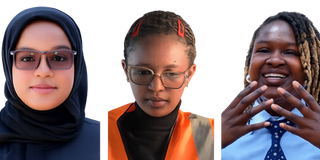
From left: Khadija Omar, Norah Kimathi and Idah Anyango. They are using artificial intelligence to save lives.

What you need to know:
- Driven by lived experiences, these young women are harnessing artificial intelligence to tackle pressing societal and industrial challenges.
- From assistive robotics to maternal health prediction, they are redefining how technology serves communities.
When floods strike, they often leave behind a trail of destruction: household items soaked beyond repair, homes swept away, especially those built with substandard materials, and, in the worst cases, loss of lives, particularly among children.
For Norah Kimathi, these flood-induced tragedies became the starting point of her innovative thinking and problem-solving mindset. Raised in Nairobi West, where such incidents were part of their lives, Norah began developing solutions at an early age, driven by her strong interest in science and mathematics, in which she excelled.
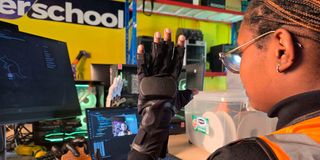
Norah Kimathi, co-founder of Zerobionic, an assistive robotics company advancing inclusive Stem education across Africa, demonstrates how they train a humanoid robot in sign language at their Nairobi workshop on April 13, 2026.


“I started tinkering with devices that could help me and my family go about our daily activities in a normal way whenever such incidents would occur,” she says.
First inventions
At just 15, she began experimenting with simple tools, including building a small makeshift phone using Lego bricks, without any formal technical training. “I started building a small mini phone using Lego, and at the time, I didn't even know what I was doing,” she recalls.
What she did not realise then was that she was already thinking like an engineer, developing practical solutions to challenges directly affecting her environment. That early curiosity would later evolve into an academic and professional path within science, technology, engineering and mathematics (Stem).
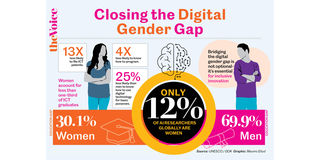
Today, Norah, 22, is among the women in Kenya with a degree in Informatics and Computer Science from Strathmore University. Her achievement stands out in a field where women remain under-represented, with the latest publicly available government data from 2022 showing that women accounted for 30.1 per cent of ICT graduates, compared to 69.9 per cent of men.
AI-powered innovation
Beyond her academic success, she has joined a growing group of women leveraging artificial intelligence (AI) to solve real-world challenges and improve efficiency across sectors.
According to the United Nations Educational, Scientific and Cultural Organisation, women and girls today are 25 per cent less likely than men to know how to use digital technology for basic purposes. They are also four times less likely to know how to programme computers, and 13 times less likely to file for an information and communication technology patent.
Worse still, only 12 per cent of artificial intelligence researchers globally are women. Norah is the co-founder of Zerobionic, an assistive robotics company advancing inclusive Stem education across Africa.
Her journey into assistive technology was shaped during her university years, where she actively participated in outreach programmes such as Young Scientists Kenya. “I started moving from school to school, mentoring children who are younger than me in Stem courses,” she says.
It was during these school visits that she encountered a challenge that would redefine her work and focus. “We happened to encounter some kids who could not hear, and some actually couldn't speak, so we had to teach using images,” she recalls.
The process proved slow and frustrating, particularly when explaining complex scientific concepts such as chemical equations. “You're trying to explain a chemical equation, and even for someone who can hear, it takes time, so you can imagine for someone who can't hear,” she explains. “It took us about seven to nine hours of frustration.”
That experience revealed a critical gap: the absence of a localised Stem sign language system tailored for learners with hearing impairments. From that realisation, Zerobionic was born, focusing on developing AI-powered robotic hands capable of translating complex Stem concepts into sign language in real time. It is a journey she began at just 19, in her first year at university. She is set to graduate in July 2026.
The system is designed to continuously learn and evolve alongside advancements in science and technology. “We have models that are constantly running in the background, learning and updating as Stem evolves,” she says.
The impact has already been significant, with the company conducting more than 78 pilot projects across Kenya and expanding into other countries. “We have expanded into Liberia, South Africa and Ethiopia, reaching over 510,000 beneficiaries,” she notes.
However, scaling across Africa exposed another major challenge: the lack of a standardised sign language system across the continent. “We quickly found out that the biggest problem is there's no standardised African sign language dataset,” she explains. “We have American and British sign language, but nothing unified for Africa.”
To address this, her team is now building a continental dataset designed to support multiple sectors beyond education. “At the moment, we have over 90 billion parameters of data, and in the next two to three years we are hoping to open-source it,” she says.
The innovation is also designed with sustainability in mind, using recycled materials in the production of robotic components. “We don't build them using metal; we use recycled plastics sourced through youth-led recycling networks,” she explains.
These networks also create opportunities for young people, who are incentivised to collect materials such as bottles and tyres. “So once they bring the materials to us, we reward them with books, money, or pathways into education,” she says.
Production has been significantly improved through 3D printing, reducing manufacturing time from months to about a week. Previously, she says, it would take two to three months, but now they can complete a robotic arm in about one week.
Hybrid business model
Zerobionic operates a hybrid business model combining hardware and subscription-based software services to improve accessibility. “A humanoid robot in the market can cost between Sh2 million and Sh5 million, but we have reduced our costs by over 60 per cent,” she says. “We try to subsidise it to around Sh300,000, with flexible payment options for institutions.”
For schools unable to afford upfront costs, the company offers leasing options and tiered subscription plans. The initial payment can be as low as Sh40,000, followed by a monthly subscription depending on the tier, she says.
At the core of the system is AI capable of interpreting speech, text and images in real time. “It has different layers such as perception and reasoning to ensure accuracy and filter out incorrect outputs,” she says.
She recalls an early failure during a pilot in Rwanda that helped improve the system's reliability. “Noise interference caused the system to pick up and display a vulgar word, which pushed us to improve accuracy and governance,” she explains.
The system has since improved significantly and now operates at about 92 per cent accuracy, she says. Looking ahead, Norah aims to scale the technology further and expand its reach across the continent. “We are now hoping to reach over one million students by the end of next year,” she says.
At Machakos Senior Secondary School for the Deaf, early pilots of the Zerobionic system are already shaping how students engage with Stem learning. Dennis Ayoyi, a physics, computer studies and mathematics teacher at the school, describes the initiative as a significant shift in how learners with hearing impairments interact with science and technology.
The school participates annually in the Young Scientists of Kenya competition, where the Zerobionic collaboration was first introduced to them in 2026. “This year, we were approached with a proposal to take part in the Zerobionic project, which involves robotics in Stem education,” he explains.
The initiative aimed to spark interest in Stem among learners with hearing impairments while introducing robotics capable of mimicking Kenyan sign language, he says. The school enrolled 40 students, evenly split between boys and girls, drawn from Grade 10 to Form Four.
“They learned about robotics, mechatronics, and even tried basic signs like fingerspelling from A to Z,” he says. “They were excited and even pointed out both the strengths and weaknesses of the system during the sessions.”
One of the key strengths identified was the system's ability to support independent learning among students with hearing impairments. “It can support online meetings by improving accessibility for learners who rely on sign language communication,” he adds.
However, students also identified technical limitations, particularly in the accuracy of hand shapes used by the robotic models. “The hand shapes were not always clear, and sometimes the robot could not fully close its fist,” he explains.
This limitation, he says, could lead to misinterpretation of signs, highlighting areas that still require refinement.
Changing how mining works
For Khadija Omar, the future of mining lies not only underground but also in data. A mining engineer and doctoral candidate at Pennsylvania State University in the US, Khadija is applying AI to one of the world's most hazardous industries, designing emergency response systems that could help save lives in high-risk mining environments.
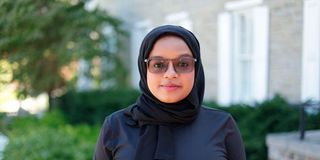
Khadija Omar, a Kenyan and doctoral researcher at Penn State University in the United States. She advances artificial intelligence and automation to predict and prevent mining disasters.
Her work sits at the intersection of engineering, robotics and machine learning, a path she began shaping long before her PhD. That journey started in Kenya, where she earned her bachelor's and master's in Mining and Mineral Processing Engineering from Taita Taveta University, steadily building expertise in AI-powered safety systems.
Childhood exposure
But the roots of her interest go deeper, into the mining communities of Lamu and later Kwale, where she spent her childhood. Growing up around extractive sites gave her an early understanding of the promise and peril of the sector. “I grew up in a community where mining is rampant, and I was privileged to gain apprenticeship experience early,” she says.
Internships at Base Titanium and the Ministry of Mining sharpened that awareness. On site, she witnessed first-hand the safety gaps that continue to threaten workers across the industry. After graduating with first-class honours, her exceptional performance quickly earned her appointments: first as a mining engineering technologist and later as a tutorial fellow.
After her postgraduate studies, where she focused on using AI to predict mining hazards, she went to the University of the Witwatersrand in South Africa for experiments. There, she says, she met “gurus” in the industry.
Predictive models
Together, they developed predictive models capable of analysing coal properties and estimating the likelihood of combustion before disaster strikes. “We built models that help mines predict the likelihood of fires and take preventive action,” she says.
Her work is also transforming mineral exploration, an area long defined by expensive drilling and sampling. “Mining is very resource-intensive, but AI allows us to predict mineral distribution using data instead of excessive exploration,” she says.
Ending preeclampsia
At the University of Nairobi Institute of Tropical and Infectious Diseases, Idah Anyango is building what she hopes will become data-driven solutions to some of the country's most pressing maternal health challenges.
A Health Systems Management graduate from the Meru University of Science and Technology, Idah grew up in Mukuru kwa Njenga informal settlement in Nairobi. She is now working to connect artificial intelligence with the fight against preeclampsia, a condition she has personal experience with. “I experienced preeclampsia at 18, and it nearly cost me my life despite attending antenatal clinics.”
She recalls receiving limited intervention despite clear warning signs, an experience that exposed what she describes as systemic gaps in early detection and specialised maternal care. “I was only given medication and routine care, yet I needed specialised attention because my condition was already high risk.”
That experience now drives her work. "I want to use data to identify risks early so that other mothers do not go through what I experienced. I want to study patterns in maternal health and build models that can help detect risks early enough to save lives."
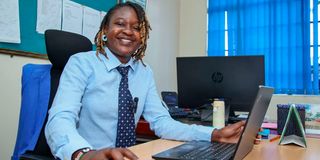
Idah Anyango, an office assistant intern at the University of Nairobi Institute of Tropical and Infectious Diseases, during the interview on April 14, 2026.
Preeclampsia is not her only focus. She is simultaneously developing two other applications at different stages. One aims to predict the risk of acquiring advanced HIV disease using key indicators such as CD4 cell counts and viral load. “I am expanding more and fine-tuning the model each day,” she says. The other is a data science and analytics system she estimates is about 70 per cent complete.
But the preeclampsia tool remains her flagship project. “I'm hopeful I'll be done in the next three months and pilot them,” she says, adding that she is currently fine-tuning and retraining the models for better results.
Much of her time goes into research, consulting health experts, reviewing studies and clinical trials, and exploring health management information systems and hospital-generated data to understand how machine learning can be applied in healthcare. “I've begun my entry level into research,” she says, describing this phase as one of learning and exposure.
Her progress, she says, has been shaped by continuous learning and community support. “I have been able to achieve this through actively learning and mentorship, through engaging with different tech communities and attending workshops, training and networking.”
She is equally disciplined about keeping her technical skills sharp. “Without coding every single day or at least 10 to 20 minutes, you lose the skills,” she says.
Looking ahead, Idah plans to pursue further studies and is weighing between a master's degree in data science and one in epidemiology, hoping either path will strengthen her ability to build predictive models grounded in both technical and public health knowledge.
Her ambition is clear: to build health systems that can identify risks before complications escalate. “It's better to predict before it actually happens,” she says, envisioning a future where data-driven tools enable health systems to respond earlier and more precisely, and ultimately save lives.
Shift in women's participation in Stem
Prof Julius Oyugi, director of the University of Nairobi Institute of Tropical and Infectious Diseases, says there has been a noticeable shift in women's participation across Stem fields over time. “When I joined the University of Nairobi, we had fewer girls coming to study medicine, but today we have significantly more women enrolling,” he says.
He notes that at the postgraduate level within the institute, women now form the majority in several programmes. “In most of our programmes, women make up more than 60 per cent, and in some cases, they outnumber men,” he says.
This shift, he says, reflects broader systemic changes that have improved access to education for women. “Access to free education and government sponsorship has created an environment where women can thrive in Stem,” he says.
Gender gap in science
As a result, he argues, the gender gap in science and technology fields is steadily narrowing. “Women are now almost on a par with men in Stem, and in some areas, they are actually overtaking them,” he notes.
At the University of Nairobi, he adds, some of the leading scientists are women, further demonstrating the shift in representation. He, however, emphasises the need to invest more intentionally in AI and data science education. “If we want growth as a country, we must build capacity in AI and data science because innovation depends on it,” he says.