Country with a women’s rights adviser but no female at the table shaping its post-2030 future
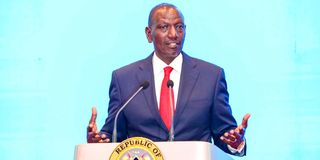
President William Ruto at Safari Park Hotel in Nairobi on March 28, 2026. His promises to women are under growing scrutiny, as flagship pledges in his Kenya Kwanza manifesto and Women’s Charter show patchy progress and glaring gaps.

What you need to know:
- Fresh appointments to key state advisory bodies reignite questions over President William Ruto's commitment to the two-thirds gender rule.
- Despite creating the Office of the Women's Rights Adviser, critics say women remain underrepresented in influential government positions.
In the books of history, President William Ruto may stand out as the leader who established the Office of the Women’s Rights Adviser and signed a charter with women containing a raft of transformative promises.
More recently, he recognised the power of women in leadership and the change they can bring. On April 1, when he met with members of the Maendeleo Ya Wanawake Organisation, he advanced a development-oriented view of women, promoting their transformative role in leadership.
“I have worked with many women and had the opportunity to engage with them at different levels. Through this, I have come to realise that it is true that what a man can do, a woman can do,” he said, going on to praise each of the six women Cabinet Secretaries in his 22-member Cabinet for their achievements.


Nevertheless, on June 30, a three-judge bench of the High Court in Milimani, Nairobi, declared Dr Ruto’s Cabinet unconstitutional for violating the Constitution’s two-thirds gender rule and ordered him to reconstitute it within 120 days. The ruling highlighted a gap between Dr Ruto’s commitments and promises contained in his election manifesto.
“Realisation of the two-thirds gender rule in elective and appointive positions in the public sector, within 12 months following election, including 50 per cent Cabinet positions to women,” reads part of the Kenya Kwanza manifesto under its commitments to women.
The commitment is reaffirmed in the Kenya Kwanza Alliance Women Charter. In the charter, Dr Ruto promised to establish a “Women Rights Agency at the Office of the President”, which has since been created. However, questions are emerging over whether the office has had an impact on the President’s plans and appointments, given that it is expected to ensure women are not left behind in the national development agenda.
During Citizen TV’s Daybreak show on July 23, High Court advocate Titus Makhanu questioned the government’s commitment to gender equality, pointing to the role of Presidential Women’s Rights Adviser Harriet Chiggai. “Hon Chiggai sits as a presidential adviser on matters of women and children, yet this government has consistently failed to implement the two-thirds gender rule,” he said.
During Dr Ruto’s special national address on July 30, he said he had “invited Prof Hiroyuki Hino, Prof Anyang’ Nyong’o and their distinguished colleagues,” to begin examining Kenya’s future beyond Vision 2030. He said the team had presented proposals on strategic guidelines for the country’s long-term transformation, laying the groundwork for a new national vision aimed at building a prosperous, first-world Kenya.
However, none of the “distinguished colleagues” is a woman. The core team comprises Kisumu Governor Prof Anyang’ Nyong’o; Japanese economist and lead co-chair Prof Hiroyuki Hino; policy and development expert Prof Michael Chege; development and political economy researcher Prof Karuti Kanyinga; and governance and political science scholar Prof Peter Wanyande. The team is supported by the President’s Council of Economic Advisers, but concerns over women’s representation also arise within the council.
In October 2022, when Dr Ruto appointed five members to the President’s Council of Economic Advisers, only one was a woman – Dr Nancy Laibuni – who was appointed as an associate member. This fell short of the constitutional two-thirds gender threshold, a commitment Dr Ruto pledged to uphold in his appointments.
In subsequent appointments made in August and October 2024, none of the four advisers appointed to join the council was a woman. According to her LinkedIn profile, Dr Laibuni continues to serve in this capacity.
Prof Wainaina Gituro, the former acting director-general of the Vision 2030 Delivery Secretariat, said the team that developed the post-Vision 2030 proposals had provided a roadmap rather than a final national vision.
He said broader consultations would offer an opportunity to incorporate diverse perspectives, including those of women. “What the team gave is just a roadmap. The consultations are the next stage,” Prof Gituro said. “A draft would first be prepared by technocrats, particularly at the State Department for Planning, before being subjected to discussion by stakeholders.”
Prof Gituro stressed that the vision should not be viewed as a government document but as a national document reflecting the aspirations and perspectives of all Kenyans.
However, he agreed that the initial core team would have benefitted from the inclusion of a woman, as well as young people and persons with disabilities. “Even at that thinking stage, it was important to have a woman,” he said. “Women and men could bring different perspectives that would strengthen the final product.”
State House spokesperson Hussein Mohamed had not responded to our requests for a response by the time of publication. He declined our call and did not respond to text messages.