Day of the Girl Child: Inside the struggles of Kenya’s displaced teenagers
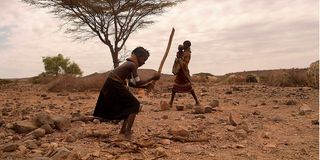
A young girl breaks firewood against a rock in Parapul village, Loiyangalani, Marsabit County, in 2022. Her daily struggle reflects the harsh realities faced by many girls across Kenya — where poverty, displacement, and broken promises continue to dim their dreams of education and a better future.

What you need to know:
- For Esther Chebet, a 17-year-old girl evicted from the Mau Forest, the International Day of the Girl Child holds no meaning.
- Repeated displacements forced her out of school and into farm work, leaving her disillusioned by promises that never reach Kenya’s marginalised girls.
At just 17, Esther Chebet, a girl from Nakuru County, has already lived through multiple government evictions that shattered her education and future. Once a pupil in Standard Two, she now works on farms to survive, her dreams buried under displacement and poverty.
As the world marks the International Day of the Girl Child today, Esther’s story reflects the gap between lofty promises and lived realities for Kenya’s most marginalised girls. Despite new African and national commitments—from the AU Convention on Ending Violence Against Women and Girls to Kenya’s Kenya’s reproductive health and sanitary pad policies—implementation gaps and systemic neglect continue to leave girls like her behind.
Esther’s family was first evicted from their home in Marishooni and resettled in Nessuit, both in Nakuru County. “We were followed by frequent evictions that disrupted my schooling,” she says. “My parents lost everything; our house was burnt, and that was the end of my education.”


When asked whether her life has changed since last year’s International Day of the Girl Child, she responds with irritation in her voice: “Changed, you mean I’m in school? Or changed, you mean what?”
For Esther, while others in urban areas march, attend hotel conferences, and hold forums to mark this year’s International Day of the Girl Child, life remains the same as it was last year and the year before. Yet, in the shadows of her story, the highs and lows of progress have unfolded across the continent and country.
Protective framework
In February 2025, African heads of state and government adopted the African Union Convention on Ending Violence Against Women and Girls. The convention affirms that every woman or girl has the right to live free from all forms of violence, a right indivisible from other human rights and fundamental freedoms.
It obliges African countries to ensure women and girls are treated with dignity and respect, to protect them from all forms of violence, and to safeguard the rights of older women from discrimination and abuse. It also recognises stateless persons, internally displaced women, asylum seekers and refugees, mandating governments to provide them with special protection and access to essential protective, preventive, legal and judicial services.
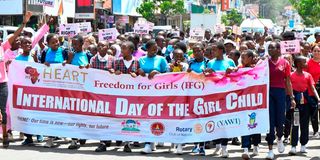
Schoolgirls take part in a procession on the streets of Nakuru City to mark International Day of the Girl Child.
Until 2017, the State Department of Basic Education managed procurement and distribution. It was later moved to the State Department of Gender in the 2017/18 financial year, then returned to the Ministry of Education in late 2019 following tendering challenges.
From 2019/20 to 2022/23, the Education Ministry continued to provide sanitary pads, before the responsibility was again transferred to the Ministry of Gender in 2023/24. For 2024/25, the mandate now lies with the National Government Affirmative Action Fund (Ngaaf), overseen by women representatives.
Despite Section 39(k) of the Basic Education (Amendment) Act, 2017, which obliges the Ministry of Education to provide free, sufficient, and quality sanitary towels to every girl in public basic education, the number of pads distributed remains inadequate.
The Auditor-General acknowledged the ministry’s efforts but noted persistent insufficiency in the quantities supplied. As such, in 2024/25, if girls do not receive sanitary pads, Ngaaf will be the institution to hold accountable.
Reproductive health
In the area of reproductive health, four petitioners, namely Rachael Mwikali, Esther Aoko, Ambassador for Youth and Adolescent Reproductive Health Programme, and the Kenya Legal and Ethical Issues Network on HIV/Aids moved to the High Court in 2022, challenging the National Reproductive Health Policy (2022–32).
They argued that the policy impeded access to reproductive healthcare for women under 21 and required parental consent for girls under 18 for all reproductive health interventions. However, in a decision delivered on September 2, 2025, Judge EC Mwita found no fault in the policy.
The judge referred to the section on adolescent and youth reproductive health, which acknowledges adolescent health as an ongoing challenge. It highlights that childbearing begins early in Kenya, with almost one in four women giving birth by age 18 and nearly half by age 20.
Judge Mwita noted that the section highlights a recurring challenge, identified as failure to develop a dignified transition from childhood to adolescent and to young adulthood, including parenting and guardian support.
He, therefore, concluded with a call for programmes aimed at reversing the trend over time, including support during the transition to cognitive maturity and limited decision-making capacity among minors.
He further emphasised the need to clarify the age of consent for reproductive health interventions, given the inconsistencies across guidelines and the absence of explicit legal pronouncements on the matter.
Teenage pregnancy
In December 2024, the government announced that teenage mothers could register with the Social Health Authority (SHA) and be issued with unique identification numbers to benefit from the Primary Healthcare Fund and the Social Health Insurance Fund (SHIF). However, to receive maternal services under SHA, they must be active, paid-up members.
Then, on September 30, Health Cabinet Secretary Aden Duale, speaking at Umma University in Kajiado, declared that “all teenage mothers in our country, if they deliver, they deliver free.”
However, community health promoters (CHPs) tell a different story. A CHP in Loitoktok, Kajiado, said: “Nurses at the dispensary I’m attached to insist I must refer teenage mothers to sub-county hospitals and there they must pay using SHIF. If they are not registered, they must pay in cash. So, how is that free? I don’t know.”
For Esther and many other girls like her, the promises made in policies and declarations feel far removed from their daily realities.


