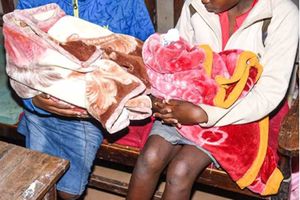
Wheels of change: How bicycles are keeping teen mothers in school
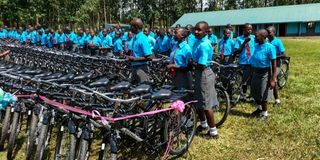
Students of Emahola Secondary School with bicycles they received from World Bicycle Relief.

What you need to know:
- Kakamega County faces a teen pregnancy crisis, with the Kenya Demographic and Health Survey 2022 ranking it among the worst-affected regions, specifically among girls aged 15-19.
Rukia* (not her real name), an 18-year-old student at Emahola Mixed Secondary School in Mumias East, knows the weight of societal judgment all too well. At just 16, she dropped out of school after becoming pregnant, shattering her family’s hopes for her future.
The pregnancy came with harsh consequences—whispers from neighbours, financial strain, and the painful realisation that her dreams were slipping away.
The baby’s father, a motorcycle rider from the nearby village of Khabondi who once ferried Rukia to school, disappeared after learning of the pregnancy, leaving her to face the challenges alone.
However, Rukia’s mother refused to let her give up, encouraging her to go back to school even though it proved to be a difficult balance to strike - being both a student and mother.
Two years after giving birth to her daughter, Rukia made the difficult decision to return—this time, walking three-and-a-half-kilometer journey to school each day, no longer a carefree student but a determined young mother.
Full of ambitions to make her future better, she would wake up at 4am to prepare her daughter and complete her chores before setting off for school on foot.
“I decided not to get any lift from boda boda riders but walk to and from school every day. Sometimes, I would get to school late because I had to breastfeed and prepare my baby before leaving home. In the evening, I would get home too late to properly spend time with my child,” she said.
Rukia’s case is not isolated.
Also read: Bicycle for health in Kakamega County
Violet* was just 15 and preparing for her KCPE exams in 2022 when her life took an unexpected turn. She discovered she was pregnant, sending shockwaves through her family, school, and community. The father? A boda boda rider who had been transporting her to and from school, only to exploit her trust.
Like Rukia, Violet’s education was put on hold. But after two years, she fought her way back, enrolling in Form One with a toddler in her care. The challenges were immense—long walks, societal stigma, and the exhausting balance of motherhood and studies.
A turning point: Wheels of change
For Violet, Rukia, and other girls in Mumias East, hope arrived on two wheels. World Bicycle Relief (WBR) donated bicycles to their schools, transforming their daily struggles.
No longer forced to walk long distances or depend on risky boda boda rides, these young mothers now pedal their way to school—saving time, energy, and dignity.
“The bicycle has given me back my independence,” says Violet. “I get to school faster, spend more time with my child, and most importantly—I’m in control of my journey.”
At Emahola Secondary School, the impact of the bicycle initiative is undeniable. Among the 100 student beneficiaries, the gift of wheels has done more than ease commutes—it has reignited academic motivation and punctuality.
Each bicycle came with a condition: "Use it only for school."
The schools signed a study-to-own contract to formalise the agreement with the WBR. A Bicycle Supervisory Committee was formed consisting of teachers, Parent Teacher Association members, students, and local leaders to monitor the programme.
Mourine Kolenyo, Western region manager for WBR, emphasised that the bicycle donation programme prioritises girls, aligning with the organisation’s mission to expand opportunities for the girl child.
“The bicycles are a solution for the long distances covered by learners, especially girls who have been walking for over three kilometres daily just to get to school—a journey that’s not only exhausting but also exposes them to risks. We urge the girls to use the bicycles to change their lives and the future of the community,” she said.
Mr Aggrey Libendi, the principal of Emahola Secondary, said the bicycles have become a game-changer for the rural school, where long distances previously hindered punctuality and academic performance.
“The move will help us catch up with the syllabus. The bikes will add value to the students and facilitate improvement in exams. I know this project will boost the school enrolment as many other learners will come expecting to get a bicycle,” he said.
Mr Libendi said due process was followed to identify the beneficiaries through a transparent mode that considered those from far narrowing down.
He added: “The bicycles belong to the school and students graduating from Form Four will leave them behind to benefit others.”
Risky treks
Most families in the area are relieved that the girls have no longer to face the long and dangerous treks to school.
“The bicycle is a godsend tool in my daughter’s education journey. I am sure she will complete her education because there is no more disturbance from boda boda riders,” said a mother to one of the girls from Emahola school.
Rukia is now determined to excel in her Form Four exams, with dreams of becoming a lawyer—a career she once thought was out of reach.
She has also reclaimed her time. The hours once lost to walking are now spent studying, caring for her daughter, and helping at home; all without exhaustion holding her back.
“This bicycle gave me more than wheels—it gave me control over my life. Now, I ride past the men (boda boda riders) who once made me afraid, knowing my future is mine to shape. My daughter will grow up seeing her mother fight for education—and win.”
Mumias East Sub-County Education Officer Faith Awonda has reported a decline in schoolgirl pregnancies since the introduction of bicycles, crediting the initiative with reducing girls' vulnerability during long commutes.
Ms Awonda said the Ministry of Education is focusing on a range of solutions aimed at boosting girls’ school attendance, including bursaries for girls, making school a safe place from gender-based and sexual violence, and improving sanitation.
Kakamega County faces a teen pregnancy crisis, with the Kenya Demographic and Health Survey 2022 ranking it among the worst-affected regions, specifically among girls aged 15-19.
Ms Charity Vidola, deputy nurse-in-charge at Khaunga health center, said the rate of teenage pregnancy in the area has gone down.
“Initially, we used to get over 10 school girls reporting for maternity services monthly. But now we get at least three to four cases.”
In the last five years, World Bicycle Relief has issued over 7,000 bicycles to schoolgoing children in Kakamega County.
Mr Peter Wechuli, Buffalo Bicycles Programme manager for Kakamega County, said the initiative is more than just transport—it’s a shield against exploitation and a tool for empowerment.
He noted that many girls are lured by boda boda riders with ‘free’ rides or money; only to end up pregnant and out of school. “Bicycles break this cycle by giving them independence and safety.”