El Niño floods and the rising risks facing Kenyan women
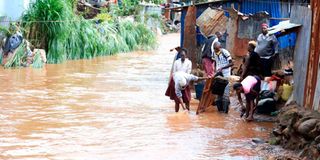
Flooding in Kibera after a downpour. Women and girls face heightened risks of displacement, disease, GBV and loss of livelihoods as extreme weather intensifies.

What you need to know:
- Women and girls face heightened risks of displacement, disease, gender-based violence and loss of livelihoods as extreme weather intensifies.
- Flood survivors recall loss and hardship as authorities urge families in high-risk areas to prepare for evacuation.
Mariam Isaak was fast asleep when she was woken by bone-chilling cold. Upon checking, she realised that her bed had suddenly been filled with water.
The time was 1am on that fateful night in November 2024, when Kenya continued to experience enhanced rainfall. Mariam, who hails from Garissa, tells the Nation that the Tana River had broken its banks and many nearby homes had either been swept away or flooded.
Startled, Mariam, who says she was then a lactating mother, jumped out of bed with her four-month-old baby in her arms. “I rushed into the other bedroom and assisted three more children as they tried to swim through the powerful floodwaters. Thankfully, we escaped the flooded house. Shortly afterwards, the floodwaters swept away our home and everything inside. We could only stand by helplessly, unable to save any of our belongings,” Mariam recalls.
Mariam says they spent the night in the cold. Her husband was away at the time. The following day, the mother of four says they headed to the grounds of Young Muslim Secondary School, where a temporary internally displaced persons’ camp was being set up for victims. She, however, says life in the camp was not a bed of roses, as they grappled with a lack of food, clean water and clothes.
“There was no water in the camp, and when water was brought by well-wishers, it was not enough. Due to the water shortage, poor sanitation resulted in waterborne diseases such as cholera. Lack of food also took its toll on us, especially children and pregnant and lactating women.”
She notes that getting health services was a big challenge for her, particularly as a mother with a newborn. “Most of the hospitals were not accessible as they had been submerged by floods, which had disrupted antenatal and postnatal clinics, immunisation, deliveries, reproductive health services such as family planning, and general medical services.”
Data provided by the county government showed that the flooding experienced between October and December 2024 displaced about 7,200 households in Garissa alone.
With the looming El Niño rains, Mariam, whose family has since gone back to their land, is a worried mother. She says that this time round, she is taking the advisories seriously, adding that she will relocate immediately when the rain starts.
“This time I do not want to take chances. Last time we escaped death by a whisker. Because we cannot prevent the Tana River from overflowing, it will be us who have to move. I have talked with my relatives in safe areas to accommodate us during the entire El Niño period,” she says.
Kenya experienced severe and catastrophic floods during the March–May 2024 rainy season. Downpours and flash floods resulted in nearly 300 deaths and left dozens of people missing. Victims included women, girls and children.
Mariam’s plight mirrors that of many women who are disproportionately affected by floods whenever the country experiences heavy rains. During the 2025 El Niño, flash floods caused massive destruction, with women and girls among the worst affected. For women residing in informal settlements and rural areas, memories of that period rekindle the loss of livelihoods and the heavy burden of keeping their families safe, hence the need for immediate survival.
Their plight highlights the disproportionate impact of extreme weather on both rural and urban poor women. Latest data projections by Care Climate Change show that more than 170 million women and girls globally are projected to be at risk of severe food insecurity, gender-based violence (GBV) and related climate hardships due to the 2026–27 El Niño cycle.
The humanitarian organisation warns that projections show that deep-rooted social inequalities will intensify during the El Niño period, affecting women’s and girls’ health and security. Economic displacement and stress from El Niño could also increase the risk of GBV, child marriage and labour exploitation.
Kenya, Somalia, Ethiopia, Sudan, South Sudan and Uganda have been flagged. The Kenya Red Cross has projected that more than two million people could be affected in Kenya. The agency notes that women, girls, and pregnant or lactating women face heightened risks of displacement, loss of livelihoods and limited access to reproductive health services.
Michael Mutisya, a climate adaptation specialist, notes that flooding does not affect everyone equally, adding that women face unique and disproportionate risks. He tells the Nation that women face heightened vulnerability to waterborne illnesses, greater disruptions to their livelihoods, lack of specialised reproductive healthcare, and significant exposure to GBV in crowded evacuation shelters.
He adds that pre-flood smart preparation and safety planning are paramount, stressing the importance of ensuring essential commodities for women and girls are within reach during times of flooding.
“Preparedness should ensure enough stock for women’s emergency kits. Standard emergency packs have in the past omitted female-specific needs. There is a need to prepare a separate bag with menstrual hygiene products (pads or menstrual cups), specialised medicines, a flashlight, whistle, and a clean change of clothing that allows for easy physical movement.”
He adds that women and girls should be taught practical survival skills, including swimming, first aid training or basic disaster response certification where possible. The specialist, however, cautions people against wading or swimming through moving floodwater, as it often hides debris and open drains and carries high levels of sewage and industrial pollution that can trigger immediate skin and internal infections.
“Women should also be advised to wear functional, protective clothing in case they are forced to move through shallow water or damp conditions. They should wear sturdy boots and trousers rather than long, heavy traditional dresses that trap water, create a tripping hazard or restrict rapid movement,” he adds.
He advises on the establishment of a neighbourhood support network comprising trusted female neighbours who can agree on who will look after children, the elderly or family members with disabilities if an immediate evacuation is ordered.
A guide
Crawn Trust, a rights organisation, also shares a guide on how women can counter some of the challenges that come with flooding. In a statement, it notes that addressing these gendered risks during floods requires a multifaceted approach.
“Firstly, there is a need for gender-sensitive disaster preparedness and response mechanisms. This includes ensuring that women and girls have equal access to information, resources, and decision-making processes during emergencies,” the statement reads.
The organisation also observes that investment in resilient infrastructure and urban planning is crucial to mitigating the impact of floods, with a focus on the needs of women, girls and other vulnerable groups. It says this can involve the construction of flood-resistant housing, improved drainage systems and safe evacuation routes that consider the needs of pregnant women, mothers and children.
“Efforts to strengthen social support systems, including psychosocial support and GBV prevention services, are also essential. Empowering women and girls with knowledge, skills, and resources to cope with and recover from flood-related challenges is fundamental to building resilience and ensuring their wellbeing in the face of climate-related disasters.”
The government, through a multi-sectoral approach involving the Ministry of Interior, the Ministry of Health and county-level administrations, has launched targeted safety interventions to cushion women and girls against vulnerabilities.
The Health ministry has activated the Health Sector El Niño Contingency Plan across 18 high-risk counties. This plan safeguards maternal and public health by focusing on safe water and sanitation and the distribution of 10 million treated mosquito nets to protect pregnant women and families from the projected malaria surge.
Health and Professional Standards Principal Secretary Mary Muthoni said they are working with other health partners to help shore up preparedness and minimise the setbacks the rains could cause. “We have experienced El Niño before and we have taken time to learn from disasters and build on the challenges we faced so that we can better mitigate its effects,” she said.
Past climate disasters have shown that displacement camps and resource shortages worsen security risks for women. The government is partnering with humanitarian organisations such as Plan International to build long-term climate resilience and protect women and girls from spikes in GBV and sexual exploitation in high-risk zones.
The interventions will also seek to avert harmful practices arising from displacement, such as child marriage and child trafficking. Government Spokesperson Charles Owino has called on county governments to map out areas likely to be affected and begin preparing for the evacuation of families for their safety. “Those settled in riparian areas are expected to vacate and get to safer grounds ahead of the rains,” he said.