Faith, grit and service: The story of Dr Beatrice Adagala, Vihiga’s Woman Rep
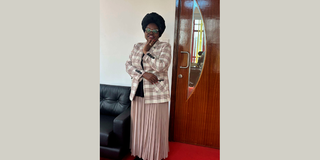
Vihiga Woman Rep Dr Beatrice Adagala at her Bunge Towers office during an interview on October 1, 2025.

What you need to know:
- Dr Beatrice Adagala’s journey from a church prayer in Vihiga to Parliament began with a call to serve and a passion for women’s empowerment.
- As Woman Rep, she has championed projects for survivors of GBV, supported women’s enterprises, and pushed for land inheritance reforms.
- Despite limited funds and criticism, she continues to advocate for equality and inspire women to lead.
It was 2008, a time of great change in Kenya, and the air was buzzing with talk of a new constitution. On a calm Sunday in a local church in Vihiga County, the message that day was not just spiritual but also political. Martha Karua, a powerful figure and champion for women in politics and the then Minister for Justice and Constitutional Affairs, had come to speak about good governance and why women should step into leadership. As her words inspired the congregation, the local bishop made an unexpected request.
He asked anyone who felt called to enter politics to stand up for a prayer. In a crowd where political ambition was usually reserved for men, there was hesitation. But one woman, moved by a passion she had carried for years, rose to her feet. She was, as she remembers, the only woman amongst the men. As prayers were said for her, Dr Beatrice Adagala, a former postal worker and shop owner, felt her future click into place.
Sitting down for a conversation, Adagala is soft-spoken, often letting out a gentle, thoughtful laugh before answering a question. But her journey to Parliament was built on a foundation of strong action. Long before that church prayer, her passion for helping others had been growing during her time at the Kenya Post and Telecommunication Corporation—now Posta. It was there, meeting people from all walks of life, that her focus on women and girls sharpened. She started the Adagala Foundation, helping orphaned girls by paying their school fees and even welcoming some into her own home.


As a mother of three sons, she opened her heart and her house, guiding these girls through their education. Some are now graduates with families of their own. This care naturally grew into activism, following cases of abused and raped girls with the help of legal groups to ensure justice was served.
"I looked at it and said, you know, the women are really suffering," she explains.
Just before the church prayers for political aspirants, Adagala had unfortunately lost her job that same year when her employer was retrenching. To cope and keep herself busy, she started a boutique in Mbale, a place where she connected with even more women. So when the political call came—first through that prayer and then with the creation of the Woman Representative seat in the new constitution—she was ready.
Her first campaign in 2013 was tough. Running with a new party, she faced political bullying and confusion but came a strong second. Instead of giving up, she went back to the people, continuing her grassroots work. Her constant presence, compared to her opponent's time spent in Nairobi, eventually won the trust of the electorate, and in 2017 she was elected.
Yet one of her biggest battles is against the perception of her job. She has heard the talk that Woman Representatives are just "flower girls" who do nothing of value. She laughs softly before responding with firmness.
"I wish they may know that the women are not flower girls," she says. "Women are equal MPs."
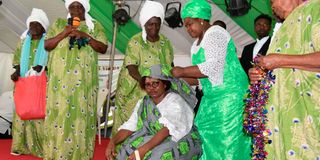
Dr Adagala receives a traditional Maragoli crown during her thanksgiving and homecoming ceremony held at Vokoli Girls High School, Vihiga County, on August 10, 2019.
She believes that failing to support women in politics hurts everyone, and she looks to countries like Rwanda, where women are now the majority in Parliament, as a vision for Kenya's future. For this to happen, she says, the big political parties must give women a real chance to compete for regular constituency seats, not just the special women's seat. She also points to the real problems women face when they try to enter politics: a lack of money and the threat of violence. She remembers one meeting for women's economic empowerment where an area MP sent people to throw tear gas to break it up.
"If violence can be tamed, if women can be taken care of, things will be okay," she states.
She shares a long list of what she has actually done. She established a rescue centre for survivors of gender-based violence, one of only seven such centres built by Woman Representatives at the time. After some delays, she is proud that the county government, with help from donors like UN agencies, has now made it operational.
Her work empowering groups is seen across the county. She has provided women and youth with incubators for hatching chicks, chairs and tents for their meetings, car wash machines, salon kits, and machines for making building blocks, cooking oil and clean-burning briquettes. She has given out posho mills and funds for table banking. To protect children, especially girls, she has focused on water, providing large tanks to all schools for children with disabilities and to all schools in the county after Covid-19, so pupils don't have to walk long, dangerous distances to fetch water.
A special project close to her heart is her "second chance" programme. Using her office's funds, she says she has helped women who were married off young and trapped in abusive marriages to go back to school. She has found schools, talked to grandparents to care for the children, and supported mothers—some of whom are now in university—to restart their lives.
But the path of empowerment is not smooth. She openly shares the frustrations. Some groups they empower see their officials run off with the funding. They give heifers to women's groups, only for the animals to be stolen.
"They steal the animals from the women. They steal their chicken and their heifers," she says, citing insecurity as a major challenge.
The funds themselves are a constant battle. The NGAAF kitty, which was five million shillings per constituency and has only recently been increased to seven million, is simply not enough for the vast needs. The money is also ring-fenced for specific purposes, making it hard to respond to emergencies, a reality that often leads to public misunderstanding.
Some constituents, however, feel her impact is uneven. George Alemba from Sabatia says that whilst she has given out equipment like motorbikes and salon kits, the distribution is not fair across the county.
"She has given little funding to a few groups, but those groups existed even before she took the reins," he says. "Her little financial support should not make her think she can claim ownership."
Jane Musanga, a trader in Hamisi, is grateful for the shade she uses at her stall, a donation from the Woman Rep's office.
Nepotism
"It shields us from the hot sun and rain," she says. "However, I feel that the representative can do more."
Another voice, Washington Ahana from Mbale, claims her presence is "hardly felt on the ground" and hints at unproven claims of nepotism.
Adagala is aware of the immense challenges. She speaks openly about the limited funds she has to work with, which are never enough for the vast area of five constituencies she covers. She also talks about the pressure to help with social problems, like rebuilding a house for an old woman after a fire, even though her office has no official budget for such emergencies.
"People think such things are in our mandate. The truth is that we don't have funds for that," she explains, noting she often uses her own money to help.
Her work in Parliament extends beyond county projects. She has actively presented motions aimed at national change. One was to give young Kenyans duty-free access to import machines for starting small industries, an effort to tackle unemployment. Another focused on creating job opportunities, though she notes it was delayed because a similar bill was discovered, seemingly forgotten elsewhere.
A particularly significant motion she is currently pushing concerns land inheritance.
"You know women suffer when it comes to land issues," she explains, highlighting the plight of widows in some communities who are dispossessed of everything when their husbands die. This bill, she discloses, is now with the legal team and researchers in Parliament, a slow but crucial process for securing women's rights.
On the tricky topic of how female leaders are sometimes judged on their looks, she is refreshingly practical. When asked about being called beautiful in public, she laughs softly. She sees it as a simple compliment, no different from praising a man for being smartly dressed.
"People tend to overanalyse actually," she believes.
As her second term winds down, her future is in the hands of the people she serves. She dismisses talk of term limits for her seat, arguing that experience matters. She will go wherever her constituents want her, whether that is staying on as their representative or moving to another position.
"What the people say on the ground is what I'll go with," she says.
When the work in Parliament and the county gets too much, she finds peace on her farm.
"I'm a farmer. You know, you can't preach something that you don't do," she says, her voice warming. She keeps animals, grows local vegetables and tends to her fish ponds. It is here, away from the political noise, that the woman who stood up alone in church recharges, ready to continue her quiet, determined mission for the people of Vihiga.