FGM goes underground: The new tactics circumcisers use to evade police dragnet
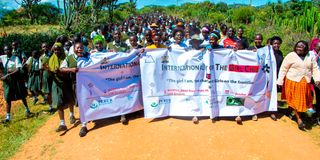
Girls and women from West Pokot and beyond march to the HerLab facility in Morpus to commemorate the International Day of the Girl Child on October 11.

What you need to know:
- FGM is resurging underground as girls seek secret procedures in private clinics and across the Uganda border.
- Activists warn that new tactics by circumcisers are putting thousands at risk despite Kenya’s strict ban; girls are escorted into forests or ferried across borders to evade arrest.
- Community leaders and rights groups are urging urgent government intervention as cases spike ahead of the festive season.
Hundreds of girls in West Pokot County are now turning to private clinics to undergo genital mutilation in secret. Many others slip across the border into Uganda’s Bukwo District, where the cut is carried out under the guise of festive merry-go-round gatherings—an attempt to avoid arrest by Kenyan security officers.
With the Pokot community living on both sides of the border and moving freely between the two countries, the practice has surged once again, stirring anger among locals. Many girls in Otiot and Mosop locations are reported to have been circumcised secretly in recent weeks. Besides the private clinics, the procedures are often carried out deep within bushes and forests, protected by local warriors, before the girls are escorted back to their homes.
Elder Philip Toywanyang says FGM ceremonies have been ongoing in recent weeks. Mosop location chief Paul Kalyatum attributes the rising cases to a shift in tactics intended to evade law enforcement. “Residents should cooperate with the police and report the circumcisers,” he urges.


I Rep Foundation, an anti-FGM organisation operating in the region, confirms that the new strategies have enabled many girls in Mosop to undergo the cut. “Some people continue to defy the law and perform the cut, placing many girls’ lives at risk,” says project officer Lucy Lorot.
She calls on the government to take firm action against the offenders. FGM was outlawed in Kenya under the Female Genital Mutilation Act, 2011. I Rep board chairperson Moses Lokeris has also urged authorities to impose sterner measures to curb the practice.
“Female circumcision persists in the region because of ignorance and a lack of information about its adverse effects,” he says. He adds that the harmful practice also remains widespread in areas inhabited by the Marakwet. “Some girls from West Pokot cross into Marakwet to undergo the ceremony before returning home.”
Anti-FGM activists acknowledge that some Ugandan girls also cross into Kenya to undergo the forbidden rite. “Thousands of girls remain at risk of retrogressive practices, including teenage pregnancies, early forced marriages, and female genital mutilation during the upcoming festive season,” warns anti-FGM crusader Doris Chetotum.
Elsewhere in Ndanai village, Bomet County, seven older women gather at Irene’s* matrimonial home. They say they are meeting for “a monthly table-banking project”, but this is only a cover-up. Behind the closed door of the small hut, a crime is unfolding. Irene is being subjected to a harmful practice that inflicts lifelong physical and psychological trauma—a practice that continues to undermine women’s rights despite being outlawed.
The youngest of the seven women stands guard at the door, keeping watch for strangers and ensuring the act remains concealed from the wider community. Inside, 43-year-old Irene* undergoes female genital mutilation (FGM). Her husband leaves the compound beforehand—a sign of tacit approval—and stays away for two weeks while the women secretly nurse her.
Irene’s ordeal is far from unique. Across Kericho, Narok, Nakuru and Elgeyo Marakwet counties, married women—some well into their 40s—are increasingly being forced to undergo the cut. Anti-FGM advocates say perpetrators have shifted their focus from school-aged girls to adult women to evade legal consequences and minimise community scrutiny.
This growing trend is deeply troubling. Kenya’s FGM Act and the Protection Against Domestic Violence Act (2015) criminalise FGM/C in all its forms, regardless of a woman’s age, marital status or perceived consent. Traditionally, the practice was carried out before marriage. Today’s shift towards married women demonstrates both the persistence of harmful cultural norms and the lengths perpetrators will go to avoid detection.
The two-month school holiday—the longest in Kenya’s academic calendar—remains a dangerous period for girls and women in hotspot counties. During this break, some families hold weddings, initiate boys, and secretly subject girls and women to the cut, often under the cover of darkness.
Gertrude Chepkemoi, founder and chairperson of Beacons of Hearts, says that with intensified community surveillance and growing awareness of the dangers of FGM, families that have not abandoned the practice are now exploiting social activities such as women’s groups to evade the law. However, community members can report administrators who abet FGM to the Interior ministry or to the Commission on Administrative Justice.
During the International Day of the Girl Child celebrations on October 11, 2025, in Siongiroi grounds, Chepalungu, Bomet County, government officials, elders and faith leaders expressed alarm over emerging practices that threaten progress in ending FGM and reducing teenage pregnancies.
Stakeholders point out that girls aged 15–19 and women aged 20–49, particularly those who are married, remain among the most vulnerable. They stress the need for stronger community-led protection systems, wider access to accurate information, and targeted support for those at risk. Empowering survivors, holding perpetrators accountable, and strengthening collaboration between government, cultural leaders and civil society were identified as critical steps to reversing these harmful trends.
Health risks
FGM poses severe health risks, including excessive bleeding, infection, complications during childbirth, and lifelong trauma.
Interior Cabinet Secretary Kipchumba Murkomen said he had directed the police and local administrators to intensify crackdowns on perpetrators and ensure timely arrests that lead to prosecution.
For Gender Cabinet Secretary Hanna Wendot, despite ongoing surveillance and sustained awareness campaigns, FGM remains a persistent challenge in the 22 hotspot counties. More concerning, she said, is the rise in new cases in the South Rift. She emphasised that this trend can be overturned by enhancing community education on women’s rights and challenging the norms that pressure women and girls to undergo mutilation in order to be accepted.
Abdinoor Sheikh Mohamed, Chief Executive Officer of the National Council for Children’s Services, said the sexual exploitation of underage girls remains deeply worrying, often resulting in increased school dropouts due to unplanned pregnancies. He stressed that the solution lies in a multi-layered approach: empowering both girls and boys with accurate information, strengthening protection systems, expanding access to adolescent-friendly services, and ensuring communities actively safeguard children’s rights.
“We must equip young people to prevent gender-based violence, sexual exploitation, teenage pregnancies and the spread of life-threatening sexually transmitted infections, while supporting survivors to continue their education,” he said.
Bernadette Resian Loloju, Chief Executive Officer of the Anti-FGM Board, said the decline in FGM prevalence from 21 per cent to 15 per cent demonstrates the impact of sustained awareness efforts. She added that preventing new cases will require action at household level, with parents actively protecting their daughters and husbands defending their wives by resisting harmful cultural pressures.
Even though anti-FGM advocates are increasingly using online spaces to raise awareness, this information is still out of reach for many rural women. In this case, the gender digital divide—in which women are 35 per cent less likely to use the internet—deepens. Even though men, who often approve the practice, access the internet more, the information seems not to reach them. It is not available in the languages they best understand, the messaging is not targeted, or it has simply not triggered change.
*Name changed to protect the identity of the victim.
Reporting by Vitalis Kimutai, Oscar Kakai and Barnabas Bii


