Fighting deforestation: West Pokot women's group embraces clean energy briquettes to create wealth
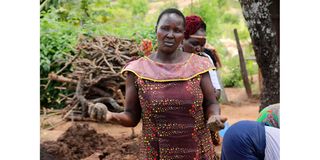
Flomena Ngolekeris, the chairperson of Napatakarin Women's group, and Joan Cheyech (partially hidden), an official of the group, show a sample of their briquettes in Chepararia, Pokot South, on April 8, 2026.

What you need to know:
- A women’s group in West Pokot is transforming waste into clean fuel while protecting forests and livelihoods.
- Through briquette making, they are building income streams and offering sustainable alternatives to traditional charcoal today.
It is a sunny morning as we make our way into Kamale village in Chepararia, Pokot South. The melodious voices of women singing a Pokot song welcome us to one of the homesteads. We find a group of women busy mixing what appears to be a heap of mud as they belt out the tunes.
The mixture is not ordinary mud but one made of soil, charcoal, and sawdust and used to make charcoal briquettes. The dwindling forest cover due to deforestation has seen this group of women in West Pokot embrace the use of briquettes to help conserve the environment and as a source of income.
Napatakarin Women's Group in Chepararia has adopted charcoal briquettes as a sustainable alternative to traditional firewood and charcoal, playing a crucial role in conserving the local environment. They use freely available raw materials like soil, charcoal, and sawdust to make the briquettes, making the cost minimal.

Flomena Ngolekeris, the chairperson of this group, says their journey started in 2024 when they were trained in briquette making by a nongovernmental organisation. She says that from then, their membership—15 women drawn from different villages—has never looked back.
“Since the start of last year, we have been making the briquettes for use at home and for sale. We are also using them as a way of saving the environment since they are pollution-free,” Flomena tells Nation in an interview.
The group meets once every month, when they make at least 10 bags of briquettes and leave them to dry. Each bag carries about 1,000 pieces of briquettes, which go for Sh20 apiece. “Each bag gives us about Sh20,000, which means the 10 bags we make every month can fetch Sh200,000. We share the profits, and the money helps us to take care of our families,” she adds.
Flomena observes that the reason many people are increasingly opting for charcoal briquettes is their slow-burning nature. “Briquettes are designed to burn slowly and consistently for long periods, typically three to three-and-a-half hours due to their compressed, uniform composition. They are ideal for ‘low-and-slow’ cooking. Their dense structure and binders allow them to burn longer and more steadily than the normal charcoal.”
Flomena, however, notes that their journey has not been smooth-sailing, saying that at times, limited market access has been a major undoing for them. “At times, we have a pile-up of our products due to slow uptake and a limited market, which affects our sales, revenue, and overall welfare. If we can be helped to get more markets, we can venture into mass production.”
Joan Cheyech, an official in the group, is happy that the briquettes business has provided a consistent income throughout the year. She notes that the business, however, goes down during the rainy season, usually because of logistical challenges. To improve the business and make more profits, Joan is seeking assistance to expand their market beyond West Pokot County.
Market for products
Currently, their group sells the briquettes in Chepararia, Ortum, and Kapenguria towns. “The group would also be grateful if we could get a well-wisher to help us with a machine for making briquettes. It will help upscale production and save members a lot of time used to make the products,” Joan says.
They also make money by being trainers of trainers. They have the capacity to go to other counties to train other women on briquette making. “We have the expertise and what it takes to train other women in different counties in briquette making. Already, we are training women in different areas in West Pokot in making this important product,” Joan adds.
Charcoal briquettes offer significant advantages over traditional lump charcoal, including a longer, slower, and more consistent burn. They are more cost-effective, eco-friendlier (often made from waste biomass), produce less smoke, and provide higher, more stable heat, making them ideal for efficient cooking and grilling.
Briquettes are often cheaper and more efficient than traditional charcoal, reducing overall fuel costs. They are normally made from agricultural waste (like sawdust, charcoal dust, maize cobs, or coconut shells), reducing deforestation and waste while providing a sustainable energy source.
“Cooking using briquettes is more fulfilling than the traditional charcoal, as it results in improved indoor air quality and reduced health risks since it is pollution free,” says Maximillian Joel, a member of the group.
The scope of use of briquettes in Kenya today is expanding rapidly for both domestic and industrial applications. Briquettes are increasingly used to replace firewood and traditional charcoal, particularly in urban, peri-urban, and institutional settings, offering a cleaner, more energy-efficient, and cost-effective alternative to unsustainable biomass.


