From dust to fuel: How lecturer is turning charcoal waste into clean cooking energy
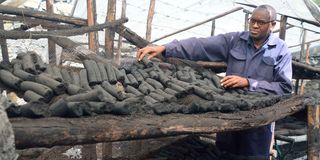
Dr Boniface Mutua, an Environmental Science lecturer at Laikipia University, who is also the founder of Ecostrides Solutions Limited, arranging briquettes that are made from charcoal waste at his start-up in Njoro, Nakuru County on March 11, 2025.

What you need to know:
- For many Kenyan families struggling to make ends meet, cooking gas remains unaffordable, leaving charcoal as the primary fuel.
- But traditional charcoal production drives deforestation.
On the dusty streets of Njoro town in Nakuru County, what many see as worthless black powder, Dr Boniface Mutua sees as a solution—both for struggling families and Kenya’s deforestation crisis.
Every morning, the Environmental Science lecturer at Laikipia University visits local charcoal vendors, carefully collecting the scattered charcoal dust that would otherwise blow away in the wind or wash into waterways.
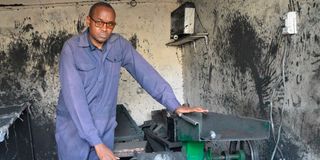
Dr Boniface Mutua operating a pressing machine that recycles biomass from charcoal waste to makes briquettes at his start-up in Njoro, Nakuru County, on March 11, 2025.
Back at his modest 50-by-50-foot workspace, this "waste" transforms into cooking fuel - clean-burning briquettes - through his start-up, Eco-strides Solutions Limited.
Cooking gas
For many Kenyan families struggling to make ends meet, cooking gas remains unaffordable, leaving charcoal as the primary fuel. But traditional charcoal production drives deforestation, especially in fragile ecosystems. Dr Mutua's innovation addresses this affordability gap while tackling environmental concerns.
The briquette-making process is surprisingly straightforward. The collected charcoal dust is crushed into fine powder, mixed with binding agents like molasses or cassava starch at carefully calculated ratios, then pressed through an extruder machine. After drying, the finished briquettes are ready to fuel cooking fires across Njoro.
What began during Covid-19 lockdowns when Dr Mutua couldn't teach his environmental science classes at Laikipia University has grown into a social enterprise with around 100 regular customers. Beyond households, local poultry farmers use the briquettes to heat their brooding spaces, with demand spiking during cold seasons.
Inside Dr Mutua's workshop, the air is thick with the earthy scent of charcoal. His five-horsepower press machine hums rhythmically, transforming what was once considered waste into valuable fuel. The sound represents a small but significant victory in the larger battle against deforestation and climate change.
For residents of Njoro, the impact is immediate and tangible. Each briquette produced means fewer trees cut in Kenya's fragile ecosystems. The semi-arid regions of the country, already suffering from climate change-induced drought, gain precious time to recover when charcoal production decreases. And for households with limited income, the briquettes offer a sustainable alternative that doesn't force them to choose between environmental values and economic survival.
The briquettes themselves tell a story of resourcefulness. Dark and compact, they burn longer and more efficiently than traditional charcoal, producing less smoke when lit. This reduction in indoor air pollution represents an often-overlooked health benefit, particularly for women and children who typically spend more time near cooking fires.
When Dr Mutua speaks about his work, the passion in his voice is evident. As both a practitioner and educator, he bridges two worlds that often remain disconnected – academic environmental science and practical community solutions. His students at Laikipia University don't just learn environmental theory; they witness its application through their lecturer's hands-on work.
"Charcoal dusts are wastes that should be well managed. When you spread charcoal here, it's a pollutant, when the debris is crushed, you can imagine the kind of integrated dust that will emanate from there during the dry season. Aesthetically, this is waste," Dr Mutua says as he demonstrates how the fine black particles can become airborne, causing respiratory issues in market areas.
But though demand is high, obstacles remain.
Some households are sceptical, preferring traditional charcoal. The unpredictable Njoro rains complicate the drying process, and Dr Mutua's current equipment produces just half a tonne daily - far below market demand during peak seasons.
"I am looking for funds to upscale because the machines are expensive," says Dr Mutua, who estimates that a machine capable of producing 10 tonnes daily would cost around half a million shillings.
This gap between innovative local solutions and needed financing reflects a broader pattern in climate action. Dr Bessy Kathambi from the University of Nairobi points out that while tree-planting initiatives (mitigation) readily attract funding, practical adaptations like briquette production often struggle to secure investment despite their immediate community benefits.
"Most of climate finance has been on mitigation, not so much on adaptation; yet adaptation has a better potential of sustainability because it makes societies resilient," Dr Kathambi observes.
The challenge lies partly in measuring success. Unlike counting trees planted, adaptation projects like Dr Mutua's have complex, long-term impacts that don't fit neatly into three-year funding cycles.
Dr Prerna Singh, who leads the Tracking Learning Sharing activity at the Adaptation Research Alliance, explains: "Getting finance for something when the impact is not visible in the next three years is much harder and these are some of the key reasons why adaptation funding is very limited."
The seasonal nature of Dr Mutua’s business highlights the interconnectedness of climate and economic cycles. During Kenya's rainy season, demand for heating fuel increases as temperatures drop, particularly in highland areas like Njoro. Yet this same rainy weather extends drying times for the briquettes, creating production bottlenecks precisely when demand peaks. This challenge exemplifies why climate adaptation requires flexible approaches that can respond to local weather patterns and market needs.
Dr Mutua's greenhouse drying structures represent his attempt to address this seasonal challenge, but they remain insufficient for meeting peak demand. His vision for expansion includes not just larger production equipment but also more sophisticated drying facilities that could operate year-round regardless of weather conditions.
As international negotiators prepare for COP30 with adaptation as a priority focus, grassroots innovators like Dr Mutua continue their work - one briquette at a time. Their efforts demonstrate that effective climate solutions often emerge not from global conferences but from people intimately connected to local challenges.
As the day ends, Dr Mutua surveys rows of freshly pressed briquettes drying in the late afternoon sun. Each one represents carbon kept in the ground, trees left standing, and a practical demonstration that adaptation can begin with resources already at hand – even those previously discarded as waste. This humble approach to climate action, multiplied across communities and supported by adequate financing, offers a pathway to resilience that benefits both people and planet.