Hello
Your subscription is almost coming to an end. Don’t miss out on the great content on Nation.Africa
Ready to continue your informative journey with us?
Hello
Your premium access has ended, but the best of Nation.Africa is still within reach. Renew now to unlock exclusive stories and in-depth features.
Reclaim your full access. Click below to renew.
Five years to 2030: Why you should worry about setbacks hurting women and girls
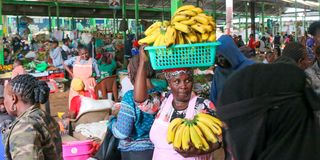
A woman hawks bananas at Wakulima Market in Nakuru City on August 15, 2024, reflecting the resilience of many Kenyan households amid global and local crises.

By Moraa Obiria
Senior Gender Journalist
What you need to know:
- Global setbacks have slowed progress on gender equality, pushing the target to 123 years.
- Kenyan women face rising poverty, scarce family-planning services, and soaring business costs.
Global problems, local nightmares for women and girls
In 2020, there was hope that a girl born anywhere in the world that year would have felt, smelt or breathed gender equality by the time she turned 100.
Why? Because the World Economic Forum, having analysed progress in closing the gender gap across 153 countries, found that at the prevailing pace it would take another 100 years to achieve parity.
Five years on, the outlook has worsened. As of 2025, it is now projected to take 123 years to reach full equality globally. For women and girls, this is nothing short of a nightmare - the result of global shocks that have deepened setbacks and widened the race to equality. From the Covid-19 pandemic, to US President Donald Trump’s funding cuts, to the Russia-Ukraine war, it has become a battle for the survival and progress of women and girls, including in Kenya.
Poverty
When Covid-19 hit Kenya in March 2020, curfews were imposed, movement was restricted and businesses closed. Life changed overnight for Florence Kemunto, a green grocer in Nairobi’s Utawala, a middle-income residential area.
Her grocery business had been thriving. She saved Sh1,500 a month across three chamas (informal savings groups). She never worried about refilling the gas cylinder, paying school fees for her two children, or settling medical bills in cash at the hospital.
But then everything collapsed. Her husband, a manager at a Nairobi hotel, lost his job when the hotel closed. In a flash, their financial security disappeared. The only cushion was that they had built their own home, sparing them the burden of rent in Nairobi.
“But I no longer save a single cent because there is nothing to save,” she says bitterly.
“As you see me, if you turn me upside down, all you’ll see is poverty. Most of my customers moved to cheaper housing during that period, others relocated back to their rural homes, and some of those who lost jobs started the same grocery business. These days, making even Sh800 a day is just a miracle.”
Covid-19 was a major setback in the global drive to end all forms of poverty among women, as envisioned in Agenda 2030 - the Sustainable Development Goals (SDGs). With five years left to 2030, Florence has no hope of lifting herself out of poverty within that timeframe.
“I spent everything I had during Covid-19, and I only managed to re-open after a friend loaned me Sh3,000,” she recalls.
Florence had started her business five years before the pandemic, and by 2025 she had hoped to expand into cereals and open at least two retail outlets. Instead, she is stuck in the same place, with all her earnings consumed by immediate needs, as her husband is still unemployed.
Back in 2015, Kenya, alongside other nations, committed to halving by 2030 the proportion of men, women and children of all ages living in poverty in all its dimensions, as defined nationally. But progress has been painfully slow. In 2015, the rural poverty rate was 39.8 per cent. By 2019, it had fallen by barely a fraction, to 38 per cent. At this rate, and in light of Florence’s reality, Agenda 2030 looks increasingly out of reach.
The action
Tackling women’s poverty is a multi-layered challenge. It requires robust social protection systems, such as childcare facilities to free up women’s time for paid work, and emergency cash transfers during crises like Covid-19. It also demands ensuring women’s equal rights to economic resources, access to basic services, ownership and control over land and property, inheritance, natural resources, appropriate technologies and financial services, including microfinance.
Building the resilience of the poor and vulnerable is equally critical, reducing their exposure to climate-related disasters and other economic, social and environmental shocks. These are among the commitments countries pledged to deliver to end poverty among women.
The danger
The detention of new mothers in hospitals over unpaid bills is a stark marker of women’s poverty. Studies show such mothers are less able to educate their children. Without education, the cycle of poverty continues. Unemployed youth, lacking skills, are more vulnerable to crime and radicalisation - a threat to peace and security for all.
Failing to end women’s poverty, therefore, is not only a danger to women themselves but to society at large.
Health
When USAID froze its funding in January 2025 - despite US government-supported supplies accounting for nearly a quarter of Kenya’s family planning needs - the goal of achieving universal access to sexual and reproductive health care within five years moved further out of reach. This includes access to family planning, reproductive health education, and integration of these services into national strategies and programmes.
Contraceptives became scarce. For women with limited means, already forced to juggle competing priorities, the fear of becoming pregnant without choice became all too real. Yet nearly half (46 per cent) of Kenyan women of reproductive age (15–49) either do not want more children or would prefer sterilisation, according to the Ministry of Health.
For women like Alice Achieng, a mother of three from Kakamega County, accessing her preferred contraceptive became a frustrating and exhausting journey. With her husband working far from home, she had hoped to receive the three-month contraceptive injection to space her children and avoid an unplanned pregnancy. But after visiting three public health facilities in the county, she left empty-handed.
The problem is widespread. A recent joint analysis on the impact of devolution by the Council of Governors, UN Women and the United Nations Capital Development Fund found that, in Kajiado County for example, although the number of health facilities has increased, many dispensaries remain understaffed and understocked, with frequent shortages of family planning commodities.
The 2022 Kenya Demographic and Health Survey further revealed that arid and semi-arid counties, already burdened by food scarcity, have the highest unmet need for family planning. Marsabit leads with 38 per cent, followed by Tana River (34 per cent) and West Pokot (30 per cent). These counties also record the country’s highest fertility rates ; West Pokot (6.9), Marsabit (6.3) and Tana River (5.7).
The action
The urgent solution lies in increasing health financing to reduce overdependence on donor support. As Family Planning 2030 Executive Director Dr Samukeliso Dube notes “I see the sector pivoting focusing on domestic resource mobilisation, innovative funding mechanisms and cost-saving measures as a way to achieve universal access to family planning.”
The danger
Dr Samukeliso is clear on the stakes: “When a woman has access to contraception, she is empowered. It’s about having autonomy over your body and accessing opportunities that otherwise you couldn’t. Because if you have an unintended pregnancy, or you die from maternal mortality or an unsafe abortion, that is the difference. With contraception, you can plan.”
Women economic empowerment
Covid-19 exited, only for the Russia - Ukraine war to enter, a conflict that reached women’s households. In Kenya, 85 per cent of mitumba traders are women, making the war an additional headache for them.
Most second-hand garments imported into Kenya come from the United States, China, and the United Kingdom, followed by Germany and South Korea. Traders, however, prefer shipments from Europe and the US due to their superior quality. When the Russia–Ukraine war disrupted shipping routes in Europe, the ripple effects quickly reached Gikomba, Toi Market, and countless other mitumba stalls across the country. Shipping delays drove up import costs, which were eventually passed on to consumers: the ordinary Kenyan households.
Unfortunately, higher prices mean that fewer of the 91.5 per cent of Kenyan households that buy second-hand clothes costing Sh1,000 or less can afford them.
“There was a time when I could move four or five bales in a week. Now, I am lucky to sell one or two,” explains Ngina Njuguna, who started trading in second-hand baby clothes in 2010. “People are buying less because prices are too high.” To stay afloat, Ngina has to take out loans, which erode her profits, as she cannot raise her prices without risking her competitiveness and losing customers.
The action
Caroline Mutuota, founder of EdenRoyal Farm, emphasises the need for support of women-owned micro and small businesses.
“There is a need for interest-free loans for women to start, sustain and expand their businesses. Otherwise, we fear going to the banks because you don’t want to lose what you already have when the banks come to reclaim their money.”
The danger
Borrowing to sustain a business presents significant dangers. Financial expert Francis Gwer has previously pointed out that defaulting on loans can result in property auctions, leading to extensive social, economic, and health repercussions. This can lead to the impoverishment of women, emotional distress and trauma, and the stigma and shame associated with loan defaults.


