From Beijing '95 to 2025: Meet the woman who wrote Kenya’s Beijing position
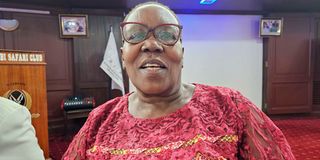
Anne Ambwere prepared Kenya’s report presented during the negotiations at the Beijing women’s conference in 1995. In an interview on February 27, 2025, she reflected on her experiences as the head of the secretariat at the Women’s Bureau under the Ministry of Culture and Social Services.

What you need to know:
- In 1995, about 500 Kenyan women travelled to Beijing for a historic conference, carrying traditional 'kiondos' while advocating for women's rights and economic empowerment.
- Their collective concerns were compiled by Anne Ambwere into Kenya's official stance, contributing to the Beijing Declaration and Platform for Action.
- Three decades later, these women reflect on significant progress made, while acknowledging ongoing challenges in political representation.
There was something undeniably captivating about the women from Kenya who congregated at the ever-popular meeting in 1995 in Beijing, China’s capital, now dubbed the “billionaire capital of the world.”
At least 500 Kenyan women, representing various sectors including government, civil society, and grassroots movements, attended.
They were not just carrying kiondo; they were laden with chondo (Swahili version of the handwoven bags) synonymous with Kamba, Kikuyu and Taita communities.


Boarding the planes was a light-hearted spectacle as they navigated the aisles with determination and joy, creating an atmosphere of camaraderie as they hustled to their destinations.
They embarked on a serious mission: one that demanded the world’s attention and acknowledgment.
Their presence at the conference was not merely for negotiation; they aimed to showcase their enterprise, generate income, and, most importantly, demonstrate that women possess the power to transform their economic realities, if only given the appropriate support.
In a meeting convened by Maendeleo ya Wanawake in Nairobi on February 27, 2025, these women reflected on their impactful journey, asserting that they had indeed left an indelible mark in the annals of women’s rights advocacy.
Beyond their kiondo/chondo advocacy, one woman, Anne Ambwere, had compiled their collective concerns into a report that was presented as Kenya’s official stance during the negotiations that resulted in the esteemed Beijing Declaration and Platform for Action.

A picture of 'kiondos'. Kenyan women with determination and 'kiondos' helped craft the world's most progressive women's rights document in Beijing, in 1995.
This pivotal document has been hailed by UN Women as the “most progressive blueprint ever for advancing women's rights.”
At that time, Anne served as the head of the secretariat at the Women’s Bureau, which operated under the Ministry of Culture and Social Services.
This bureau, established in 1976, was tasked with promoting gender equality and empowering women in response to the United Nations’ call for member states to create dedicated agencies during the International Women’s Year in 1975. Under the leadership of President Jomo Kenyatta, Kenya took significant strides towards addressing gender disparities.
The Women’s Bureau was charged with formulating policies, implementing them, and evaluating their impact. It coordinated government initiatives for women, while also collecting and analysing crucial data to support and collaborate with non-governmental organisations and women’s collectives.
“One of our critical areas of focus was enhancing women’s participation in decision-making. At the time, representation in government and the private sector was dismally low,” Anne recalls.
“We recognised the need to advocate for policies that not only increased numbers but also ensured meaningful participation. Our battle transcended politics, encompassing education, economic empowerment, and vital legal reforms.”
Anne adds, “Economic empowerment was another pillar of our advocacy. Women desperately needed ownership of resources and legal rights regarding contracts and inheritance. There was an era when a woman’s financial stability hinged solely on her husband, even for essential needs such as housing. Our campaigns sought to transform this narrative, allowing women to own property, sign contracts, and engage in business independently.”
The report also highlighted the impact of gender-based violence on women in Kenya.
“Cultural norms often restrained women from taking action against their abusers, as they were told they could not take their husbands to court. Breaking these societal shackles was an arduous journey,” she recounts.
She states that the outcome of the meeting reflected their input as presented in the report.
Three decades later, Anne reflects on the progress that has been made. She says, women now thrive in professions traditionally dominated by men, including media and law, and many own land and property, and are equipped to advocate for their rights.
“Through relentless advocacy, we have also witnessed changes in attitudes and legal frameworks surrounding gender-based violence,” she observes.
Furthermore, she emphasises the strides made in women's access to education, including ground-breaking initiatives advocating for young mothers to return to school after childbirth.
However, Anne expresses concern over the representation of women in political leadership. “
Political parties should establish gender quotas to enhance women’s representation in elective positions,” she recommends, highlighting the ongoing struggle for equality in governance.
This feature is part of our special coverage for International Women's Day, celebrated globally on March 8, to honour women's achievements and continue the push for gender equality.