From Beijing to Nairobi: Thirty years on, the revolution isn't over—it’s just getting started
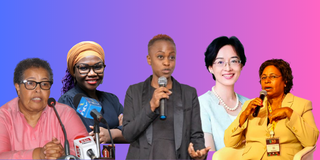
Women leaders share Beijing Declaration memories at historic Nairobi summit.

What you need to know:
- Nation Media Group's NXTHer Summit is currently underway in Nairobi, bringing together women leaders to reflect on 30 years of progress since the 1995 Beijing Declaration.
- Speakers including ambassadors, doctors, and activists are sharing stories of breakthrough achievements whilst acknowledging persistent barriers to gender equality.
Thirty years. Three decades. An entire generation has passed since the world converged on Beijing in 1995, armed with unprecedented determination to place women at the heart of global development. But the story began even earlier—in 1985, when Nairobi itself became the epicentre of women's rights advocacy, hosting the third United Nations World Conference on Women that would lay the groundwork for what was to come.
Yesterday and today, as the Nation Media Group's NXTHER summit reaches its powerful conclusion, the city that once welcomed the world's most passionate advocates for gender equality has found itself once again at the crossroads of history. The summit has brought together an extraordinary gathering of women leaders, policymakers, and advocates whose voices collectively represent decades of struggle and triumph. The theme resonates with profound intention: "Grounded in legacy, designed for impact"—building the future for the next 30 years.
When voices find their platform


The choice of Nation Media Group to host this summit reflects a growing recognition that the platforms which shape public discourse have a role to play in advancing equality. In a region where women's stories have often been relegated to the side-lines, bringing these conversations to the forefront represents more than journalism—it becomes advocacy in action.
The power of the NXT HER Summit lies not just in its theme, but in the remarkable convergence of voices it has assembled. From ambassadors to medical doctors, from university chancellors to grassroots activists, the women taking the stage over these two days represent the full spectrum of leadership that has emerged since Beijing. Their presence here—physically and intellectually—demonstrates the evolution from aspiration to achievement that has defined this generation.
A legacy written in two cities

Guo Haiyan is the Chinese Ambassador to Kenya.
Guo Haiyan, Chinese Ambassador to Kenya’s message carries the weight of shared history: "In 1985 and 1995, Nairobi and Beijing respectively hosted the third and fourth United Nations World Conferences on Women. These conferences adopted the Nairobi Forward-Looking Strategies and the Beijing Declaration and Platform for Action, which remain landmark documents guiding global efforts toward gender equality."
For those who lived through those pivotal moments, the transformation has been nothing short of extraordinary. Dr Sheila Macharia, Managing Director of the FP2030 Eastern and Southern Africa Hub, brings this historical perspective to the summit stage as she reflects on Beijing's revolutionary impact: "The most memorable thing is just the fact that people from around the world would gather, and it was time to put women at the centre of development. That meant that women—and by extension, younger women and girls—had an opportunity to aspire, and to aspire to lead in all sorts of sectors over the years."
Her message carries a particular resonance because she witnessed first-hand how radical this concept was. "That, for me, was very significant because it came at a time when the issue of women's leadership was not really considered important."
Thirty years later, the assessment is complex—a tapestry woven with threads of triumph and persistent challenges. Sheila offers a nuanced evaluation: "Thirty years on, to assess the progress that has been made, I would say there has been progress—no question about that. There has been progress in terms of women being able to enter spaces that no one had imagined: politics is a big one, leadership in business is very big, and so is leadership in the private sector."
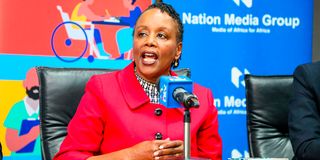
The transformation extends beyond boardrooms and parliament halls. "Even in homes, women are taking on leadership roles. Then, with education opening up for women and young women being able to dream and know that—as we have heard famous actors say—their dreams are valid, there has been progress."
Yet honesty demands acknowledgment of the distance still to travel. "I would say we still have a bit to go, because human beings are still defined very much by the norms and cultural beliefs of their society," Sheila continues, her words echoing the experiences of millions of women worldwide.
The duality of progress becomes even starker when viewed through specific lenses. "There are young women involved in matters of climate, working to protect the Earth. We have women who are engineers, women in tech, and leaders in education. However, we still have many societies where a girl's chances of proceeding beyond getting married are very limited; where it is almost taboo for women to even aspire to read or go to school; where there is still hesitation about putting women in significant leadership spaces and a preference for placing them in softer spaces."
The new generation rising
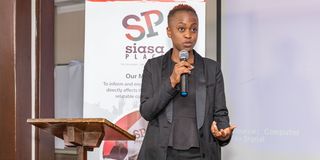
Nerima Wako-Ojiwa, Executive Director of Siasa Place.
Nerima Wako-Ojiwa, Executive Director of Siasa Place, brings a different perspective to the conversation—one that acknowledges both the magnitude of remaining challenges and the extraordinary pace of change among younger women.
"Thirty years after the Beijing Declaration, there's still a lot of work that needs to be done. Of course, there are positives—we're seeing more women entering politics, governance, and leadership—but it's still a small number. When you compare it to the totality of global populations, we still need a lot more representation."
But it's the speed of breakthrough that catches her attention. "What I'm happy about is younger women stepping into leadership. We've seen prime ministers below the age of 40. We've seen female presidents on our continent—something we would never have thought possible 30 years ago, when statistics showed that without clauses, policies, and laws in place, it would take women 200 years to reach leadership parity."
The mathematics of change offers both hope and urgency: "To see that in 30 years is progress, but we could do much more to push that toward 50/50."
Nerima's observations extend to the grassroots level, particularly in Kenya, where she has witnessed a new kind of women's leadership emerging. "The second thing is we've seen so much happening, especially in Kenya—from the anti-femicide movements to the protests that started in June 2020—with a lot of women at the forefront, strategically organizing. Now, it's time for these women to step into leadership. That's what I'm hopeful about, and I hope they dare to step up and that violence in politics decreases."
Her vision connects individual courage to systemic change: "Hopefully, when we have more women in political leadership, we will see a decline in violence."
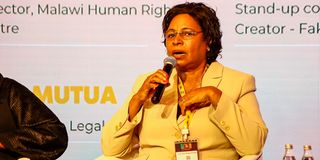
Former Gender CS Prof Margaret Kobia speaks during the NXT HER Summit at Mövenpick Hotel, Nairobi, on August 21, 2025.
The summit has brought together voices that refuse to accept the status quo. Prof Margaret Kobia, Chancellor of St Pauls University, embodies this spirit of unwavering commitment: "We have zero tolerance for fighting against women's leadership. That's why I'm showing up for the NXT HER Summit."
Her personal anthem speaks to a generation of women who have moved beyond seeking permission: "My feminist anthem right now: refuse to be a victim. Use your expertise, your voice, and your power to create change." The clarity of her vision is unmistakable: "We want the future to be hers—because she knows what she wants."
The economics of empowerment
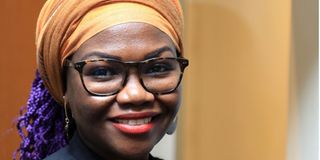
Dr Stellah Bosire, Executive Director Africa Centre for Health Systems and Gender Justice.
Dr Stellah Bosire brings the credibility of dual expertise—as both a medical doctor and lawyer—to arguments about women's economic empowerment. Her perspective cuts through theoretical discussions to practical realities: "As a medical doctor and a lawyer, I know from experience that when we shift economic power to women, we not only shift power to her, we transform households, we transform communities, and we transform the nation in terms of GDP."
"Nations are healthy because resources are in the hands of women. I know what it means to put resources in the hands of women. I know the transformations that happen not just in the household, in the communities, but in the entire nation. Indeed, empowering women is empowering a whole nation," she observes.
From Faiza Mohamed, Africa Director of Equality Now in Nairobi, comes perhaps the most defining characteristic of this generation of African women leaders.
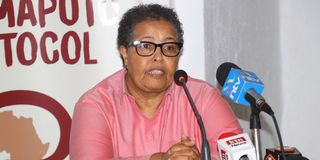
Equality Now Africa Director Faiza Jama Mohamed at a press briefing in Mombasa in 2023.
"30 years after the Beijing conference, women are still seeking justice and equality. That's why I'll be attending the next HER Summit."
Her definition is both simple and profound: "One word to describe African women is she's resilient." This resilience becomes the foundation for future action: "That's why it's important to be at the next summit, because the future is hers, because she's present."
As these two transformative days draw to a close, the speakers who have graced the summit platform carry more than individual stories—they represent a collective commitment that spans continents and generations.
The women who have shared their insights at the NXT HER Summit embody the spirit Ambassador Guo Haiyan articulated: "NMG's NXT HER Summit demonstrates its proactive commitment, as a renowned media organization, to lending its sincere voice to women's empowerment. Protecting women's rights and promoting gender equality requires the collective participation of all nations."
Her perspective as a female ambassador adds particular weight to the call for global solidarity: "As a female ambassador, I look forward to more countries and individuals actively supporting and broadly participating in initiatives to advance gender equality. We sincerely hope that more women will fulfil their potential and achieve their aspirations."
The invitation forward
Sheila had issued perhaps the most compelling invitation to this landmark gathering: "The NXT HER Summit is one that I would encourage everyone to attend. This is such a landmark event for us in the country—an opportunity to have intergenerational voices reflecting on where we are with regard to the Beijing Declaration, which spoke to the place of women at the heart of development and gender equity."
The questions she posed have framed the summit's ultimate purpose: "What are the new spaces they see we should be occupying but are not? Where are the wins and where are the challenges? So I invite everybody to come and be a part of it. Next week, on August 21 and 22, join us, register, sign up, and let's talk about this plan for the next two years, which I think is super mainstream."
As the NXT HER Summit concludes, it represents more than a conference—it is a living bridge between the promises made in Beijing 30 years ago and the realities that must be built in the next 30. In Nairobi, where this journey of global women's empowerment first took root in 1985, the conversation continues, the commitment deepens, and the future awaits.
The legacy is grounded. The impact has been designed. And the next thirty years begin now.


