From breaking the bias to 'give to gain': Counting what women have given—and gained
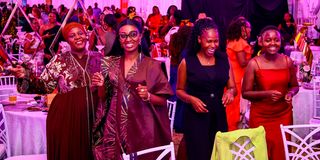
Guests dance during the IWD gala dinner at Muthaiga Golf Club Nairobi on March 7, 2025.

What you need to know:
- Years of International Women’s Day reporting reveal women’s contributions, policy shifts, persistent inequality, and unfinished constitutional promises.
- From storytelling to accountability, this IWD reflection counts what women gave, what society gained, and what remains undone.
When the 2026 International Women's Day (IWD) theme was unveiled, my first reaction was to frown at it. ‘Give to gain’ - it felt like someone had reduced the entire weight of women's contributions to a business proposal with measurable returns.
But then something shifted. Maybe that’s exactly the conversation we need, not about transactions, but about what has actually been given and what has been gained. Not in theory or aspiration, but in the five years since Nation Media Group decided to treat IWD as more than a date on the calendar.
So let’s do something different this year. Let’s count.


What we gave
Space. Not just column inches, though there were thousands of those. Space for women to be complicated rather than convenient, brilliant rather than just inspirational, angry rather than just resilient. Space for stories that made readers squirm because they showed how things actually are, not how we pretend they should be.
Coverage that profiled the woman building a business from a roadside kiosk and the woman breaking into a boardroom that had never seen someone like her. The survivor who found words for violence she had been taught to call love. The activist who kept pushing when everyone said the law would never change. The mother who chose her daughter's education over every other expense, knowing she might never see the return but trusting it would come.
Five themes guided this work: Breaking the Bias in 2022, Embrace Equity in 2023, Inspire Inclusion in 2024, Accelerate Action in 2025, and now Give to Gain in 2026. Each theme pushed further, asked harder questions, and refused to settle for applause when what was needed was accountability.
What we gained
Evidence. Not just anecdotes, but patterns that emerged across years of reporting. Policy shifts that happened after coverage exposed gaps too wide to ignore. Survivors speaking up because they saw others speak first and survive the telling. Girls reading profiles of women who looked like them and deciding, quietly but firmly, that they too could aim beyond what their circumstances suggested was possible.
Conversations that rippled outward in homes, workplaces, and communities where people began questioning arrangements they had previously accepted as just how things are. The kind of slow, unglamorous change that does not make headlines but reshapes the ground everything else is built on.
And clarity. Perhaps the sharpest gain of all. Five years of focused attention revealed just how deep some problems run and how fierce the resistance is to pulling them up by the roots.
What remains undone
Here is where things get uncomfortable, which means this is where we need to stay longest.
The two-thirds gender rule sits in our Constitution like a promise we made to ourselves and then decided not to keep. Article 27(8) is clear: no more than two-thirds of members of elective or appointive bodies shall be of the same gender. We wrote it in 2010. Sixteen years later, the National Assembly and the Senate remain predominantly male. We are nowhere near compliance. Parliament operates in ongoing violation of the Constitution with no consequence, no urgency, and no shame. The excuses pile up year after year: wrong timing, limited resources, and political complications. Meanwhile, half the population remains locked out of the decisions that shape their lives.
Femicide has not slowed. Women's work remains chronically undervalued, their labour underpaid not because they contribute less but because the systems that assign value were never designed with them in mind. Pay gaps persist alongside leadership gaps, not because women lack what is required but because the pathways to power were laid by people who never imagined women walking them.
What men need to do
This is not about allyship or support, though both help. This is about interrogation: examining the systems that grant men privilege whether they asked for it or not, questioning the assumptions that excuse male absence while punishing female imperfection, dismantling structures that let men opt out of responsibility while locking women in.
Equality is not loss but liberation from performing invulnerability, carrying dominance like armour, and the isolation that comes with refusing to share power or admit need. The work is dismantling barriers that should never have existed and refusing to benefit from systems that harm half the population.
What communities should stop doing
Stop hiding harm behind the word "culture." Tradition can evolve without disappearing. Respect for heritage does not require accepting practices that damage people. Economic control in marriage is domination, not provision. Early marriage is theft of childhood and futures, not protection. FGM is violence dressed in ritual, not respect.
Some inheritances deserve refusal. Some things handed down need to be examined, questioned, and if they fail the test of human dignity, discarded. Culture has never been static. We stopped many things our grandparents held sacred. We can stop more.
What this year demands
The theme makes sense now because it refuses to romanticise giving. Women have been giving for generations—time, labour, brilliance, bodies, futures—often with no acknowledgment and less return. What we gain by finally documenting that giving and asking hard questions about who gives and who takes is the possibility of a different arrangement, one where giving leads somewhere beyond exhaustion.
Reciprocity, not transactions. Justice, not charity. Shared responsibility for building the kind of society where giving does not mean disappearing, rather than women shouldering burdens alone while everyone else watches.
For the next year, this will be the lens. Stories will document what women give and what that giving produces: the children educated, the policies forced into existence, the violence prevented, the futures made possible. The questions will probe who is asked to give and who is allowed to receive, which forms of giving get celebrated and which get taken for granted, when giving becomes a substitute for justice rather than a step towards it.
What you can do today
You know who gave you something they did not have to give. Someone taught you, mentored you, believed in you before you had proven anything, opened a door, held space, refused to let you quit. Someone stretched a budget to keep you in school, intervened when harm was coming, or built something you are standing on right now.
Tell them. Not someday when the moment feels right or when you think you have achieved enough to make the gratitude feel earned. Tell them today, before the theme changes, before another year passes.
Because here is what five years of this work has proven: the return always comes. Not always in the form expected or to the person who gave. Sometimes it skips generations, lands in a stranger's life, shows up in communities the giver never visited, or manifests in changes set in motion without anyone knowing where they would lead.
But it comes. That is pattern, evidence, the testimony of women who gave decades ago and are now watching what they planted finally break ground.
On this International Women's Day, as we mark five years of asking what stories owe the world and what the world owes the women in those stories, the answer is clearer than ever.
We owe presence and enforcement of the laws already written, the two-thirds gender rule we promised and then abandoned, accountability for violence, fair pay for equal work, and pathways to power that do not require twice the effort for half the recognition.
And gratitude, specific, named, spoken aloud, to the women who gave when no one was counting and kept giving when no one was watching.
So tell them. Today.