From elders to fathers: How one man is converting Wajir men to fight GBV
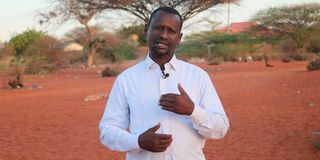
Mohamed Turane, a Wajir gender champion, in Hodhan village, Wajir East, on September 12, 2025.

What you need to know:
- In Wajir East, gender champion Mohamed Turane gathers elders, women, and men under trees to confront the rise of gender-based violence and harmful practices such as FGM.
Despite the law, traditional dispute resolution through maslaha continues to derail justice for rape and defilement survivors.
It is late afternoon when we depart Wajir town for Hodhan village in Wajir East. The village is about 15 kilometres away and the sandy road makes the drive slow. Along the way, we meet children walking home from school, their bags strapped to their backs.
After about 10 minutes, we reach our destination and find a small gathering. One man is addressing the group. The men and women sit in the shade, shielding themselves from the blazing afternoon sun as they listen attentively.
The speaker is Mohamed Turane, a leading gender champion who has been at the forefront of the fight against gender-based violence (GBV), including female genital mutilation (FGM) and defilement.


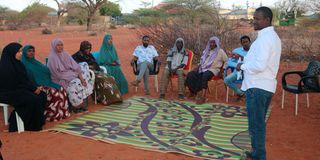
Mohamed Turane addresses a gathering in Hodhan village, Wajir East, on September 12, 2025. He leads efforts against cultural harmful practices in Wajir.
Cases of GBV have been on the rise in Wajir in recent years, including incidents of defilement, rape, and sodomy. Turane has gained prominence in the county for confronting harmful cultural practices that disproportionately harm women and girls. “These evils happen within our communities, schools, and even our homes,” he tells the gathering.
Turane also serves as programmes and governance officer at the Arid Land Development Focus. When we later speak to him, he stresses the need for urgent measures to tackle the GBV scourge. He has been leading community dialogues to raise awareness of the vice at the grassroots. “Through community dialogues, we enlighten locals on what GBV entails. We also teach residents about reporting pathways,” he explains.
His campaign focuses on cultivating attitude change within the community, particularly in how women and girls are treated. It also seeks to challenge negative forms of masculinity. Turane is a strong opponent of the maslaha system—a traditional dispute resolution mechanism practised by the Somali community to settle cases of defilement, rape, and domestic violence. “Defilement and rape should not be handled by elders through the maslaha system. These are criminal acts, and perpetrators must be taken to court to face the law.”
He blames maslaha for interfering with witnesses, often preventing them from testifying in sexual violence cases, which in turn leads to the collapse of trials. Turane underscores the importance of male involvement in the fight against GBV, noting this is why their campaign targets elders and men.
“In our campaigns, we sit with elders and make them understand that there is no shortcut when it comes to defilement, rape, and FGM. Men are often the perpetrators of GBV, so it is crucial to involve them in ending the menace,” he says, adding that changing attitudes is key to winning the fight.
Mohamed Gedi, another community member, describes maslahaas the greatest impediment to justice for survivors of GBV. “As a father of five girls and one boy, I fully support the campaign to fight gender-based violence and harmful cultural practices. As Muslims, we do not support GBV in any form. It is against our religion,” he tells the Nation.
He stresses the need to make Somali men understand the importance of respecting women, treating them with dignity, and upholding their human rights. “There is a need for robust campaigns at community level targeting men to help them realise why they must get involved.”
Amina Ahmed, a resident and gender champion, laments that FGM remains rampant and is still carried out in secret. “Many girls have died from excessive bleeding after undergoing FGM. Many women have also experienced severe complications during childbirth, which are linked to the cut,” she says.
The mother of five adds that awareness campaigns led by Turane and his team are beginning to change attitudes in the community. “The ongoing sensitisation has enlightened locals on the dangers of FGM and why they must reject it,” Amina says.
Mohammed Abdillahi, an elder, voices his support for the activists’ work, insisting survivors of sexual violence must be given justice. “If a girl or woman is violated, such cases must go to court so that perpetrators face the law,” he says.
Abdillahi acknowledges that elders have a role to play in tackling sexual violence, noting they must not shield offenders through traditional dispute resolution systems.
Entrenched cultural practices, together with rising alcohol and substance abuse, are blamed for fuelling GBV in Wajir.
Aliyow Buri, the Wajir East Police Commander, reports that 27 sexual violence cases have been recorded this year: 16 defilements, eight rapes, and three attempted rapes. “Once we receive sexual violence cases, we process the files and forward them to the Director of Public Prosecutions for approval and prosecution. The work of the police is to protect, ensure justice prevails, and guarantee survivors get full justice,” he tells the Nation.


