From grief to grit: Why Laikipia widow’s story demands a rethink of unpaid care work
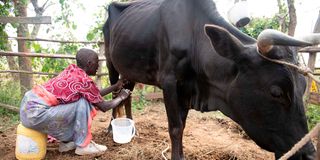
Beatrice Wairimu milk her cow at her home in Miyogo, Laikipia East, on July 2, 2025. Beatrice is a widow living with disability and shoulders the burden of unpaid care work, including domestic chores.

What you need to know:
- Beatrice Wairimu, a disabled widow, endures exhausting unpaid care work while raising dependents and farming.
- Despite spinal injury, Beatrice manages livestock, household chores, and caregiving with no financial support.
In the pre-dawn darkness of Miyogo village in Laikipia East, while most of the world still sleeps, Beatrice Wairimu is already at work. The crisp morning air bites at her skin as she carefully positions herself beside her cows and goats, her movements deliberate and practiced despite the challenges her body presents.
To an observer watching her milk, there would be no immediate sign of the disability that has shaped her life for the past 13 years. Her hands work with the confidence of someone who has performed this ritual countless times, extracting life-sustaining milk that will feed her family and provide the small income that keeps them afloat. It's only when the milking is done—when she reaches for her walking stick with one hand and balances a jerrycan of fresh milk in the other—that the full weight of her daily reality becomes visible.


"Welcome to my home. Feel much at home," she greets visitors with a smile that seems to radiate warmth despite the burdens she carries.
Beatrice's story begins with a convergence of tragedies that would have broken many others. Thirteen years ago, around the same time she lost her husband, a spinal cord condition left her unable to walk or stand upright. The woman who once moved freely through her world suddenly found herself navigating life with new limitations, yet with responsibilities that only seemed to multiply.
Today, as a widow living with disability, she shoulders the care of her daughter who also lives with disability and cannot do anything independently. Added to this is her two-year-old grandson, left in her care when her daughter died during delivery in 2023. The layers of caregiving create a web of responsibility that stretches from dawn until well past dusk.
"I usually milk four litres a day," Beatrice explains, outlining the economics of survival that govern her mornings. "I use two litres and sell the other two for Sh50 each, hence making Sh100 per day."
This modest income—roughly three dollars—represents just one thread in the complex tapestry of unpaid labour that fills her days. Her routine reads like a masterclass in time management born of necessity: wake at 6am, milk the animals, prepare breakfast, clean the compound, feed the livestock, tend to farm work, prepare lunch, bathe her adult daughter, care for her grandson, search for firewood, fetch water. The cycle continues until she finally rests at 11pm.
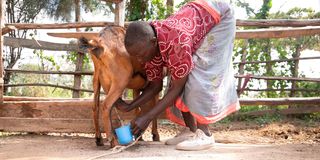
Beatrice milks her goat on July 2, 2025
"Every day, I wake up at 6am and start with milking the cows and the goats. I then prepare breakfast and later clean the compound. I feed the animals before going to the farm," she recounts. The matter-of-fact way she describes her schedule belies its intensity.
The physical demands of caregiving take on additional complexity when the caregiver herself lives with disability. Beatrice must help her adult daughter with basic tasks like bathing, while simultaneously meeting the needs of an energetic toddler who depends on her completely.
"I get tired every day. Waking up at 6am and going to bed at 11pm is not an easy thing for me, bearing in mind my age and condition. But being a firm believer that disability is not inability, I strive to do what I can," she reflects, her determination evident in every word.
The financial picture grew more complicated when both pillars of support in her life collapsed. Her husband's death in 2014 was followed nearly a decade later by her daughter's death in 2023, leaving Beatrice as the sole breadwinner for a family that includes two of society's most vulnerable members.
"Both of them were helping me a lot financially, but since they died, I have faced a lot of challenges, including taking care of my grandson and my other daughter living with disability," she says.
Rose Ngima, Beatrice's neighbour, has witnessed this struggle first-hand. Her observations illuminate how disability can compound the already disproportionate burden of unpaid care work that falls on women's shoulders.
Invisible weight
"People living with disabilities, particularly women, face a lot more challenges dealing with the burden of care work. They are unable to handle their workload and need someone to assist them with duties like collecting firewood, fetching water," Rose explains. She notes that Beatrice is mostly overwhelmed by domestic chores, "something that puts her health in great danger."
Beatrice's story is far from unique. Across Kenya and around the world, women like her carry the invisible weight of care work—labour that sustains families and communities but remains largely unrecognised in economic calculations. The numbers tell a stark story: according to the Kenya National Bureau of Statistics, women spend three hours and 36 minutes more on unpaid care and domestic work than men. For working women, the gap narrows only slightly to three hours and 18 minutes more per day than working men.
This recognition has sparked action at the policy level. In May, UN Women Kenya, in collaboration with the State Department of Gender and Affirmative Action, launched the Evidence to Policy for Kenya Care Economy project. The initiative, supported by the Gates Foundation, is being implemented in three counties: Kitui, Laikipia, and West Pokot, with Hand in Hand Eastern Africa serving as Laikipia's implementing partner.
The project aims to recognise, reduce, redistribute, reward, and represent care and domestic work—most of which is carried out by women and remains unpaid and invisible. For Dan Bazira, UN Women Deputy Country Representative, the implications extend far beyond individual households.
"It is an economic issue. And where there is social and economic, there is development. Under looking unpaid care work means economic development is being affected. Women should be engaged at the forefront of family and society development," he emphasises.
The solution, Bazira argues, requires systematic investment in care infrastructure. "The government machinery needs to allocate resources to the county to ensure there are ECDEs (Early Childhood Development and Education centres), support structures for markets that are being constructed and other provisions. Once this is done, you will see a change where a woman has more options to select other economic livelihood options. The moment we provide that platform, caregivers will thrive."
This push for recognition aligns with international frameworks that have long acknowledged the importance of unpaid care work. The Beijing Declaration and Platform for Action of 1995 stressed the importance of unpaid work and aimed to support policies focused on unpaid care. Similarly, Sustainable Development Goal 5 commits member states to recognising and valuing unpaid care and domestic work through the provision of public services, infrastructure, and social protection policies. The achievement of gender equality, as articulated in these frameworks, is cross-cutting and inseparable from the rest of the Agenda 2030 goals.
Globally, countries are beginning to grapple with how to value this hidden economy. While no country has fully "monetised" unpaid care work by incorporating it directly into GDP calculations, progress is being made. Statistics Canada has found that unpaid care work, such as childcare and eldercare, has significant economic value, equivalent to a substantial portion of GDP in some regions. Australia has conducted studies to estimate the monetary value of unpaid care work, while several Latin American countries have implemented policies to support families and caregivers, recognising the economic impact of their contributions.
Milestone
In Kenya, this week marked a significant milestone when the State Department of Gender presided over an event where stakeholders validated the Draft National Care Policy. "Kenya's care economy has achieved a major milestone today following the landmark validation of the Draft National Care Policy spearheaded by the State Department of Gender. This now sets the stage for onward processes, leading to its adoption by the Cabinet," the department announced on its Facebook page.
The policy's institutional frameworks include proposals to establish well-equipped childcare centres, elderly care facilities, and training programs for caregivers. The focus extends to compensating tasks like cleaning, domestic work, and caring for the elderly, sick, or children—the very work that defines Beatrice's daily existence.
Back in Miyogo village, as the sun sets on another day of labour that will largely go unmeasured in official statistics, Beatrice continues her routine. Her story serves as both a testament to human resilience and a call to action—a reminder that behind every statistic about unpaid care work is a person whose contributions sustain not just their family, but the very fabric of society.


