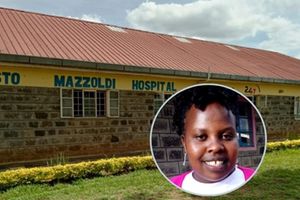
From mama fua to business owner: The woman turning slum survival into thriving enterprise
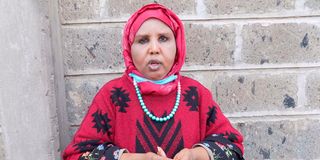
Balkhisa Bashir, who trains community members in slums how to make products for a living, during the interview on August 26, 2025.

What you need to know:
- The woman-led skills training is helping slum mothers to start small businesses.
- They are turning back-breaking laundry work into booming businesses.
Winnie Mwikali, 34, used to rise before dawn and navigate the narrow pathways of Mukuru Kwa Njenga in Embakasi, Nairobi, searching for households that needed their laundry done. The pay was meagre, the work back-breaking, and the income unpredictable. As a single mother of two, she shouldered the weight of feeding her children, paying rent, and keeping them in school, entirely on her own.
"I would wash mountains of clothes for people, but the money I earned could barely stretch to cover my basic needs. Rent, food, school fees—something always had to wait," she says.
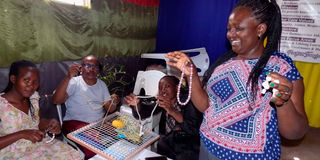
Community members make beads in Embakasi on August 26, 2025.


Today, Mwikali owns a salon where she braids hair for a steady stream of clients. She also makes liquid soap, which brings in extra income. Both are skills she acquired through training that changed the trajectory of her life. "I now have two sources of income—my salon and my soap business. For the first time, I can plan ahead instead of just surviving each day," she says.
Mwikali is one of more than 500 women, men, and youth in Nairobi's informal settlements whose lives have been transformed by Balkhisa Bashir, founder of Barwaqa Relief Organisation.
A practical solution to poverty
In Kenya's informal settlements, particularly in Nairobi, many residents cannot afford three meals a day. It is a challenge they have grappled with for years. Unemployment remains pervasive, and without formal education, white-collar jobs are virtually inaccessible to slum dwellers who lack the requisite qualifications.
Balkhisa recognised this gap and chose to address it with a practical solution: equip people with skills to create products they can sell. She offers training in a diverse range of crafts. Beneficiaries learn to make liquid soap, candles, baskets, and garments. They learn to bake, style hair, knit, and apply screen printing techniques. They also craft beadwork—bangles, necklaces, and bracelets—all of which have commercial value.
Once they master these skills, they sell their products to generate income for food, clothing, and their children's education—from primary school through to university. But the training extends beyond handicrafts. Balkhisa pairs practical skills with business acumen.
"We begin with theory—the fundamentals of running a business. Once they grasp that, we move to hands-on production," she explains. "But we do not stop there. We train them to become trainers themselves, so they can pass on these skills to their neighbours and multiply the impact.
This cascade model allows the programme's reach to extend far beyond what Balkhisa could achieve alone. The newly trained women do not just teach others—they also sell the products they create. Beneficiaries complete a course Balkhisa calls Master of Business in the Street, which covers how to launch, operate, and manage a small enterprise, as well as the discipline of saving. Upon completion, they receive certificates recognising their achievement.
From mama fua to entrepreneur
Lynne Wafula, 36, a resident of Kibra and mother of three, knows this transformation intimately. As a single mother, she once made the daily trek to Lang'ata to wash clothes for a living. "Being a mama fua meant never knowing whether I would earn anything on a given day. Some mornings I would travel all the way there, find no work, and return home empty-handed. It was exhausting and demoralising," she recalls.
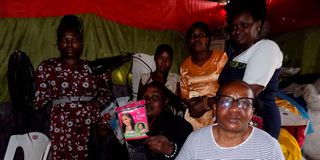
Community group in Embakasi, Nairobi, on August 26, 2025.
After completing her training with Balkhisa, Lynne now runs a tailoring business. "I never imagined I would become a tailor. Now I make clothes and earn a dignified income. The training unlocked possibilities I did not know existed for someone like me," she says.
Products that find markets
The products created by trainees find ready buyers. Local shops across the country purchase their candles and resell them to customers. Balkhisa notes that their products are competitively priced and made from natural materials—qualities that appeal to budget-conscious consumers.
Handwoven baskets fetch Sh2,500 each. The women display them at exhibition events, where they attract buyers looking for authentic, locally made goods.
"If a woman sells 10 baskets, she earns Sh25,000. If she disciplines herself to save even Sh1,000 from that, she begins to build a foundation for growth," Balkhisa explains.
The organisation also connects trained women with income-generating opportunities beyond product sales. "When clients need catering for events, we deploy our women who trained in food preparation. They cook, they serve, and they get paid. It is another avenue for them to earn," she says.
Who benefits
The majority of trainees are single mothers and widows—women without formal employment who struggle daily to make ends meet. "What I find remarkable is watching women who came to us with nothing but desperation leave with businesses of their own choosing. They are no longer waiting for someone to rescue them—they are rescuing themselves," Balkhisa says.
The programme is deliberately inclusive. Men and youth have also received training. Persons with disabilities are equally welcome. "Our doors are open to everyone. Disability is not a barrier to learning or earning," she says.
To date, Balkhisa has trained more than 500 people, many of whom now deploy these skills to sustain themselves and their families.
Looking ahead
Balkhisa's vision extends beyond immediate income generation. She wants to see holistic empowerment—economic stability paired with mental wellness and strong communication skills. "When people understand how to run a business, when they are mentally sound, and when they can articulate themselves well, they will thrive. They will sell, they will save, and poverty will lose its grip on them," she says. "My dream is simple: to see people rise out of poverty by doing what they are capable of doing."
Her organisation relies on donor funding and plans to expand its reach to more vulnerable communities in informal settlements across the country. For now, the evidence of impact speaks for itself. In Mukuru Kwa Njenga, Mwikali's salon stands as testimony. In Kibra, Lynne's tailoring business echoes the same story of transformation. The goal, Balkhisa says, is self-reliance—and one woman at a time, it is being achieved.