From village women’s club to global power: The making of Winnie Byanyima
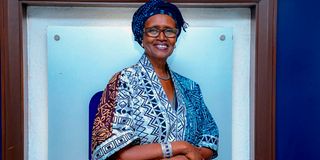
UNAIDS executive director Winnie Byanyima, who is also an aeronautical engineer, politician, human rights activist and feminist, during the interview at Nation Centre, Nairobi, on March 3, 2026.

What you need to know:
- Raised in a rural women’s club, Winnie Byanyima grew into a global feminist leader challenging injustice.
- From Uganda’s turbulent childhood to UN leadership, Winnie Byanyima continues pushing back against inequality and power.
Before she became a global name, before the United Nations, before the Ugandan constitution-making and the parliament and the engineering degree, Winnie Byanyima learned her most important lessons in a women's club in rural Uganda.
Her mother ran it. Every week, women would gather in their compound to learn to read and write, share skills and talk. A young Winnie would sit and watch as these women did something that never left her: they fought for each other.
"It was exciting helping these women hold pens and pronounce words," she says, smiling at the memory.


"A girl would be brought in by her mother to our home, fleeing an arranged marriage at 13 or 14. The women would strategise. They would hide her. They would confront the fathers. They would find a way to keep her in school. In that club, I saw and witnessed what women could do when they stood together."
"I was born in the women's movement," she says.
Looking at the life she has lived, it is difficult to argue with that.
Winnie's story begins in the 1960s, in a Uganda that would soon descend into darkness. She turned 12 the week Idi Amin seized power. What followed was a childhood shaped by brutality: soldiers grabbing girls off the street, friends returning from funerals with shaved heads, fear woven into everyday life.
Through all of it, her father taught her not to accept injustice but to resist it safely. It was a careful, important distinction for a family living under a regime that did not tolerate resistance.
Her parents also taught her something that would stay with her just as long: that being a girl was not a limitation.
"We were three girls and three boys," she recalls. "In our home, it was important that each of us could do what the other could do. There were no limits for a girl." When people told her something was not for girls, she learned to ask why. And then she would try it anyway.
At a time when female engineers were almost unheard of in Uganda, she applied for engineering at Makerere University.
"I was a bright student and I thrived in mathematics and sciences. When it was time to join university, I had two options: to become a doctor, or an engineer. My dad really wanted me to become a doctor, his doctor, but I care deeply for people and cannot stand to see people in pain. So I decided I was not going to be a doctor," she recalls.
She walked into the engineering faculty with more than 200 students and found only eight women among them. She counts them easily, many years later. That is how few they were.
"I claimed that space and I have been claiming spaces all my life," she says.
For all her confidence, Winnie admits she carried something heavy for a long time. Until she turned 50, she felt like an imposter, like someone who had arrived somewhere she was not supposed to be.
"I would show up at meetings and hear people speaking in clichés," she says. "New concepts would land on the table and there was an assumption we all knew what they meant. I felt maybe I got here by mistake."
Turnaround
She would sit in UN meetings, surrounded by people who spoke fluent English and moved through those spaces as though they owned them, and she would feel out of place. She read widely, worked harder than most, climbed steadily, and still the doubt followed her.
Then, at 50, something changed.
"The time I hit 50, I looked around and said, there has to be something wrong with them, not me. If I do not understand, it means somebody has brought something they need to explain."
What she had been feeling, she came to understand, was not a reflection of her ability. It was the effect of being in rooms that were built by and for people who looked nothing like her. The men, the Europeans, those who spoke without accents, carried a confidence that came not from ability but from always having been told they belonged. She had been measuring herself against that and calling the gap her failure.
"My message to women who aspire to lead but feel inadequate is simple: believe in yourself, but know you are in a world with male privilege. Challenge it. Do not just accept it without questioning it and pushing back."
When she became Executive Director of UNAids, she declared the organisation would be feminist. The reaction was swift. Men pushed back loudly. She did not apologise and she did not soften the position.
"The organisation was sick. There had been a culture of abuse. I needed to change the culture, and to change it, I needed to impose a new one."
Ask Winnie where her feminism comes from and she takes you straight back to that village club. Her mother was not simply running meetings. She was building something, quietly and without making a show of it, in a compound in rural Uganda. The women who came every week learned to read, yes, but they also learned to stand together. They fought for property rights, for marriage registration, for the girls in their community who deserved to finish school.
"I learned to make crafts in those clubs," Winnie says. "I can knit, embroider, do beadwork, crochet, make baskets. But more than that, I learned to love women's work and to understand women's struggles."
Mother's story
Her mother's own story deserves a moment. She went on to become the first African woman to open a hardware store on the high street of their town, a business district that had long been dominated by Indian traders and where women simply did not do hardware. She stood behind that counter, advised builders on materials, and broke barriers without making a performance of it.
"She taught me to break barriers and to not allow gender restrictions."
It is a lesson Winnie has carried into every room she has walked into since, whether it was Uganda's constitutional assembly, where she led the women's caucus that helped shape one of Africa's most talked-about constitutions, or the offices of the United Nations, where the systems she works within were designed by and for rich countries and where she pushes back against that at every turn.
Today, alongside everything else, Winnie is carrying something deeply personal. Her husband, opposition figure Dr Kizza Besigye, has been in detention since November 2024, abducted from Nairobi and held in what she describes as solitary confinement. He spent his 69th birthday in prison, unwell and without access to his doctor.
When she talks about defending him, her voice does not waver.
"Most of the time, when I am defending him, in my mind I am defending a comrade. That comes first. He is being attacked for what he stands for. And what he stands for, I also stand for. We met in the political struggle."
She keeps his case in the public eye and connects it to others who have been detained or have disappeared. When the online attacks come, as they do regularly, she handles those too.
"At first, the online trolls and cyberbullying affected me," she says. "But with time, you develop a thick skin and I have done exactly that. I have learned to block the rude ones, ignore the flippant ones and focus on what I am doing."
Where she stands
On International Women's Day, she is clear about where she stands. Women already give too much, she says, and the conversation needs to shift.
She lays out what that giving looks like: women feed their children first and go to bed hungry. They manage the whole family's health while neglecting their own. They work in fields, in homes, in communities, putting in hours that nobody counts and nobody pays for. Globally, women do an estimated six trillion dollars of unpaid care work every year.
"I would not ask a woman to give more. I would say: gain from what you give. Recognise and reward women's unpaid work. That would be the message."
On what she hopes her legacy will be, she does not pause. "That I fought injustice. And that there is more justice in the world."
The world she wants is one where no woman suffers violence, especially at the hands of someone who claims to love her. Where no child grows up in fear. Where girls and boys look ahead and see the same possibilities. Where every person is valued equally. "A world where we end suffering," she says.
When she needs to step away from it all, from the advocacy and the worry and the weight of the work, she goes to her garden in Uganda, walks in nature and reads. And sometimes, alone in the bathroom, she hums "Morning has broken".
"It reminds me to have a positive attitude about a new day."
For all the titles she carries, executive director of UNAids, former member of parliament, engineer, activist, mother of a son who she says now turns around and teaches her about feminism, Winnie Byanyima is still, at her core, the girl who sat in that village club and watched women fight for each other. She decided then that this was the kind of woman she wanted to be.
"I will not compete with men in being one sharp thing," she says. "I will do several things. I will not be perfect at any of them. But I insist on carrying my different roles.