From walking to school barefoot to pursuing a PhD: Meet the woman from Moyale who could shatter Kenya's ultimate glass ceiling

Amina Halake during an interview at Arabian Cuisine in Nairobi on July 27, 2025, following the launch of her 2027 presidential campaign under the Alliance for Change party. Halake, wife of former presidential candidate Abduba Dida, is seeking to become Kenya's first female president.

What you need to know:
- Amina Halake has officially declared her presidential bid for the 2027 General Election under the Alliance for Change party.
- The former banker, who is pursuing a PhD in Leadership and Governance, promises servant leadership and accountability.
- The wife of former presidential aspirant Abduba Dida, seeks to become Kenya's first female president with a platform centred on fighting corruption and restoring dignity to all citizens.
In the dusty corridors of Kenyan politics, where power has long been the preserve of men, a voice rises with quiet revolution. Amina Halake stands at 50, not asking for permission to dream, but declaring her intention to shatter the highest glass ceiling in the land—to become Kenya's first female president.
"I do not offer myself to be your leader; I offer myself to be your servant," she declared at her official campaign launch.”
"For too long we have had leaders, but what Kenya needs now is service. And perhaps that is why our beloved country is referred to as She, not He."


This is not political rhetoric dressed up for applause. This is Amina Halake—banking executive, academic, survivor—charging into the 2027 General Election with the audacious belief that Kenya is ready for what she calls "transformative, motherly leadership."
Under the rebranded Alliance for Change (AFC) party—formerly the Alliance for Real Change (Ark) that her husband, former presidential aspirant Abduba Dida, once led—Halake has positioned herself not as a political heir, but as an independent force shaped by her own journey through struggle and resilience.
Her candidacy pulses with an urgency that feels deeply personal. At its heart lies an unrelenting focus on accountability, particularly regarding extrajudicial killings and enforced disappearances that have torn through Kenyan families like a wound that won't heal.
"Mothers cry for their sons. Families bury their loved ones without answers. This must end," she said.
"Under my leadership, every life will matter. We will hold security agencies accountable and restore dignity to every Kenyan, regardless of tribe, religion, or region."
Forged in the Northern Frontier
Halake's story begins in Moyale, Marsabit County, in the historically neglected Northern Frontier District. Here, in a landscape where scarcity was a constant companion, a young girl learned lessons that would later shape a presidential vision.
"I remember going to school barefoot. I remember trekking kilometres to fetch dirty water because that's all we had," she recalled in an exclusive interview with the Voice. "But I also remember my mother's sacrifices. She worked day and night to ensure we got an education."
From St Mary's Primary School in Moyale to Moyale Girls High School, then to the University of Nairobi where she earned a degree in Commerce (Marketing) followed by a Master's in Strategic Management, Halake built her path one determined step at a time. Today, she pursues a PhD in Leadership and Governance—an academic journey she describes as reflecting her "obsession with building an equitable, well-governed nation."
"The leadership of this country touches me deeply. I have been a leader all through—primary school, high school, campus. It's in my bones," she explained.
Her professional journey took her through five years at a local bank before she transitioned to the Islamic banking sector. There, she discovered the contrasts between conventional and Sharia-compliant banking systems, deepening her understanding of economic justice.
While many are discovering Amina Halake now, she has been preparing for this moment for years. In 2017, she contested for the Woman Representative seat in Marsabit County—a campaign derailed by family tragedies when she lost a young uncle to a road accident and an aunt died in the same period, forcing her to split time between Nairobi hospitals and the campaign trail.
"I couldn't cover the vast terrain of Marsabit. It's a huge county, and I lacked the resources and time. But even then, I finished third, and I was proud of that," she said.
Her political education accelerated through supporting her husband's presidential campaigns in 2013 and 2017. Their first attempt surprised the nation when they outperformed seasoned politicians like Martha Karua of the well-known Narc-Kenya party.
"That taught me a powerful lesson: you do not need to be rich or come from a dominant tribe to lead this country. What matters is how you package yourself and what you offer the people," she reflected.
For Halake, the cynical assumption that politics is inherently corrupt represents exactly the problem she wants to solve.
"The idea that politics is dirty is exactly why it remains so. Politics is not dirty. But if you lie, deceive, buy votes, and manipulate people, then you are dirty," she stated with characteristic clarity. "If I tell you what I believe in, and you buy into that vision, that's clean politics. That's the politics I stand for."
This philosophical stance isn't just idealistic—it's battle-tested. As a woman in politics, she has faced the particular brutality reserved for those who dare to transgress traditional boundaries.
"There are those who are unhappy with me. They will paint me with all sorts of labels. But I've learned to block out the noise and move forward," she said.
A platform built on pain points
Her campaign focuses unapologetically on the issues that matter most to ordinary Kenyans: corruption, healthcare, education, infrastructure, and youth empowerment. Her critique of the current administration cuts deep, grounded in the lived reality of citizens watching their government's priorities.
"We're told free education is no longer sustainable, yet the same government is spending Sh1.2 billion to build a church. If that money was redirected to schools, we wouldn't be having this conversation," she pointed out. "We're told we need affordable housing, but why not use those funds to ensure every Kenyan child is in school and every hospital has medicine?"
She warned current and former opposition leaders not to underestimate a population that has evolved beyond blind loyalty.
"The Kenya of today is not the Kenya of yesterday. The youth have eyes. They can see. They have ears. They hear. You can't keep lying to them and expect the same blind loyalty," she said.
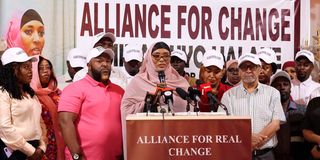
Amina Halake addresses journalists at Arabian Cuisine in Nairobi on July 27, 2025, during the launch of her 2027 presidential campaign under the Alliance for Change party.
At the core of Halake's candidacy lies a deep longing for justice—both legal and social. She envisions a country where laws apply equally to all, where the poor are not crushed under a system designed to protect the powerful.
"Kenya has become a place where the law bends for the powerful and breaks the weak. We must end this. We must build institutions that serve every citizen," she declared.
Her war on corruption is personal and comprehensive. "Corruption is why our hospitals lack medicine, why our roads are pothole-ridden, why our farmers sleep hungry, and why our youth are jobless. We will dismantle these networks."
On gender equality, Halake speaks with the authority of lived experience. "What a man can do, a woman can do ten times better. If you raise a woman, you raise an entire community."
She draws from the cultural challenges that Northern Kenyan girls still face—female genital mutilation, early marriage, and discouragement from pursuing education—to illustrate broader systemic inequalities.
"We've had to run away from forced marriages, from circumcision. But we are here. We are resilient. The people of Northern Kenya can thrive in any condition."
When questioned about whether her Islamic faith precludes her from leadership, her response is both firm and enlightened: "Our faith holds women in very high esteem. There is nothing in Islam that prevents a woman from leading. Look at President Samia Suluhu in Tanzania—a formidable Muslim woman leading her country with dignity."
The shadow that looms
Despite her resolve, Halake carries a burden that could complicate her political journey. Her husband, Abduba Dida—affectionately known as "Mwalimu"—was sentenced in 2022 by a court in Illinois, USA, for stalking and threatening a woman. He was jailed for seven years, released in April 2025 after serving three years, and remains under legal supervision until 2029.
While Halake did not address this directly at her launch, it represents a shadow that political opponents and voters alike will scrutinise. Whether the electorate will separate her ambitions from her husband's controversies remains an open question in a political landscape where family associations often define careers.
Yet she remains undeterred, driven by what she describes as a mission larger than personal ambition.
"My ambition is not for personal gain. It is to end the pain felt by Kenyans, to bring justice where there is none, and to remind this nation what true leadership looks like."
When asked about possible coalitions, Halake indicated that AFC is open to partnerships, but with strict conditions. "Our door is open to anyone ready for change. But we're not accepting everyone. If you have a questionable history in public life, you cannot be part of our movement."
The vision of a mother's touch
She believes Kenya is ready for what she calls "a mother's touch—a nurturing but firm hand at the helm."
"I am confident that where I stand, youth will not suffer. Where I lead, bad leadership will not see the light of day."
Her vision extends beyond political promises to a fundamental reimagining of Kenyan society. She dreams of roads reaching every village, hospitals stocked with medicine, clean water as a right rather than a luxury, and children attending school without fear of being turned away. Most importantly, she envisions a democracy where dissent is protected, not punished.
"An ideal Kenya is one where a youth can disagree with the president and say it openly, without fear of reprisals. That is democracy. That is dignity," she said.
A campaign for the moment
Her campaign has only just begun, but her message is already finding resonance across a country weary of broken promises and hungry for authentic change.
"The ground has shifted. The Kenya of today is more aware, more vocal, more demanding. And I'm here to meet that moment—with courage, with integrity, and with service."
Whether Amina Halake ultimately succeeds in her presidential bid or not, she is already making history by redefining what it means to lead—not as a politician seeking power, but as a servant offering service.


