Governor Wanga under fire as cabinet reshuffle, deputy pick spark gender rule backlash

Homa Bay governor Gladys Wanga addresses a rally at Kamukunji grounds in Kibera, Nairobi, on January 14, 2026. She has been accused of failing to enforce what she champions, in her county executive committee.

What you need to know:
- Homa Bay’s gender progress faces scrutiny as Wanga’s cabinet reshuffle sparks backlash from activists.
- Activists threaten legal action, accusing Wanga of failing to uphold two-thirds gender rule commitments.
During the G7 meeting in 2024, Kirinyaga governor Anne Waiguru hailed Homa Bay County as a benchmark for advancing the two-thirds gender rule, following the election of its four women leaders in 2022. However, Ms Wanga, who championed women's political inclusion during her campaign, now finds herself under pressure from activists, who say her own cabinet tells a different gender story.
The G7 is the caucus of the seven female governors elected in 2022: Waiguru; Gladys Wanga (Homa Bay); Wavinya Ndeti (Machakos); Susan Kihika (Nakuru); Cecily Mbarire (Embu); Fatuma Achani (Kwale); and Kawira Mwangaza (Meru), who has since been impeached and removed from office.


Three women members of Parliament from Homa Bay’s single-member constituencies were elected to the National Assembly, alongside Woman Representative Joyce Osogo Bensuda. They are Millie Odhiambo (Suba North), Eve Obara (Kabondo Kasipul), and Lilian Gogo (Rangwe). Ms Wanga also broke new ground by becoming the first female county chief from Nyanza.
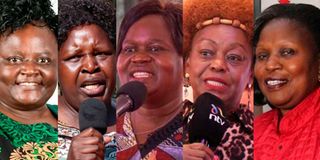
From left: Homa Bay woman representative Joyce Osogo Bensuda, Rangwe MP Lilian Gogo, Homa Bay governor Gladys Wanga, Suba North MP Millie Odhiambo, and Kabondo Kasipul MP Eve Obara.
The Homa Bay gender gains extended to the ward level. Six women were elected as Members of the County Assembly, a significant jump from one in 2013. They are Joan Ogada (Kojwach), who is serving her second term, Alice Winga (Kabondo West), Monoflorita Ondiek (Homa Bay Town Central), Dorine Aoko (East Kamaga), Susan Onyango (Gwassi South), and Sophie Salim (Lambwe).
Ms Wanga has credited herself with inspiring more women to seek elective office. However, her recent cabinet reshuffle and deputy governor nomination have drawn sharp criticism, with activists accusing her of undermining the principle she publicly champions.
Only two women remain in the county's 11-member executive committee. Previously, three women held executive positions: Roseline Omollo, who also serves as acting chief of staff (devolution and governance); Sarah Malit (fisheries and blue economy); and Grace Osewe (health). Ms Omollo was replaced by governance chief officer Isaac Ongiri, who was elevated to the executive. Activists now demand that the governor reverse course, failing which they will seek legal redress.
Interface Community Health Desk chairperson Evanse Oloo and Asego Public Litigation Forum chief executive officer Michael Kojo say they will move to court to stop the newly appointed officials from taking office, arguing that the governor has violated the two-thirds gender rule.
Mr Oloo expressed concern about Danish Ongango, the roads executive who has been nominated as the governor's deputy, saying he should not hold two offices, yet the county has not met the constitutional gender threshold. “Let him resign as roads executive so that the governor can appoint a woman to head that department,” he said.
The activists point to Kisumu County as a precedent. After the 2022 election, Governor Anyang' Nyong'o faced similar criticism when only one woman featured in his initial cabinet nominations. Public outcry followed, and the activists went to court, securing an order that halted the vetting of nominees. Mr Nyong’o subsequently revised his list to include more women.
“Kisumu is one example of a county that obeyed the law when the governor appointed more women to his cabinet. Homa Bay should do the same,” Mr Oloo said.
He argued that gender advocacy had worked in Ms Wanga's favour during her election campaign, hence she should ensure her cabinet reflects those values. He appealed to her to appoint at least six women to the executive.
For his part, Mr Kojo accused the governor of sidelining persons living with disabilities and the youth in her cabinet and urged her to include representatives of both groups among her top officials.


