Here comes the sunset clause: Why men could also need gender top-up in Parliament
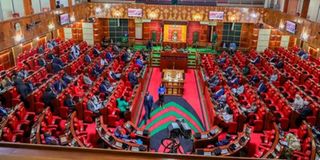
A National Assembly sitting in Nairobi. The Constitution of Kenya (Amendment) Bill, 2025, seeks to operationalise the two-thirds gender provision through a top-up mechanism

What you need to know:
- Kenya’s proposed Constitution (Amendment) Bill, 2025, aims to actualise the two-thirds gender rule through a top-up mechanism.
- A 20-year sunset clause that could end affirmative action, but supporters see it as progress, while critics warn the timeframe is too short to overcome deep-rooted barriers to women’s political participation.
Kenya’s long journey towards gender parity in political representation has taken a new turn with the Constitution of Kenya (Amendment) Bill, 2025, a proposal seeking to operationalise the two-thirds gender provision through a top-up mechanism.
Yet hidden within the Bill—widely referred to as the Gender Bill by legislators and legal experts—is a powerful but little-understood feature: a sunset clause that could eventually bring affirmative action measures to an end after 20 years. Parliament, however, may enact legislation to extend the period for one additional term not exceeding 10 years.
So, what impact could this clause have in the long term?

A sunset clause, constitutional lawyer Jacob Otachi explains, is a legal provision that automatically causes a law or policy to expire after a set period unless it is renewed. “A sunset clause is typically used to limit the timeframe or duration of an affirmative action or special measure,” he says.
In Kenya’s case, the drafters have set the duration at 20 years. After that, Dr Otachi notes, the gender top-up mechanism—designed to ensure women occupy at least one-third of elective positions—will expire unless Parliament decides otherwise.
At the root of the clause is optimism. Dr Otachi observes that the drafters anticipate that, after two decades, Kenyan society will have achieved gender equality in political representation, eliminating the need for affirmative action.
He further clarifies that the proposed law is not only about increasing women’s representation but also acknowledges that, in a fully empowered society, men could one day require a top-up mechanism should the gender balance shift. “The Gender Bill isn’t just about women seeking elective seats—the reverse could also occur in an empowered society,” he says.
However, not everyone is convinced this vision is realistic. Laikipia North Member of Parliament Sarah Korere argues that the 20-year timeframe is overly ambitious, given the structural and cultural barriers that continue to limit women’s participation in politics.
“It’s such a short time to expect women to have turned things around in 20 years. It’s not realistic,” she says.
Korere believes affirmative action measures such as nominations and top-ups remain essential because they serve as stepping stones for women entering politics. “If I was not nominated, my friend, I wouldn’t have seen any possibility of becoming a member of Parliament. But because I was given that stepping stone, even that small girl in my village in Doldol now sees the possibility that she can be anything,” she says.
The MP points out that the challenges women face in politics are still deeply rooted, with access to financial resources being the biggest obstacle—alongside political violence and exclusion within political parties.
“Campaigning for elective office in Kenya demands significant funding for logistics, party fees, and voter outreach, which many women lack,” she explains. “Kenyan politics is marred by a lot of violence, which really puts women off. Political parties are among the biggest stumbling blocks to women’s empowerment. They rarely give women proper support or opportunities to rise.”
For her, achieving gender balance is a long-term journey that cannot be rushed or confined to a 20-year limit.
Adding to her argument is the global reality that the timeframe for achieving gender parity has been revised upwards. The World Economic Forum’s 2020 Global Gender Gap Report projected it would take 100 years to reach full gender parity. By 2024, that estimate had widened to 123 years, largely due to global setbacks such as the Covid-19 pandemic, casting doubt on whether a two-decade clause is sufficient for Kenya to close its gender gap.
Furthermore, gender mainstreaming in Kenya remains heavily underfunded. In the 2022/23 financial year, an analysis by the National Gender and Equality Commission found that public sector institutions allocated just 0.08 per cent of their total budgets to gender mainstreaming—far below the commission’s recommended 1.5 per cent.
These figures highlight a mismatch between Kenya’s ambitions and its investment in gender equality. Should Parliament pass the Bill and President William Ruto assent to it, the sunset clause would set a ticking clock on affirmative action—raising the question: Will 20 years be enough to achieve parity, or will the sun set too soon on women’s progress?