History, slavery and the enduring scars of female genital cutting in Africa

Rose and razors for performing female genital cutting.

What you need to know:
- For centuries, slave routes from Africa reshaped societies and influenced enduring practices, including female genital mutilation.
- Historical records link Arab slave trading systems to the control of African women’s bodies and sexuality.
For 1,300 years, over 100 million slaves were trafficked from Africa to the Arabian Peninsula. Owning Black people as property left deep demographic, cultural, and psychological scars across the continent. In the centuries preceding the 1900s, African homesteads were raided; men, women, and children were captured, marched, and trafficked for hundreds of miles. Millions perished from hunger, dehydration, and exhaustion during these forced journeys.
The Arab slave trade had three routes. The Red Sea route captured Africans from the coast of Eastern Africa. Crowds of Black people were ferried from Sawakin (Sudan), Zayla (Somalia), Tajura (Djibouti), and Massawa (Eritrea). They were shipped to the transit town of Hijaz in Yemen before being ferried to the Arabian Peninsula and the Persian Gulf.
The trans-Saharan route captured people from nations presently known as Chad, Nigeria, Burkina Faso, Mali, Mauritania, Senegal, Gambia, Guinea, and Sierra Leone. They were brutally assaulted, savagely raped, and coerced to trek across the Sahara Desert to North Africa.


The Indian Ocean route trafficked people from the East African region (Kenya, Tanzania, and Uganda) to islands in the Indian Ocean (Reunion, Mauritius, Comoros, and Madagascar), and partly to the Arabian Peninsula.
Most slaves were teenage girls, with a male-to-female ratio of 1:2; 41 per cent of these girls were aged 13–15. Slave merchants used small ships to transport them to the Arabian Peninsula. The journey lasted a minimum of 13 weeks, and rape was common aboard.
During the Ottoman Empire in the Arabian Peninsula, one of the Sultan’s privileges was owning a group of women to quench his promiscuous thirst. Due to Islamic injunctions against the enslavement of Arab women, black girls from Africa were leveraged as war booty and concubines in the royal harems of Arabia.
African female genital mutilation (FGM) can be directly traced to the Arab slave trade. Arabs’ pre-industrial reliance on pastoralism, characterised by extended periods of male absence, created an environment of control over female sexuality, which led to the adoption of restrictive norms, including FGM. In ancient Arabia, mutilating the female genitalia was believed to lower sexual desire among women and restrict their roles to childbearing, emphasising obedience to male interests.
FGM became a custom enforced as a mark of virginity and a Sunnah concept of chastity and purity. There are four variants of FGM: clitoral hood removal; complete removal of the clitoris (clitoridectomy); removal of the entire clitoris and part of the inner labia; and the fourth and most invasive, infibulation (pharaonic circumcision).
The fourth involves complete mutilation and excision of the external genitalia, stitching of the vaginal opening, and leaving a minuscule hole the diameter of a matchstick as a passage for urine and menstrual blood. The stitched vaginal area may only be opened in adulthood by the survivor’s husband or “owner.” Infibulation was the earliest form of FGM. The infibulated vaginal area was held sacred, as a covert culture of sodomy became prevalent in Arabian society.
During the Arab slave trade, infibulation was forced on black girls aged 8–16 to prevent vaginal penetration. It resulted in the deaths of millions of African girls. It was used to impede conception during long slave journeys and to ensure chastity and loyalty to slave masters. Infibulated women had a higher value on the slave market, as the practice marked womanhood, purity, and signalled sexual fidelity.
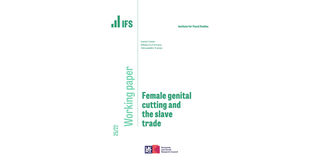
Cover of Female Genital Cutting and the Slave Trade.
Female Genital Cutting and the Slave Trade is an exposé and compilation of historical and ethnographic records that show how FGM was introduced to Africa. Current African countries with the highest rates of FGM are Somalia (99 per cent), Djibouti (97 per cent), Egypt (94 per cent), Eritrea (93 per cent), Sierra Leone (91 per cent), and Sudan (85 per cent). All these nations were primary “capture zones” for Arab slave traders.
Infibulation evolved into a cultural identity across African ethnicities, and its traits relating to virginity, purity, and beauty were eventually embedded in African traditions. Cultures in West, North, and Eastern Africa internalised and adopted variants of FGM. Clitoral hood removal, clitoridectomy, and removal of the entire clitoris and part of the inner labia were formalised by many communities, most of which adopted the harmful practice in line with their values and social structures.
FGM transformed into a status symbol of honour and prestige and denied black women sexual freedom. Presently, a staggering 65 per cent of African women have undergone FGM, and 12.9 per cent have experienced infibulation. Some 93.4 per cent of African FGM survivors belong to ethnic groups that encountered Arab slavery.
African regions with no Arab slave trade routes were not affected by FGM. In Southern African nations such as Zimbabwe, Botswana, Namibia, South Africa, and Lesotho, male circumcision is extensively practised by ethnic groups such as the Ndebele, Tswana, Zulu, Xhosa, and Basotho, but FGM is largely unknown. This is also evident in Central African nations such as Angola, DRC, Gabon, and Congo Brazzaville, which were not infiltrated by Arab slavery.
This report highlights how understanding the origins and diffusion of FGM is crucial to explaining its persistence and formulating policies for its elimination.
The writer is a novelist, Big Brother Africa 2 Kenyan representative and founder of Jeff's Fitness Centre (@jeffbigbrother).


