How Bundibugyo Ebola affects pregnancy and menstruation
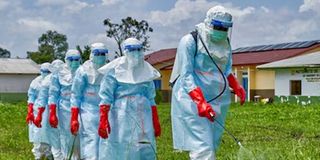
Red Cross workers disinfect Rwampara General Hospital in Rwampara outside Bunia, Ituri province, Democratic Republic of Congo, May 21, 2026. Kenya’s Bundibugyo Ebola outbreak raises concerns over women’s reproductive health.

What you need to know:
- Researchers warn that evidence from previous Ebola outbreaks links infection to miscarriage and menstrual irregularities, but the reproductive health risks of Bundibugyo Ebola remain uncertain.
- Medical experts say immune dysregulation following severe Ebola infection could affect pregnancy outcomes and menstruation, although further studies are needed to establish the biological mechanisms involved.
The World Health Organisation said on October 5, 2026, it had been informed of a laboratory-confirmed imported case of Bundibugyo Ebola virus disease in Kenya. The patient had travelled from the Democratic Republic of the Congo through Uganda. The Ministry of Health confirmed the first case on October 6.
Evidence from previous outbreaks shows the virus can cause adverse pregnancy outcomes and irregular menstruation among women who have survived the infection. A study published in the International Journal of Gynecology and Obstetrics found that 47.8 per cent of 29 women treated for Ebola at a hospital in Monrovia, Liberia, reported spontaneous abortion.
Of 105 women who had regular menstruation before infection, 29 per cent reported menstrual irregularities afterwards. The Zaire Ebola virus was the species responsible for the 2013 - 2016 epidemic in Liberia, which claimed 4,810 lives out of 10,678 confirmed cases.


Immune dysregulation
Now that Bundibugyo Ebola virus has arrived in Kenya, what could this mean for women?
Marianne Mureithi, professor of Medical Microbiology and Immunology, says research from previous outbreaks has raised concerns about reproductive health problems among women who survive Ebola. But, she says, there is not enough evidence to establish whether the same complications will occur among women recovering from Bundibugyo Ebola.
Prof Marianne says the reproductive health changes observed in previous outbreaks could be linked to immune dysregulation following severe Ebola infection. “The most likely explanation is that the immune dysregulation may trigger either unsuccessful pregnancy outcomes or upset normal periods,” she says.
She explains that severe infection may trigger inflammatory or immune responses that influence reproductive physiology and disrupt the immunological environment required for a successful pregnancy. However, she cautions that the available research does not definitively establish that Ebola causes these complications.
Also read: Why Ebola survivors need semen testing
Although the findings from the Liberia study are concerning, she says a larger sample size is needed to establish whether the changes are directly linked to the infection. The research in this country involved Zaire Ebola virus, a species different from Bundibugyo Ebola virus detected in Kenya.
Prof Marianne says more studies are needed to establish whether women recovering from Bundibugyo Ebola will experience similar reproductive health complications. “We cannot confidently say that Bundibugyo affects women's reproductive organs differently from the Zaire Ebola. We do not have enough research comparing the two as yet,” she says.
How long can the virus persist after recovery?
Prof Marianne says recovering from Ebola and completely clearing the virus from the body are different things. Studies from previous outbreaks have detected the virus in the semen of male survivors almost a year after they recovered and returned to their daily lives, she says.
She says survivors are advised to follow safe sex practices and undergo follow-up testing every three months. Two consecutive negative polymerase chain reaction tests are required to establish that the virus has been cleared, she says
For women, however, there is less information about how long the virus may persist in the ovaries, vaginal tract or other parts of the reproductive system, she says.
Breastfeeding mothers
She says there is no convincing evidence that a woman who has fully recovered will transmit Ebola to her baby through breast milk. Or that a future pregnancy could result in a baby born with the virus. More data are needed to establish these possibilities, she says.
Prof Marianne explains that the main difference between the Bundibugyo, Zaire and Sudan Ebola species lies in the severity of outbreaks and death rates.
She says Zaire Ebola has been responsible for the largest and deadliest outbreaks in West Africa and the Democratic Republic of the Congo.
According to the US Centers for Disease Control and Prevention, Sudan Ebola virus causes death in about 50 per cent of people who get sick with the disease. This virus, it says, caused several outbreaks in Uganda and near the border between South Sudan and DRC.
Bundibugyo virus is the most recently discovered type of orthoebolavirus. It was discovered in 2007 and causes death in about 30 per cent of people who contract it. It was associated with two large outbreaks, one in DRC and the other on the border of DRC and Uganda.
She says vaccines and treatments are available for Zaire Ebola, but Bundibugyo Ebola does not yet have an approved vaccine or treatment. Researchers, she says, are studying the virus and evaluating vaccine candidates to understand its structure and how vaccines may respond to it.
Miscarriage versus biological mechanisms
On the other hand, Walter Jaoko, Professor of Medical Microbiology and Tropical Medicine, says researchers have observed an association between Ebola infection and miscarriage but have not established the precise biological mechanisms responsible. “Nobody really knows why,” he says, adding that establishing a causal relationship requires further research.
He explains that observing higher miscarriage rates among women infected with Ebola does not, on its own, establish why the miscarriages occur. Researchers would need to investigate whether the infection affects reproductive health at the hormonal level or through other mechanisms, he says.
Why menstruation can become dangerous
Prof Jaoko says the effect of Ebola on women during menstruation can be explained by the disease's tendency to cause bleeding that is difficult to stop. “Ebola is a haemorrhagic fever, which means it causes fever and bleeding,” he explains.
“If you have any cuts, they can continue bleeding for a long time. During menstruation, the lining of the uterus sheds, and so it is like a wound. When you have Ebola, the bleeding may continue because the blood does not stop easily. That is where it disproportionately affects women during their menstrual period. Normally, the body stops bleeding on its own, but menstruation becomes a problem because of the difficulty in stopping the bleeding.”
However, Prof Jaoko says it is difficult to quantify how much menstruation increases the risk of death among women infected with Ebola.
Recovery varies
He says the length of time Ebola remains in the body after recovery varies between individuals. “Follow-up studies have found that the virus can persist in semen for different periods, with some men clearing it soon after recovery while others continue to test positive for weeks or months,” he says.
He says almost all men followed up during the first three months after infection have been found to have Ebola virus in their semen. And the proportion declines as time passes. A small proportion of men have been found to have persistent virus for longer periods, with Prof Jaoko citing figures of about four per cent lasting up to one and a half years.
He says these findings demonstrate the importance of longitudinal studies, in which researchers repeatedly test survivors over time to establish how long the virus persists. For women, the effects of Ebola on reproductive health after recovery remain uncertain, and Prof Jaoko says further research is needed.
Women face greater stigma after recovery
Beyond the direct effects of the infection, Prof Jaoko says stigma can affect the long-term sexual, reproductive and social lives of women who survive Ebola. He says women who recover from the disease may face rejection from male partners, affecting their relationships and social well-being.
He draws a comparison with HIV, where women often experience greater stigma than men living with the infection. “Men with HIV also experience stigma, but it is not as much as women. You find that a man can still live and marry,” he says.
Prof Jaoko says the unequal treatment of women who survive Ebola is not unique to the disease but reflects broader social attitudes in many African societies.


