How childhood struggles shaped Ilhan Omar’s political rise to US Congress
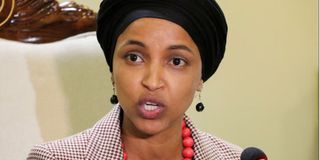
US Representative Ilhan Omar during her visit to Muzaffarabad, Pakistan-administrated Kashmir, Pakistan, April 21, 2022.

What you need to know:
- From refugee camps to political office, Ilhan Omar’s journey shows how hardship can forge unstoppable strength and ambition.
- Battling hunger, displacement and prejudice, Ilhan Omar rose from Somalia’s chaos to break barriers in US politics.
Ilhan Omar’s mother died when she was a preschooler, but her older sisters and loving aunts ensured she never lacked feminine affection. As a seven-year-old petite girl in Somalia’s capital, Mogadishu, Ilhan was bold and combative, relishing her fights against male bullies.
Her father, Aabe, was a well-read educator with a razor-sharp memory who never wavered in his convictions. He was enlightened and dismissed the Somali custom that only the birth of a boy was a moment of pride. When Ilhan was born on October 4, 1982, her father was pleased and refused to see her as a burden simply because she was a girl.


Ilhan was eight years old when civil war broke out in Somalia. President Mohammed Siad Barre, who had controlled the central government for more than two decades, was ousted in January 1991 by the United Somali Congress and the Somali Salvation Democratic Front. By November that year, the clan factions within the coalition had taken up arms against one another and soon plunged the country into anarchy.
Ilhan’s father descended from the Majerteen clan in northern Somalia. They became targets when the coalition disintegrated. One terrifying night in 1992, Ilhan’s neighbours, mostly from the Hawiye clan that was ethnically cleansing the Majerteen, tried to break into their home by firing at the bolted doors. They swore to return after their failed attempt. The following day, Ilhan’s entire family fled Mogadishu.
Ilhan saw human corpses scattered on the streets as she boarded a cattle lorry with her pregnant aunt, Fos, on what was the most uncomfortable journey of her life. An elderly woman lay on top of her for most of the trip, and they were stopped at extortion roadblocks by gun-wielding militants.
In the coastal town of Baraawe, deafening gunshots filled the air, sending the passengers fleeing in fear. Ilhan and Fos slept on the beach, and at dawn on their second day, she was relieved when her father found them. They began another lorry journey to Kismayo. It was Ilhan’s first experience of extreme hunger as food blockades meant they went days without eating.
From Kismayo, most of Ilhan’s relatives trekked 500km across the Kenyan border, while Ilhan and her father, too weak and fatigued to walk, boarded a light aircraft used to smuggle contraband shrimp. The pungent smell of rotting seafood overwhelmed Ilhan as she battled with motion sickness.
The plane landed in a desert, and they walked to Utange Refugee Camp, five kilometres west of Mombasa Port, where they set up a tent gifted by the Red Cross. At Utange Camp, hidden dangers extended beyond malnutrition. Malaria, dysentery and respiratory diseases were rampant, and refugees died daily, buried in makeshift graves—including Ilhan’s pregnant aunt, Fos.
Her father began seeking documents to relocate his family to the United States. He registered with the United Nations High Commissioner for Refugees and waited years for a determination under the US Refugee Admissions Programme.
After four years at the camp, Ilhan’s family of seven passed their initial screening and were granted passage to the United States. A charity organisation, Catholic Charities, arranged their stay in Arlington, Virginia. They boarded a plane bound for New York City, full of Sudanese, Rwandan and Ethiopian refugees.
From New York, they flew to Washington DC and rode a bus to Arlington. They moved into a two-bedroom flat and applied for social security cards. In middle school, Ilhan struggled with English, and started physical fights when mocked.
Her frequent scuffles landed her in detention for most of her sixth-grade year, where she became known as “the child who fights”. Yet, the long hours of study during detention turned her into an A student, and by seventh grade, she was fluent in English. After eighth grade, her father moved the family from Arlington to Minneapolis, Minnesota, home to the largest Somali population in the US.
Ilhan joined Edison High School, which had even more altercations than her previous school. It had a coalition called Unity in Diversity to ease racial tensions. After finishing high school, she enrolled at North Dakota State University in Fargo, earning a BA in International Studies and a BS in Political Science.
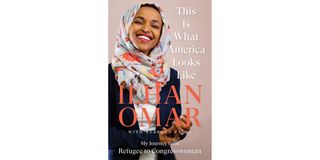
The cover of Ilhan Omar's memoir, This Is What America Looks Like: My Journey from Refugee to Congresswoman.
In her memoir, This Is What America Looks Like: My Journey from Refugee to Congresswoman, she recalls being among those hardest hit by the 2008 financial crisis, which evolved into the worst recession since the Great Depression.
Her hard-earned qualifications suddenly seemed insignificant, leaving her disillusioned and angry—emotions that fuelled her entry into politics. On October 10, 2015, Ilhan launched her campaign to represent District 60B in Northeastern Minneapolis. On August 6, 2018, she was declared the victor, becoming the first Somali-American in the US Congress and the first black woman to represent Minnesota.
The writer is a novelist, Big Brother Africa 2 Kenyan representative and founder of Jeff's Fitness Centre (@jeffbigbrother).