How gender-responsive procurement is opening doors for women entrepreneurs in Kenya

Entrepreneurs Rebecca Cherop (left) and Beryl Odhiambo. They are beneficiaries of gender-responsive procurement training.

What you need to know:
- Despite the 30 per cent Agpo rule, women entrepreneurs still face cultural and financial barriers in securing contracts.
- Women business owners say gender-responsive procurement training is helping them compete in male-dominated industries.
When Rebecca Cherop registered her own construction company in 2009, she did not initially think it would be such a difficult task to secure business. However, being a woman in a male-dominated field within a largely patriarchal community, Rebecca’s journey to becoming a recognised contractor in West Pokot has not been a bed of roses.
Rebecca tells the Nation that Pokot culture is characterised by a great deal of gender stereotyping, with women often viewed as children and therefore unfit for the construction industry. “In some forums, men verbally attack us, saying they do not know what women are doing in the construction industry instead of being in the kitchen,” she says in an interview.

Rebecca Cherop looks on as a welder works at an upcoming women’s hospital in Kapenguria town on April 9, 2026.


She says things become even more difficult when trying to secure a share of government construction contracts. “There is stiff competition for government contracts and even those in the private sector, with women disadvantaged. Securing some of the contracts requires a contractor to have deep pockets, something many women contractors lack.”
The contractor notes that financial stability is paramount in securing some of the contracts and undertaking construction work, which is capital-intensive. However, Rebecca has reason to smile following the introduction of gender-responsive procurement in both the government and private sectors, which she terms a game changer.
She is a beneficiary of the UN Women Kenya-supported United Arab Emirates Strategic Partnership Framework (UAE-SPF). The programme supports women entrepreneurs through targeted capacity-building on gender-responsive procurement (GRP), women’s empowerment principles, and access to finance and trade.

Rebecca Cherop plasters a wall at an upcoming women’s hospital in Kapenguria town on April 9, 2026. Rebecca is one of the few women contractors in West Pokot.
For her, the training in e-procurement by UN Women was an eye-opener, as it helped her secure several business opportunities. “Before the training, I did not know anything about e-procurement. However, through the training, I was able to register for Access to Government Procurement Opportunities (Agpo), where another woman contractor and I have won at least two contracts.”
She notes that despite the rule requiring 30 per cent of public contracts to be awarded to women, youth, and persons living with disabilities, women still find it difficult to secure contracts. She is calling on both the national and county governments to support women contractors and ensure adherence to the 30 per cent rule under Agpo. “Women entrepreneurs have what it takes to deliver whatever work they are given. All they need is an opportunity and a level playing field in the business environment.”
Projects won
One of Rebecca’s flagship projects is a women’s hospital in Kapenguria, which is now 80 per cent complete after construction began in 2023. The hospital has facilities such as laboratories, consultation rooms, and four delivery rooms. It also boasts two delivery theatres, newborn units (nurseries) with a capacity of 40 beds, maternity wards, X-ray rooms, a gynaecology ward, a four-bed intensive care unit, and offices.
More than 400km away in Nairobi, we find Beryl Odhiambo, another beneficiary of gender-responsive procurement and founder of Bellyz Organics. She has transformed her peanut butter venture from a small kitchen experiment into a growing, compliant enterprise. Beryl says her turning point came after attending GRP training under the UN Women Kenya programme.
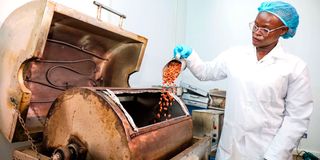
Beryl Odhiambo, the founder of Bellyz Organics, a women-led agribusiness venture that produces and sells high-quality, natural peanut butter, during an interview at the production facility in Vishnu Industrial Park, Ruiru, on February 12, 2026.
The training, she observes, equipped her and other women entrepreneurs with practical knowledge on certification standards, procurement compliance, product customisation, and access to contract portals. “We were trained on the certifications needed, the standards required, and how to tailor products to both local and international markets,” she says. “If I had not attended the training, I would not understand what is needed to access procurement opportunities.”
When she started Bellyz Organics in January 2023, she had just three kilogrammes of peanut butter. Today, she produces up to 100kg a month. The growth, she says, has been slow but steady. “Currently, we can produce up to 100 kilos a month. Some days we do 10 kilos, some days 20; it depends on customer flow.”
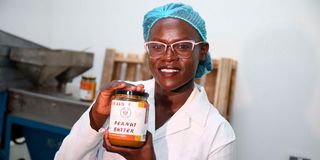
Beryl Odhiambo, founder of Bellyz Organics, a women-led agribusiness venture dedicated to the production and sale of high-quality, natural peanut butter, during an interview at the production facility in Vishnu Industrial Park, Ruiru, on February 12, 2026.
Her brand targets health-conscious consumers seeking natural, minimally processed products. Bellyz Organics produces plain peanut butter, peanut butter with sesame seeds, peanut butter with pumpkin seeds, and roasted peanuts, all with zero additives. She operates production facilities in Nairobi and Ruiru.
Business visibility
Beyond procurement readiness, the training opened doors to visibility for her business venture. She says that at the Changamka Festival, an event supported by UN Women, she sold out her entire stock of 250kg of peanut butter. Today, Bellyz Organics generates about Sh50,000 monthly, rising to Sh100,000 during peak seasons. The business employs two casual workers and also pays her a salary.
Antonia N'Gabala Sodonon, the UN Women representative in Kenya, says her organisation is committed to enhancing women’s economic empowerment and helping achieve gender equality. She says strengthening women’s economic empowerment is crucial to reducing structural inequalities and achieving sustainable and inclusive development.
“Gender-responsive procurement creates enabling ecosystems for women entrepreneurs and women-owned businesses to thrive, compete, and drive economic development. The UAE-SPF programme therefore provides momentum by expanding economic opportunities for women entrepreneurs in Kenya, including through making procurement policies and practices more gender-responsive.”
For many women entrepreneurs in Kenya, breaking into public procurement, accessing regional markets, securing business registration and certification, and unlocking affordable finance remain uphill tasks. Structural barriers, from limited collateral to opaque bidding systems, continue to exclude women-led enterprises from opportunities.
County record
Stephen Kapel, the head of procurement in West Pokot, says the county has met the Agpo threshold, with 14 per cent of all contracts assigned to women. He notes that women make up the majority of suppliers in county hospitals, as well as hospital and road contractors. However, he says women have faced challenges following the decline of LPO financing of tenders by banks, which has locked many out.
He emphasises the need for sensitisation to gender-sensitive procurement, including Agpo, to make more women aware of their rights and the opportunities available to them. “As a county, we are currently not doing badly, though much still needs to be done. We have, however, been facing challenges with e-procurement, which is web-based, locking out women because of lack of internet access.”
He advises women not to shy away from government contract opportunities, saying gender-responsive procurement is an important tool for achieving gender equality in procurement. Women-led businesses secured Sh33.1 billion in government contracts in 2024/25, accounting for 58.3 per cent of the total value awarded under the reserved Agpo programme.
Despite these gains in reserved contracts, women continue to face structural challenges in accessing the broader Sh1.6 trillion public procurement market. State corporations awarded the highest volume, issuing Sh15.5 billion in Agpo contracts to women, followed by state ministries at Sh5 billion.
Although the Agpo initiative reserves 30 per cent of all public contracts for women, youth, and persons with disabilities, UN Women data indicates that women-led enterprises still secure only about 18 per cent of government contracts because of entrenched cultural and structural barriers.
Gender-responsive procurement helps women entrepreneurs by levelling the playing field in competitive supply chains. By promoting supplier diversity, gender-responsive procurement provides women-led businesses with reliable market access, financial empowerment, and opportunities to scale their enterprises beyond micro-businesses into formal, resilient companies.
Major private sector entities are also adopting gender-inclusive sourcing to close the gender gap in supply chains, including initiatives such as Sourcing2Equal Kenya, implemented by the International Finance Corporation.