How one acre and a widow’s resilience transformed farming in Homa Bay
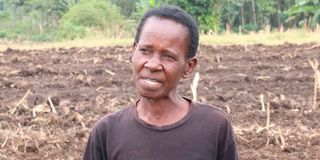
Rose Amenya in Wahambla village, Homa Bay County, on August 8, 2025. She has transformed crop farming in her village.

What you need to know:
- After her husband’s death, Rose Amenya turned to farming, inspiring her Homa Bay village with knowledge.
- The widow has transformed despair into resilience, teaching farmers modern methods to boost Homa Bay yields.
Rose Amenya’s phone hardly ever rests. One morning, a farmer in Wahambla calls her in distress. His crops have developed yellow leaves, and with little agricultural knowledge, he has no idea what to do. Before she can get to his home, another text pings in. This time, it is a farmer from a neighbouring village whose collard greens have stunted since transplanting.
Within hours, Rose has visited both farmers and offered practical advice on how to restore their crops. Later, back at her home, she scrolls through more messages from farmers across Homa Bay Town East. In her community, she is fondly called Trainer of Trainers (ToT), the go-to person for struggling farmers seeking help.
Rose is not an agricultural officer by profession, but her knowledge makes her one of the most trusted sources of farming expertise in the region. Her journey began in 2001 after the death of her husband. Left to raise three children of her own, and later another four from her late co-wife, she turned to farming as her only hope for survival.

“Farming was the only way I could put food on the table and take my children to school,” she recalls.
What started as a necessity has over the years grown into her life’s mission. Rose has mastered modern crop production practices, fought hunger in her community, and become a focal point for the county’s agricultural extension programmes.
Through workshops organised by the government and farmers’ groups, she has sharpened her skills, learning new methods she now teaches others. Her work aligns directly with global efforts to end hunger and poverty through the Sustainable Development Goals (SDGs). Yet, she acknowledges the challenges Homa Bay faces—from financial constraints to limited technical expertise in SDG implementation.
“In the past, most farmers used traditional methods like cultivating only with hoes or reusing seeds from previous harvests. This reduced yields drastically,” she explains.
Determined to change this, Rose invested her energy in her late husband’s one-acre farm near Rangwena Bridge on the Homa Bay–Kendu Bay road. She now produces a wide variety of crops, supplying both individuals and institutions. “I have transformed the way people in my village think about farming. Many had lost interest, but now they see the benefits,” she says.
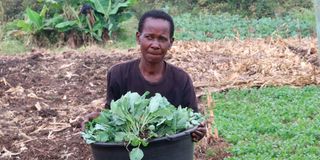
Rose Amenya on her farm in Wahambla village, Homa Bay, on August 8, 2025.
Her turning point came when she joined professional farming groups and later partnered with nongovernmental organisations for training. Recognised for her ability to explain complex concepts in simple language, the county government appointed her as a ToT. Her role mirrors that of an extension officer, helping farmers adopt certified seeds, irrigation, and mechanisation.
“I encourage farmers to form groups and register them so that they can access loans and support. In my village, we have even bought water pumps for irrigation,” she says proudly.
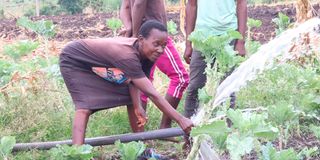
Rose Amenya irrigates her farm in Wahambla village, Homa Bay, on August 8, 2025.
Rose now serves as the organising secretary of Wahambla Farmers’ Group, which has 54 members growing collard greens, tomatoes, and coriander. They draw water from River Rangwena, ensuring year-round production.
During training sessions, she guides farmers on crop rotation, organic farming, pest control, and even market surveys. To beat price fluctuations, she sells her crops on contract to two schools, each purchasing at least 80 kilogrammes of collard greens weekly at Sh50 per kilo.
“Contract farming protects me from price drops that usually follow high production seasons. It gives me stability,” she explains.
Her farm is neatly divided into sections for different crops, a demonstration of the practices she teaches others.
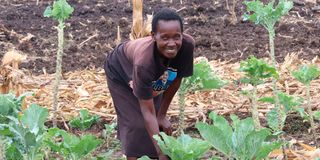
Rose Amenya harvests vegetables on her farm in Wahambla village, Homa Bay, on August 8, 2025.
Homa Bay County Agriculture Director Erick Adel confirms that the county is working closely with farmers like Rose to boost food security. “We support them with certified seeds, drought-resistant crops, and climate-smart agriculture to align with the bottom-up economic transformation agenda,” he says.
With over 255,000 farmers registered under the Kenya Agricultural Information Management System, the county hopes to replicate Rose’s model of resilience and innovation.
For Rose, however, the mission is personal. “I will continue learning and sharing knowledge so that farmers in my village never go hungry,” she says with quiet determination.


