I thought I would be next: Why this young woman refuses to let political violence silence her
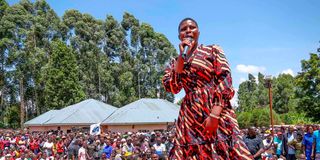
Agneta Mwangale, a 24-year-old Bungoma Woman Representative aspirant and supporter of the Linda Mwananchi movement, was attacked by youths armed with machetes, axes and stones during a rally in Homa Bay on August 16, 2026.

What you need to know:
- Agneta says witnessing the killing of the security aide and surviving the attack has left her deeply traumatised. She is currently undergoing trauma counselling.
- Nevertheless, the attack has not diminished her determination to contest the seat. She is candid, however, about the challenges of pursuing political office without financial resources.
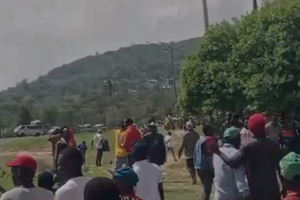
Agneta Mwangale recalls the moment armed youths surrounded the vehicle she was travelling in as it headed to a Linda Mwananchi rally in Homa Bay on August 16.
The 24-year-old is vying for the Bungoma Woman Representative seat in next year’s general election and supports the Edwin Sifuna-led movement.
She says the group that surrounded them numbered in the hundreds. She had travelled from her home county of Bungoma and says she was unfamiliar with Homa Bay and could not identify the exact location.


Some carried machetes, she says, while others wielded axes and stones.
“They wanted to know who was inside the vehicle and why we had come to the area,” she says.
Terrifying lesson
Agneta was travelling with a female friend, a driver and two men assigned to provide security, although one had stepped out of the vehicle at some point.
What followed, she says, was a violent attack in which a security aide from Homa Bay, who had remained in the vehicle, was killed. The driver was injured, while Agneta and her friend were caught up in the violence.
“We told them we were not there to fight. They were not listening,” she says.
Agneta says she joined the movement to support its activities and gain a firsthand understanding of how political campaigns and rallies are organised.
The horrifying experience left her with a terrifying lesson: in politics, death is closer than you can imagine.
Warning signs
There had been warning signs, however. About a week before the rally, she recalls, some people made remarks on social media that she describes as provocative and inflammatory.
Then, two days before the event, they were advised not to travel to Homa Bay because the political atmosphere was unfavourable.
They instead travelled to Kisumu, where they spent the night before heading to Homa Bay the following morning.
After breakfast, they joined the day’s activities. Their first stop went smoothly, and Agneta recalls receiving a warm reception. But she says she had a nagging feeling that something was wrong and chose to return to the vehicle.
They later set off for another venue.
The roads were difficult to navigate, she says, with stretches disconnected from the main road. It was along one of those routes that they encountered the armed youth.
“They smashed the windows with machetes. As they shattered the rear window next to where I was sitting, I suffered a deep cut from the machete on my left arm near the elbow,” she narrates.
“By then, they had already dragged the driver out of the vehicle and slashed his leg. They also attacked the security aide, cutting his neck. He died on the spot.”
Agneta says they struck her on the back of the head and slashed her back repeatedly, leaving her with multiple cuts.
The daring escape
“My heart was racing. I thought I would be the next person to die because my female colleague had already been released after showing them photographs she had taken with Raila Odinga,” she says.
“I knew I had to save myself. I took off and ran as fast as I could. They chased me for some distance before giving up. I eventually found refuge in a homestead, where I spent the night.”
Agneta says she was so shaken by the ordeal that she could not even remember any emergency contacts to call for help.
The family that took her in for the night came to her aid by posting a plea for help in the comment section of a fellow Linda Mwananchi member’s Facebook page. The message was deleted shortly afterwards for fear of attracting further attacks, but they hoped someone had already seen it.
Fortunately, the colleague spotted the message and helped coordinate her rescue. She was then taken to hospital for treatment.
Trauma counselling
Agneta says witnessing the killing of the security aide and surviving the attack has left her deeply traumatised. She is currently undergoing trauma counselling.
Nevertheless, the attack has not diminished her determination to contest the seat. She is candid, however, about the challenges of pursuing political office without financial resources.
“I am struggling, of course, coming from university, not earning anything and not having a very strong background. It is a challenge. Sometimes I do not even have money to move around, whether on a motorbike or using public transport,” she says.
Agneta graduated from Moi University in 2025 with a degree in linguistics, media and communication.
Connecting with voters
Her campaign relies largely on small contributions from well-wishers and family members. She does not believe a candidate needs millions of shillings to connect with voters.
“I do not need millions to go around and campaign. My politics is very sustainable, though I cannot sustain it fully because I am not working. The little support I get from people and my family is what keeps me going,” she says.
She travels from one constituency to another using public transport and says her approach is to engage directly with residents rather than hand out money.
Sometimes, she says, she visits schools carrying one or two boxes of sanitary towels to distribute to pupils.
Her interest in politics, she says, has also been shaped by the challenges facing young people in Bungoma.
She wants greater attention paid to unemployment, access to education and opportunities for young people with technical and vocational skills.
“Nobody is talking about industries, nobody is talking about employment, nobody is talking about creativity,” she says.
“And not just not having anything to do. We also don’t have hope because there is nothing to do. Those are things that really touch my heart, because these are people that I interact with one-on-one.”
Greater support for teen mothers
Agneta says she understands how poverty can prevent bright students from progressing to university. She recalls meeting students who achieved strong examination results but were unable to join university because their families could not afford the costs.
She also wants greater support for girls who become pregnant while still in school.
“Recently, there was a school with 36 girls who were pregnant. Imagine 36 girls in one school. This is a crisis. It is part of the triple threat facing girls, and something urgent must be done,” she says.
For young people trained in fields such as fashion and design, plumbing, electrical work and engineering, she proposes creating opportunities for them to work together on projects within their communities.
The sacrifices versus stereotypes
She questions the persistent assumption that young women entering politics only advance because of their relationships with established male politicians.
She says she is an example of how young women build their own brands through hard work and significant personal sacrifices to be seen and heard.
“When I was on campus, I would travel to Bungoma to attend functions such as burials and return the same day or the following day. Those are the kinds of sacrifices I had to make to ensure my name, my support base, and my political journey survived,” she says.
“But nobody sees that. Instead, people only want to focus on the men around me.”