In Siaya’s mining villages, women rise through flour and fire
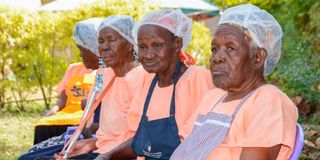
Grace Okungu (right), Eber Chiao Owalo (second right) and colleagues during a meeting on their local initiative aimed at improving livelihoods in Kametho, Asembo, Siaya County, on January 22, 2026.

What you need to know:
- Under Motisha A Dada, a community-based organisation, these rural women create an alternative livelihood to meet their family needs, thus ending over-reliance on their husbands.
- By January this year, Motisha A Dada had trained more than 100 beneficiaries attached to 10 different women’s groups, which further encourages members to share the skills with other locals.
For one visiting Kametho in Siaya County, the sight of active gold mines dominated by both men and women can barely go unnoticed.
Around the mines in West Asembo are women covered in dust, sieving what we later come to understand is gold. The dry land is also characterised by a number of empty quarries, a clear indication of just how long the economic activity has been in existence in the area.
A few kilometres from the mines are green cassava plantations, some ready for harvest, a complete contrast of the mines. It is here that members of Motisha A Dada (Swahili for motivate a sister), a community-based organisation (CBO) supporting rural women, created an alternative livelihood.


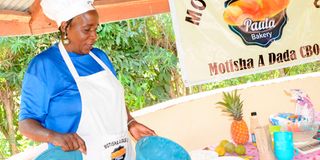
Pauline Odongo, 51, founder of Motisha A Dada, at Kametho, Asembo, Siaya County, on January 22, 2026.
When we catch up with the group on a Tuesday morning, the members, both young and old, are already in their cake-baking classes. “First, we need to wear our head nets and wash our hands to avoid contaminating the cakes,” says 51-year-old Pauline Odongo, the group founder who doubles up as the baking class trainer.
Once done, the group of six women assign each other roles, one mixing a solution of sugar and oil, two others sieving cassava flour, while another breaks three eggs. The members gently mix together the ingredients while revealing that the cake, unlike others made of wheat flour, is prepared using cassava flour, a readily available ingredient in the village.
One of the women rushes to preheat a homemade metal oven using an energy-saving traditional stove. Once the cake mixture is uniform, it is transferred to a baking tray before being moved to the already preheated oven. “In less than 40 minutes, our cassava cake will be ready for consumption,” says a smiling 74-year-old Eba Owalo.
Maize farming
For the elderly women, baking has not only presented an opportunity to consume a healthy meal but also a platform to interact and earn a living from available crops. During an interview, Eba would go ahead to reveal that for a long time, she had been a maize farmer but not until the fallout from climate change struck.
Initially, a one-acre farm would provide her with maize, produced in two seasons to support her orphaned grandchildren. Part of the harvest, she says, would be channelled towards meeting the children’s school needs.
For the last couple of years, however, the production has greatly reduced; many times, the maize plants would end up struggling with stunted growth. When the harvesting season would approach, the farm had almost nothing to feed her three grandchildren.
She would later resort to millet production, but again, the market was not sustainable. Moreover, her family could not completely depend on the crop as the sole source of food. “Times became hard over the years, while my village is known for gold mining, I could not engage in the same because of my advanced age,” Eba says.
Game changer
Two years ago, however, the elderly woman’s life took a major turn after she joined Motisha A Dada. She says she had bumped into a cassava cake made by the group’s founder in one of the shops and requested to know where she could learn how to make them.
“The range of lifestyle diseases the world is currently struggling with does not allow us elderly people to eat unhealthy food. One thing I loved, however, was the fact that the cakes were made using cassava, a crop I have enjoyed eating right from childhood,” she says.
She would later be introduced to the group. She joined 20 other women to learn about cassava and sweet potato production. She was then enrolled in baking classes. It is here that Eba learnt to bake both cassava and sweet potato cake, the other ingredients, she says, were also readily available.

Queen cakes prepared by women participating in the community project promoting livelihoods and economic empowerment in Kametho, Asembo, Siaya County on January 22, 2026.
“Had someone told me I would be making cassava and sweet potato cakes in old age, I would have dismissed them, but here I am, doing exactly what I thought I could never do,” she says, smiling.
With the skills, it is upon her to decide when to cook a whole cassava, grind some for cooking flours or bake a cake. The earnings from the farm, she says, is then channelled to meeting household needs.
Financial independence
Silvia Otieno, a resident of Kochieng in Asembo, however, tells a rather different story. The 56-year-old says for years, she heavily depended on her husband for income, a practice that often resulted in household squabbles. “We would have fights, especially when he came home with nothing. At times I would feel guilty because I lacked a source of income,” she says.
Silvia joined the group three years ago in her quest for financial stability and growth. She has since mastered the art of cake baking and cassava growing is now her major source of income. Cassava remains one of the best crops to farm in her village because of its ability to survive short rains. The crop also requires minimal maintenance, allowing her to engage in other income-generating activities.
Once mature, part of the harvest is peeled, washed and dried in the sun for three days, she says. The product is then ground to produce flour, which can either be used in cooking ugali or baking.
“I also sell the cassava to women engaged in large-scale production of cakes to maximise my earnings,” says Silvia, admitting that she now actively supports her husband to meet family needs.
Pauline says she founded the CBO in 2020 after realising that a number of women in the village had been left stranded without an income. On most occasions, whenever she travelled back to her home in Asembo, a number of women would visit her, with a majority “asking for sugar”.
“Giving them money each time was never sustainable, but I had yet to figure out how to help women,” she says.
The former nurse eventually relocated to the village and while at it, she would bake wheat cakes, which were sold to locals. One of her biggest challenges, however, was that the raw materials for baking could only be assessed in Bondo town and Kisumu, kilometres away.
Pauline says having previously tried cassava cakes, she decided to get the produce from her farm. The first to taste the cakes was her mother-in-law, who got impressed and shared the products with her friends.
Over time, the demand for the cakes kept growing while cassava was not easily accessible. “A number of women had also expressed their desire to learn the new skill,” she says.
It was during the same year that she embarked on training the first cohort of 20 women in cassava and sweet potato production. The idea was timely because the women who relied on farming were also complaining about dwindling produce due to a change in rainfall patterns. Cassava and sweet potatoes, on the other hand, were drought-tolerant crops with a promising output.
As the crops matured, the women embarked on learning value addition and different techniques of preparing the two crops. “The ripe cassava can either be boiled or consumed, fried, ground into flour to make ugali or baking,” says Pauline, adding the crop can as well be sold.
Pauline would later take the students through baking classes using readily available ingredients. Upon graduation, another cohort was admitted to the programme free of charge. Her efforts would eventually bear fruit when in 2022 she was awarded the Women on Boards Network Award Winner for supporting grassroots women.
In 2024, Motisha A Dada successfully applied and received a $5,000 grant from the Tony Elumelu Foundation Entrepreneurship Programme. The cash was channelled towards buying bakery equipment and mentoring rural women in an effort to mitigate negative effects of climate change.
“I went through entrepreneurship training for a year before receiving the award to proceed with the programme,” she says.
The Ms President Season 2 finalist says with the help of the funding, she has trained more rural women and girls with the aim of addressing food security. Her target trainees range from girls aged 15 years to elderly women.
Pauline says besides fighting food insecurity, her programme has also made a huge step in reducing cases of teenage pregnancies and early marriages. This, she says, has been possible through learners’ engagement during school holidays, thus leaving no space for peer pressure.
Beneficiaries
By January this year, Motisha A Dada had trained more than 100 women attached to 10 different women’s groups. Once trained, they are encouraged to share the skills with other locals. “To ensure they do the same, I always encourage the women to invite me to their baking class graduations,” Pauline says.
Their products are sold in shops and schools. Pauline hopes they will expand their supplies to supermarkets in the near future.
Sarah Owalo, a treasurer from Kametho Women Shiners, one of the 10 groups affiliated to Motisha A Dada, says they are also actively involved in table banking. Each week, they save at least Sh200. Members borrow and pay back with a 10 per cent interest.
“Baking has been a major turnaround for us. With only Sh200, we are able to earn Sh700 and channel part of the interest to the savings account,” she says.
Pauline is looking forward to constructing a bakery school on a parcel of land donated by her father-in-law with the aim of admitting more women and girls to the programme.


