Inside Sierra Leone’s busiest maternity hospital as aid cuts bite
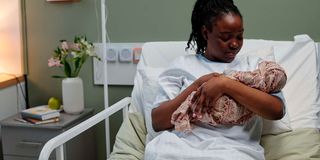
A mother carries a newborn. Across the world, Sierra Leone is one of the poorest countries and depends heavily on foreign aid to fund essential services, including in healthcare.
What you need to know:
- Aid cuts from major donors threaten Sierra Leone’s fragile progress in reducing maternal deaths and improving newborn survival.
- Hospitals face shortages of vital supplies as funding reductions put mothers and newborns at growing risk.
- Sierra Leone seeks new financing solutions after sudden aid cuts jeopardise maternal healthcare gains nationwide.
Sonita Kamara is in obstructed labour, a life-threatening complication where the baby cannot pass through the birth canal despite strong contractions. She is rushed to Princess Christian Maternity Hospital in Freetown, the busiest maternity and newborn hospital in Sierra Leone.
Her baby is in distress. “If we don’t operate within 30 minutes, the baby might die,” says Dr Rosetta Cole, senior obstetrician-gynaecologist, as she prepares to perform an emergency caesarean section.
But the operation cannot begin. The hospital has run out of basic surgical supplies: sutures, anaesthetic and IV fluids. Kamara’s family is sent into the city to search for them in pharmacies. More than two hours later, they return and the operation can finally start.


After an agonising wait, Kamara’s newborn is safely delivered but is in need of oxygen. Baby Kelvin is transferred a few metres away to the special care baby unit at Ola During Children’s Hospital. A few days later, he and Kamara are discharged.
Not every mother in Sierra Leone is so lucky.
In collaboration with award-winning documentary team, On Our Radar, Fuller spent a week following the incredible people working in Sierra Leone’s leading maternity hospital. The resulting video tells the story of their passion and commitment, the progress Sierra Leone has made in reducing maternal mortality and how, following drastic aid cuts by the UK and US, that progress now hangs in the balance.
The funding shock and the fallout
A small nation of close to nine million people on the west coast of Africa, Sierra Leone is one of the world’s poorest countries and depends heavily on foreign aid to fund essential services, including in healthcare. In 2023, it received close to $500 million in official development assistance and total aid flows have, at times, exceeded 10 per cent of the country’s gross domestic product.
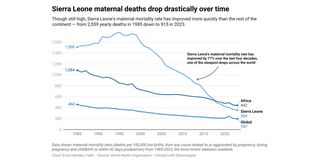
Sierra Leone once had the third-highest maternal mortality rate in the world but, since 2000, maternal deaths have fallen by nearly 80 per cent, from 1,680 per 100,000 live births to 354 in 2023, according to the latest World Health Organization (WHO) estimates. Foreign aid has been credited with helping more Sierra Leonean women and children survive childbirth.
The special care baby unit at Ola During Children’s Hospital, to which Sonita Kamara’s baby was sent, was built – and gets money for supplies – through the Saving Lives in Sierra Leone programme. Started in 2016 with funding entirely provided by the UK, the work of Saving Lives (which has included training for midwives, the provision of contraceptives and the establishment of special care baby units) had previously been a source of pride for British politicians.
In March 2023, a cross-party group of MPs travelled to Sierra Leone to see “where UK Aid is making a difference”. Helen Grant was one of the members of parliament. In a LinkedIn post after her return, Grant inadvertently describes the dependence of parts of the Sierra Leonean healthcare system on UK aid: “The vast majority of the materials used to collect blood there are funded by the UK government’s Foreign and Commonwealth Development Office (FCDO),” the Conservative MP wrote. A few months later, Saving Lives was renewed for a third, five-year phase and allocated a budget of £35 million ($47.3 million).
Then, without warning, the whole system was upended. At the end of January 2025, the Trump administration issued a stop-work order, temporarily halting all projects funded by USAid. A month later, British prime minister, Keir Starmer announced a reduction in UK aid from 0.5 per cent to 0.3 per cent of UK gross national income, and in March, US secretary of state, Mario Rubio, confirmed on X that 83 per cent of the programmes delivered by USAid would be officially cancelled.
Despite Prime Minister Starmer saying funding would fall from 2027, by late 2025, international development think tank, the Centre for Global Development was reporting that the FCDO had already axed Saving Lives “quietly behind the scenes,” reducing its remaining funding of approximately £17 million ($22.9 million) to just £1 million ($1.3 million). Sources close to the programme confirmed this, telling Fuller that they thought activities could be wound down as soon as March 2026.
An FCDO spokesperson would neither confirm nor deny the cuts, telling Fuller: “Allocations of the official development assistance budget for next year haven’t been set out yet and we will not speculate on them in advance.”
The impact of the loss of US funding has been harder to show clearly because “when US funding is cut, it affects our health institutions … not only in maternal and child health but also in other critical areas,” explained Dr Mustafa Kaba, deputy chief medical officer for clinical services at the Ministry of Health and Sanitation.
The ministry told Human Rights Watch in July that cuts in US foreign aid represented a $45 million reduction in health projects focused on maternal, child, and adolescent health. And in 2024, the US provided $3.2 million to Sierra Leone’s reproductive health, about 14 per cent of the country’s overall reproductive health funding.
Sonita Kamara’s baby, Kelvin, on oxygen at the special care baby unit at Ola During Children’s hospital, November 30, 2025. The unit was funded through UK aid. Despite lively debate on the effectiveness and ethics of aid, the consensus has been that its abrupt termination was irresponsible, would disproportionately affect women and girls around the world and invariably lead to more deaths.
"The sudden nature of these cuts is a huge blow,” said Dr Nellie Bell, head of paediatrics at Ola During Children's Hospital. “We are already stretched … but we are going to see an increase in mortality in all those [special care baby] units, for sure."
A source, who had worked on previous phases of the Saving Lives programme and agreed to speak to Fuller on condition of anonymity, said the UK government had been warned what impact an abrupt termination of funding would have. “Despite evidence and sustained warnings that these cuts would put women and girls at risk, we were ignored. Today, the consequences are unfolding in real time. The suffering is not inevitable. It is the foreseeable result of deliberate policy choices,” they said, before adding: “It is not too late to change course.”
"I am not a fan of aid dependency,” Freetown mayor, Yvonne Aki-Sawyerr, told Fuller. “But when aid is removed in the context of weak governance, mismanagement and corruption, you increase the population’s vulnerability.”
A year on, can Sierra Leone maintain maternal health progress and keep women from dying needlessly in childbirth?
Negotiations
Asked where Sierra Leone was at in its negotiations and commitments with the US and UK, Dr Kaba said the Ministry of Health was still engaging with the UK Foreign Office and embassy, but have not yet received concrete answers.
As for the US, he pointed to the recently signed bilateral agreement. Thememorandum of understanding is part of the America First Global Health Strategy (AFGHS) which sets out how Washington intends to engage in global health going forward. The press release, put out by the Department of State in December, outlines the US’ plans: “In Sierra Leone, the United States will front-load more than $30 million in 2026 to rapidly strengthen disease surveillance, laboratory capacity, health workforce, and data systems, while Sierra Leone steadily increases its own financial contributions.” It announces $173 million in funding, broken down into “$129 million in US assistance, more than $44 million in recipient co-investment.”
The administration has said AFGHS is about “reducing foreign dependency on US taxpayers” and about “helping countries move towards more resilient and durable health systems” but civil society groups disagree.
“AFGHS is being framed as health assistance, but it’s about corporate interests,” said Fadekemi Akinfaderin, chief global advocacy officer at Fòs Feminista. The feminist alliance published an analysis of the Global Health Strategy and concluded that it is “a vehicle for advancing US military and commercial interests through increasingly coercive tactics”.
With little transparency, it is unclear whether the sums announced are already being spent, on what they are specifically being spent, and what Sierra Leone has offered in return for continued US funding.
Creating a system that depends on itself
According to Dr Kaba, funding had traditionally flowed predominantly through UN agencies such as WHO, Unicef and UNFPA, as well as international NGOs, making it hard for even the Ministry of Health to fully quantify the extent of Sierra Leone’s foreign aid dependency. "It has been very difficult to estimate,” Kaba said. “When US funding was cut, we tried to assess its impact on the health sector – not only [on] maternal health – but it was challenging to get accurate data and figures”.
There are other funding sources for maternal and child health efforts in Sierra Leone including the development banks and various other countries: Japan, China, Sweden, Canada, Germany, Ireland. For instance, in 2021, the World Bank invested $60 million in a project to deliver maternal and child health and nutrition services across five districts of the country’s 16 districts. This runs through to 2027.
One way to compensate for lost funding would be to raise money for public services through taxation. But the latest revenue statistics from the OECD show that Sierra Leone’s tax revenue, relative to the size of its economy, is approximately 11 per cent – below what the World Bank recommends for “inclusive growth and development” (15 per cent) and less than the African average, 16 per cent. The 2026 government budget, however, does propose a series of new taxes, intended to “yield 1.5 per cent of GDP in additional revenues by 2027”.
Still, setting out to collect more taxes is one thing. Actually doing so is another. Abou Bakarr Kamara, senior economist at Sierra Leone’s International Growth Centre told Fuller: “Implementation depends on the capacity of national revenue institutions and that can take years”.
Despite the challenges ahead, Dr Kaba at the health ministry isn’t fearing the worst. Instead, he sees the drastically changing aid landscape as an opportunity for Sierra Leone. “We are not assuming the health sector will collapse,” Kaba said. “It is a moment to realign, adjust to realities and strengthen innovative health financing schemes. If support comes in the future, we welcome it. But we want a resilient system that depends on itself.”
At a meeting of the Africa Union in February, President Julius Maada Bio launched a 300-day campaign aimed at “ensuring continuous care throughout pregnancy, promoting safe deliveries, responding swiftly to complications, and providing thorough postnatal follow-up.” The campaign started March 1, but at time of writing no specifics details, targets or projects had been made public.
For the mothers, doctors and nurses of Princess Christian Maternity Hospital and Ola During Children’s Hospital, the decisions of two men – the US president and British prime minister – are likely to have far-reaching consequences. It remains to be seen whether another man, Sierra Leone’s president, can find other ways to ensure Sonita Kamara’s story of survival isn’t once again the exception.
This article is published in partnerships with Fuller, a global newsroom dedicated to reporting that catalyses positive change for women.


