It’s not just about pads: Pain, stigma and the school days girls lose
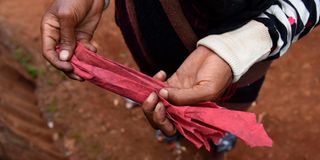
A girl holds a piece of cloth she uses as a sanitary pad in Kangemi.

What you need to know:
- For a long time, the conversation about menstrual-related absenteeism among Kenyan girls has been framed as a rural problem.
- But that framing has always been incomplete because Rose lives in the capital city, and she is losing nearly a quarter of her school life to her menstrual cycle.
Rose Achieng is 16. She lives in a shanty she shares with her mother and two younger sisters in Lindi village, deep inside Kibra in Nairobi, and she attends a mixed day secondary school a short walk from her home. She is in Form Two and likes mathematics, though she will not admit that she is good at it. What she will admit is that every month, for four or five days, she disappears from school.
The reason is that her period arrives heavy, as it always has. There is pain, the kind that folds her over and makes sitting on a wooden desk for 40 minutes, or even walking feel like punishment. And there is the problem she has learned to plan around the way other children plan around exams: she does not always have pads. Her mother sells vegetables in Toi Market. Some months there is money for pads, but most months there is just enough for food. When there is none,
Rose cuts strips from an old leso and folds them. She cannot change at school because the toilets are shared, there is no water, and there is nowhere private to clean herself. So, she stays home. “I miss school for close to one week,” she says.


For a long time, the conversation about menstrual-related absenteeism among Kenyan girls has been framed as a rural problem. But that framing has always been incomplete because Rose lives in the capital city, and she is losing nearly a quarter of her school life to her menstrual cycle.
The statistics tell us that there is a pattern to this narrative that runs deep. The African Population and Health Research Centre conducted a nationally representative survey of 4,230 young adolescents aged 10 to 14 for its Kenya Young
Adolescents Gender Norms Study, 2025. Dr Beatrice Maina, who led the research, says approximately 31 per cent of girls in that age group had started menstruating. Among them, 26 per cent reported missing or struggling to participate in activities during their last period: school, social gatherings, religious events, chores. Thirteen per cent specifically missed school. When asked why, 71 per cent cited pain. Ten per cent said they did not have menstrual products at school, while 15 per cent of all adolescents who had started menstruating reported not having enough pads for their last period.
“This is not just about pads,” Dr Maina says. “It is about pain, about dignity, about a school environment that does not accommodate a basic biological reality.”
In the slums, that reality is sharpened by infrastructure that was never built for the density of people using it. A 2025 study of menstrual hygiene management among day secondary school girls in Kibra found that between 50 and 70 per cent of girls lacked access to adequate sanitary products, and 30 to 40 per cent faced school absenteeism due to inadequate facilities. In Kenya, one in three girls misses at least five school days a month during her period. The Kibra study found that access to water was significantly linked to girls’ ability to manage their periods hygienically, and water is not free.
Six hundred kilometres away, in Marigat, Baringo County, Rebeccah Cheptoo sees the same story with different details. She is a Community Health Promoter (CHP) who has spent years working with school-going girls in the region. “Sanitary pads are out of reach for most school-going girls here because most come from low-income areas where getting pads is not a primary factor,” she says. Water, she adds, is an even bigger problem. “In Muringat, there is no free water. That compounds the already complex sanitation issue.”
This is where the reusable pad conversation becomes complicated. A reusable pad kit can cost around Sh400 and last months, making it cheaper than disposables over time. But reusable pads require water: several litres per cycle plus soap, a private place to wash them, and somewhere to dry them without shame. In a slum where water is purchased and toilets are shared, and in rural areas where water points are scarce, the reusable pad is not a solution. It is another problem dressed as one.
Then there are the toilets. “Most schools do not have enough toilets,” Rebeccah says. “Students have to take turns or queue to use washrooms. That pushes a good number to stay away from school when they are on their menses because they need privacy while on their periods, something that schools do not offer.” The result is the same in Baringo as it is in Kibra: a girl misses school, falls behind, and returns to a classroom where she is already trailing.
Shirleen Adhiambo, executive director of the Muungano Rural Empowerment Centre in Siaya County, has watched this play out for years. “The cost of sanitary pads is very high in a region that still grapples with issues like unintended pregnancies and high rates of HIV among young people,” she says.
“Most households live hand to mouth. Sanitary pads are secondary to food.” She acknowledges that pad donations now fall under the National Government Affirmative Action Fund (NGAAF), but she is blunt about the reach. “The pads do not reach every school and every student. Most schools depend on recurrent donations from well-wishers, and even these are not sufficient.” On reusable pads, her verdict is clear: they add another layer of expense in the form of water and soap. Some girls and families prefer them because they believe they are set for a long period. “But for many,” she says, “it is not a solution.”
The law says something different. Section 39(k) of the Basic Education Act requires the Cabinet Secretary for Education to provide free, sufficient and quality sanitary towels to every girl enrolled in a public basic education institution who has reached puberty, along with a safe and environmentally sound disposal mechanism. The Kenya Menstrual Hygiene Management Policy 2019–2030 commits to access and affordability. The WASH in Schools Strategy sets out standards for water, handwashing, and separate private changing rooms. On paper, the entitlement is comprehensive.
In practice, the Senate acknowledged in its own chambers that the administration of the sanitary towels programme through NGAAF, and its limited funding, “contravenes” Section 39(k). It noted that pads procured with public funds are being distributed by elected leaders at public functions, turning a legal entitlement into what looks like a personal donation. The National Assembly approved Sh500 million for the purchase of sanitary towels. Women leaders, including Homa Bay Governor Gladys Wanga, have argued that this money should be used to support local manufacturing so that pads can be sold at Sh50, a price point that would make them accessible to families like Rose’s. But Sh500 million does not reach every girl. The NGAAF budget for 2026 stands at just under Sh912 million, with a target of issuing pads to 2.6 million girls. Kenya has over 10 million girls in public basic education.
The infrastructure gap is just as stubborn. The Ministry of Education and the World Health Organization recommend one toilet for every 25 girls. A 2026 Usawa Agenda report found that at primary school level, the national average is 47 girls per toilet. In refugee community schools, it is 61. Only 28 per cent of primary schools provide bathing or changing rooms for girls, even though 81 per cent distribute sanitary towels. In other words, most schools give a girl a pad and then send her to a crowded latrine with nowhere to change, no water to wash, and no bin to dispose of it. The National Gender and Equality Commission’s own data shows that the national average pupil-toilet ratio for girls is 32:1, well above the standard. In Mandera, it is 45 girls per toilet; in Nairobi, it is 33.
There are pockets where things work better. In Meru County, Mary Nkatha, a teacher at a boarding C1 secondary school, says the situation is different because the school’s guidance and counselling department is equipped with pads and painkillers. Girls can go to the matron. But she adds a caveat that the policy conversation rarely captures: teachers are not trained to handle menstrual disorders such as anaemia or endometriosis. “When a girl has a serious problem, we send her home for specialised care,” she says. “She misses days of school. We cannot manage that here.” The pad is available, but the medical knowledge is not; this means that girls, even in boarding schools, are still losing school time.
A study published in Frontiers in Reproductive Health in 2026 offers the clearest evidence yet that this is a solvable problem. Researchers in Kilifi South distributed menstrual products: disposable pads, reusable pads, and menstrual cups to 300 high school girls across five schools. Menstruation-related absenteeism dropped significantly in every group. The median absenteeism score fell from one to zero. The study confirmed that product provision works. But it also found that fear of leakage, stigma, and cultural taboos kept girls away even when products were available. The pad alone was not enough. Pain management, clean water, private changing rooms, and a school culture that does not shame girls are all part of the equation.
“We cannot keep treating menstruation as a private problem that girls must solve alone. It is a public issue, and it requires public investment,” Nkatha notes.
The National Government Affirmative Action Fund and the Ministry of Education were contacted for comment on the coverage of pad distribution and the state of WASH facilities in schools. Neither had responded by the time of going to press.