Days after announcing a project to rebuild their broken ties, it is emerging that the ongoing Ebola outbreak and the humanitarian and security crisis in eastern Congo pushed Nairobi and Kinshasa towards a détente, as both capitals realised that the twin crises were damaging their economies.
As such, they agreed to collaborate, with the initial step being to redeploy their respective ambassadors soon. The joint communiqué shared after a four-way summit in Oyo, the Republic of Congo, did not say whether the two sides would necessarily keep embassies open.
It said, however, that they had agreed to keep diplomatic channels open. This came just as Nairobi was preparing to open a new embassy in Brazzaville, the Republic of Congo, after becoming frustrated with diplomatic blockages in Kinshasa. Kenya’s embassy in the DRC had been torched by mobs earlier in 2025, with Kenya demanding compensation from Kinshasa.
Sources said Kinshasa later agreed to compensate Kenya for the loss, but has refused to accredit the ambassadors appointed to head the mission. The meeting, however, also discussed the scale of Ebola and the churn of displacement caused by insecurity in eastern DRC, both of which have hurt the smooth flow of trade.
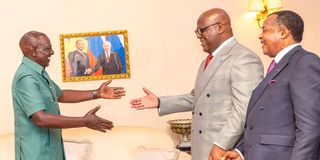
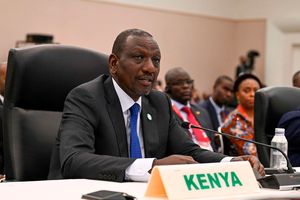
President William Ruto and his Republic of the Congo counterpart, Denis Sassou N’Guesso during the High-Level Quadripartite Political Summit in Oyo, Republic of the Congo on November 22, 2026.
Photo credit: PCS
Last month, truck drivers in Kenya petitioned the government to provide security assurances after threatening to stop transporting goods to eastern Congo, where rebel activity is rampant.
And although the final communiqué does not explicitly mention it, the quadripartite meeting held in Oyo on Sunday, 22 November, also served as a platform to discuss security issues in the Great Lakes region. This is, at least, according to comments by the President of the Togolese Council of Ministers Faure Gnassingbé.
“Faced with the security and humanitarian challenges confronting our populations, our conviction remains firm: dialogue, consultation and diplomacy must prevail in order to foster lasting political solutions and achieve genuine peace,” he said after Presidents William Ruto of Kenya and Felix Tshisekedi of the Democratic Republic of Congo attended the meeting in Oyo, hosted by Congolese President Denis Sassou-Nguesso, which Gnassingbé also attended as the African Union’s mediator.
Presidents Ruto and Tshisekedi agreed to “strengthen cooperation within regional mechanisms responsible for peace, security and integration issues, particularly the International Conference on the Great Lakes Region (ICGLR) and the East African Community (EAC), of which both countries are members, with a view to jointly contributing to the consolidation of peace and stability in the region.”
Of concern is the issue of Ebola, which has infected more than 11,000 people, killing more than 5,000 in the DRC, but has also spread to Uganda and Kenya, both of which are now enforcing tougher border controls to stop further imports. The two countries have since imposed a mandatory 21-day quarantine for anyone coming in from Congo, although Kenya has not necessarily stopped travel with the DRC.
This time, Kinshasa and Nairobi are calling for cooperation to eradicate the epidemic, which the final communiqué described as a pandemic. They vowed to seek capacity building for health workers, including training. Ebola in the DRC has mostly affected provinces that are controlled by rebels or under intense fighting between rebels and government forces.
In some areas, health workers have been unable to gain access, and supplies have been delayed for weeks due to insecurity. Some of those supplies have been shipped from Kenya, which is also a key trade route for the DRC.
Kenya argues it is inevitable that Nairobi and Kinshasa must collaborate, describing the recent tensions as bumps on the road.
“Kenya and DRC are not abstractions on a map. We share deep connections, trade, security, and brotherhood,” said Korir Sing’oei, Kenya’s Principal Secretary for Foreign Affairs.
“Our people cross, trade, marry, and build together daily — from Goma to Bunia to Kinshasa to Nairobi. Those who manufacture tension from a distance, for clicks, for funding, for foreign agendas, do not know the market woman in Goma, the truck driver on the Northern Corridor, the mother in Ituri.”
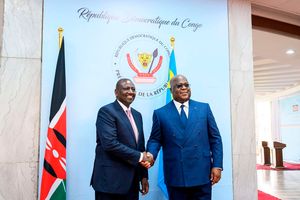
From right: President William Ruto, Republic of the Congo President Denis Sassou N’Guesso, President of the Council of Ministers of the Togolese Republic, Faure Essozimna Gnassingbé and Democratic Republic of the Congo President Félix Tshisekedi during the High-Level Quadripartite Political Summit in Oyo, Republic of the Congo on November 22, 2026.
Earlier, Dr Sing’oei had said bringing the vital Kenya-DRC relations back on track reflected the leaders’ “commitment to the ideals of Pan-Africanism, the values of solidarity and fraternity among African peoples, and the promotion of African solutions” to the challenges confronting the continent including peace, security and stability of the region.
Yet both sides had tried before. Earlier in 2025, Kenya sent a special envoy, Musalia Mudavadi, Kenya’s Prime Cabinet Secretary, to try to iron out suspicions that Kenya was siding with rebels. Mudavadi was received in Kinshasa, but months later, President Tshisekedi had not signalled a climbdown.
When Kenya nominated a new ambassador, Peter Tum, Tshisekedi still did not accept credentials from the new envoy. At the France-Africa Summit in Nairobi, Tshisekedi did travel to Kenya, but avoided a public photograph with his Kenyan counterpart.
Both sides agree that the situation in eastern DRC is tricky, but Kinshasa said the causes of conflict 20 years ago were different from today’s. Sing’oei said all kinds of political and diplomatic push should be encouraged to get a solution “given the conflict exposes the region to other risks including public health crises.”
The final communiqué carefully avoided mentioning the war in the DRC, an issue over which Tshisekedi and Ruto have held divergent if not contradictory views in the past, and which was at the root of the rift between the two leaders. They merely committed themselves to non-interference in the internal affairs of states, while reaffirming their “commitment to the principles of sovereignty, territorial integrity”.
In Kinshasa, some analysts interpret this commitment as an appeal by Congolese officials to their Kenyan counterparts not to provide a platform for their opponents in Kenya.
“I believe Félix Tshisekedi asked William Ruto to remain neutral, if not to condemn Rwanda, or to arrest and extradite opposition figures,” said Don Momat, a Kinshasa-based political commentator.
“This marks the beginning of a new cycle. The DRC is seeking to rebuild trust with its neighbours to put Joseph Kabila, who has taken the lead of the former M23 movement, under greater pressure,” said Nicaise Kibel Bel, a security expert.
One positive sign, though, is that Kinshasa and Nairobi now say they will prioritise consultation and diplomatic channels as a means of preventing and resolving any potential disputes, with a view to preserving regional peace and stability. It is better than avoiding each other or sending third-party emissaries.
They also vowed to use regional blocs such as the EAC and the ICGLR, which signals that the Congo may accept a return of mediation of bodies that it previously said were biased. The DRC has especially been critical of the EAC and even threatened to quit the body, which it said was not serving its interests.
They also agreed to put humanitarian crises on the table, seeking to address one of Africa’s long-running sources of human suffering.