Happening Now: NTV KENYA LIVE | Senate Proceedings
IWD reflection: Kenyan women do not need more recognition, they need action
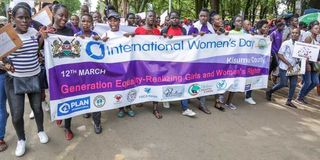
Women march during a procession to mark International Women's Day in Kisumu on March 12, 2020. Kenya's constitutional promise to women remains unfinished.
What you need to know:
- Women’s constitutional rights in Kenya face daily tests in healthcare, education, and policy systems .
- There has to be government action, funding, and accountability to ensure constitutional protections reach every clinic, classroom, and community nationwide.
Women’s constitutional rights in Kenya are being tested in clinics, classrooms, and policy rooms across the country. Access to reproductive health information, emergency care, and safe learning environments remains inconsistent and vulnerable to political pressure and administrative delays. What is at stake is urgent and tangible: the health, dignity, and survival of women and girls.
Public debate on gender equality often makes headlines and dominates political platforms. However, the real effects are experienced quietly. A teenage girl who is denied accurate reproductive health information faces a preventable risk. A pregnant woman facing a medical emergency depends on clear legal protections. A survivor of school-related gender-based violence relies on systems that must respond with urgency and care. Constitutional rights are important because they influence these everyday experiences.
Recent court decisions have reaffirmed that access to reproductive health information and services is lawful and that a woman’s life and health cannot be disregarded by restrictive policy language. These rulings strengthen Article 26(4) of the Constitution and reinforce the principle that dignity and equality are not mere ideals. They are enforceable rights.


The impact of these decisions reaches far beyond legal circles. Women across Kenya bear the burden. Market traders, students, young mothers, community health volunteers, and teachers navigate systems that can either support or fail them. When information is scarce, it is girls who grow up misinformed. When policy language stokes fear, healthcare providers hesitate. When implementation slows, families face the consequences.
Progress now faces subtle forms of resistance. Administrative inertia, moral panic in public discourse, and inconsistent funding threaten to undermine already achieved gains. Court rulings require careful implementation, and health facilities need clear guidance. Teachers require training and effective reporting systems, and county budgets must align with constitutional commitments.
Across Nairobi County and beyond, girls from historically excluded communities are asserting their right to safety in education. By sharing their lived experiences, they are demanding enforcement of existing protections against school-related gender-based violence. Their advocacy reflects the same constitutional values affirmed by the courts: equality, participation, and accountability. Their demands are practical and urgent.
Implementation will determine whether recent judicial progress transforms everyday life. Constitutional guarantees must be matched with administrative action, political will, and adequate resourcing. Clear national guidelines, functioning reporting mechanisms in schools, and protected access to accurate reproductive health information are essential.
International Women’s Day demands more than just recognition; it calls for tangible actions. These include government agencies fully executing court rulings, county health systems providing accessible and stigma-free services, and education authorities enforcing protections against gender-based violence while allocating the necessary resources to support these initiatives.
Kenyan women and girls should not carry the burden of defending rights that are already guaranteed. The Constitution provides the framework, and the courts have clarified the standard. Leadership now requires execution, transparency, and accountability. Rights must be secured in practice, in every clinic and every classroom, across the country.
The author is the Managing Attorney at Women's Link Worldwide.