Meals, miles, and medicine: The unseen work of community health promoters
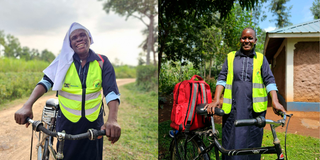
Benta Opondo (left) and Mary Akinyi both are community health promoters in Siaya County. Their bicycles have doubled their patient visits but couldn't ease the burden of being Kenya's unpaid health backbone.

What you need to know:
- Mary Akinyi is one of Kenya's 107,831 CHPs who earns Sh5,000 monthly to serve 100 households.
- Women make up 67 pc of these health workers, struggling to balance life-saving community duties with unpaid care.
- Despite inadequate pay and delayed stipends, these women continue their essential work because, as Mary says, "if we stop, our communities will suffer."
Mary Akinyi bursts from her house in Ulore Village, Siaya County, in a dash, her steps hurried and her breath shallow, like someone who has just crossed a finish line.
It is midday, and the sun beats down relentlessly, baking the red soil paths that snake through the village. The hour we arrive, between one and two o’clock, is when many Kenyan families sit down to their main meal of the day. But in Mary’s household, the ritual is a race against time.
Her husband and two primary school children are waiting, and Mary has just managed to complete the cooking.


She still has to serve the meal before the children rush back to class. She wipes sweat from her brow, balancing urgency with hospitality. She ushers us in, her bright yellow reflective vest, the standard uniform of community health promoters (CHPs), standing out against her navy-blue dress.
Her smile is warm, but behind it lies the weight of a double burden: that of being a wife and mother, and one of Kenya’s 107,831 CHPs, tasked with keeping households healthy.
“This week we are deworming children,” she tells me apologetically, clearly anxious about time. “So, I’m in a hurry to go back to administering the drugs. I only rushed home briefly to prepare lunch before I dash back.”
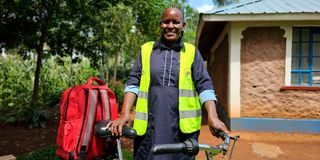
Mary Akinyi at her home in Ulore Village, Siaya County, on June 19, 2025. Despite receiving a donated bicycle that has eased her work logistics, she still faces cultural expectations to handle domestic duties alongside her role as a community health promoter.
It is the last week of the month, and Mary has 100 households to cover. Each must receive preventive care and basic health services, ranging from deworming tablets to education on sanitation and nutrition.
“This week is really a marathon,” she says with a laugh that sounds more like a sigh.
We give her a moment to catch her breath before settling under the shade of an indigenous tree outside her house.
Ordinarily, she carries out her CHP duties three days a week, from morning until evening, because of the long distances she must cover from home to home.
This week, however, the routine has been disrupted. She must carry out the deworming exercise for five consecutive days. To avoid interfering too much with her tight schedule and delaying her targets, we have to hasten our interview.
“I start at eight in the morning and should finish by five in the evening. But if I find no one at home, I must return another day, and that sometimes keeps me out until seven,” she says calmly after taking a moment to relax.
This is her routine on ordinary days, a cycle that strains her to the core as she unravels one unseen burden only to take on another: balancing socially assigned domestic responsibilities with the volunteer work of keeping her community healthy.
Director General for Health Dr Patrick Amoth says the majority of CHPs are women, who make up 67 per cent, while men account for the remainder
And they are officially expected to volunteer two hours per day, conducting household visits to provide promotive and preventive health services. In practice, however, many, like Mary, spend full days on the job.
Although they are the first line of defence, linking communities to health facilities, educating on maternal and child health, sanitation, nutrition, HIV, and drug abuse, and providing immediate referrals, women CHPs continue to struggle without adequate logistical support, especially in areas where households are far apart
Yet their invaluable labour remains undercompensated. CHPs are not salaried. Instead, each receives a stipend of Sh5,000 per month, shared equally by national and county governments. When broken down, this amounts to just Sh50 per household visit.
If Mary were to rely on motorcycle taxis at Sh50 per trip, she would spend twice her stipend simply reaching the homes. Thus, the stipend defeats its own purpose of compensating them for the supposed two hours they volunteer each day
Her husband, Alfred Adera, understands the strain, though not without conditions.
“It’s good when she is home early,” he says, leaning back under the shade of the tree, his gaze fixed on the path she often takes back from her rounds.
“That helps her prepare to go to the market or the posho mill. But I also know when she is late, especially if it rains. The roads here turn to mud.”
Mary, however, feels the pinch from both ends. “There are homes three kilometres away, and if I find no one, I must return another time. Imagine walking back and forth under a hot sun or rain. If I don’t come home to cook, things are not good at home. So, I must balance, it is heavy, but I have no choice.”
Support without relief
Beyond the stipend, they receive non-financial support that focuses on the delivery of their CHP duties, but not on how they are expected to reach the 100 households assigned to them each month.
“They are trained and sensitised on various health conditions to improve their knowledge and skills,” says Dr Amoth.
“They are given smartphones for reporting, and kits with basic medical equipment for screening. In some counties, there are welfare initiatives, and in vast areas, bicycles have been provided.”
But such support, while helpful, is not gender-sensitive. “There are no specific initiatives for women CHPs,” he admits.
For Mary and thousands of other women CHPs, whose modest stipend cannot cover the cost of hiring help, this means shouldering the duties alongside unpaid care work.
In 2021, World Bicycle Relief (WBR), a global non-profit, partnered with Siaya County to provide CHPs with sturdy bicycles.
Mary was among the beneficiaries. It eased the logistics, but did not erase the weight of cultural expectations.
“Before I got the bicycle, I could not even manage 50 households. At best, I would reach 40 or 45,” she recalls, her eyes narrowing as though retracing the exhausting treks under the scorching sun and through muddy paths.
“Now I can visit 70 to even 100. I cover more ground, and our health indicators have improved.”
The bicycle is not just for work; it has become an essential tool in Mary’s daily life.
“I use it to fetch water, go to the market, and get home earlier to prepare supper. Before, I would cook at nine in the evening and sleep past midnight. Now I can rest by ten,” she says, her voice softening with a hint of relief as she adjusts the bicycle’s handlebars, the faintest smile breaking through the weariness etched on her face.
According to Dr Amoth, WBR has supplied bicycles in Kitui, Busia, Kakamega, Kisumu, Siaya, and Kwale counties, “supporting mobility and access to assigned households, thereby increasing retention, reach, and access.”
In the eyes of WBR’s Regional Director for East Africa, Maureen Kolenyo, this mobility tool has worked miracles.
“About 88 per cent of CHPs with a bicycle reach more patients. Ninety-five per cent achieve their targets because of improved mobility,” she asserts.
Perhaps these miracles are best exemplified by Eunice Apondi, fondly known as the village doctor of Uhuru ‘A’ Village, located four kilometres from Bar Agulu Health Centre in Siaya County.
Her days are packed with farming, cooking, and looking after her grandchildren, all while managing chest pains and aching legs.
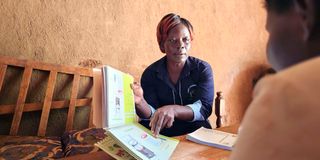
Eunice Apondi, fondly known as the 'village doctor of Uhuru A Village' in Siaya County, busy at work during a household visit to provide promotive and preventive health services on June 19, 2025.
“Even children, when they see me passing, shout, ‘The village doctor is passing!’” she says, beaming with pride.
Her role, however, is no laughing matter. One afternoon, a frantic mother handed her a convulsing toddler and disappeared. Eunice strapped the child to her back, mounted her bicycle, and pedalled to Bar Agulu Health Centre.
“Without the bicycle, I would have walked for more than an hour. With it, I got there in less than one, and saved a life,” she affirms, underscoring just how vital the bicycle has become.
Yet the gift comes at a price. “Sometimes the bicycle breaks down, and repairs cost up to Sh2,000 during rainy seasons. That is almost half my stipend,” she laments.
Still, the bicycle allows her to reach at least 40 households a month, up from just 25 before.
“I don’t just pop in,” she explains. “I call ahead for those with phones or go in the evening to book a visit. Trekking is no joke, but the bicycle makes it bearable.”
In Uyundo Village, another CHP, Benta Opondo, remembers a night when an expectant woman was rushed to her, bleeding heavily.
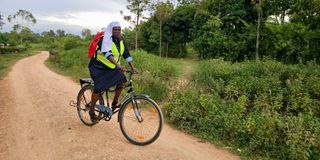
Benta Opondo, a community health promoter, rides on the dusty earthen road in her Uyundo Village on June 19, 2025. The road, which turns muddy during the rainy season, links to Kaluo Health Centre, where she has to take emergency cases by bicycle.
“With no other option, I placed her on my bicycle and pushed up the hill to Kaluo Health Centre. Less than an hour later, both mother and child survived,” she says, her eyes reflecting the relief and pride of that night.
To this day, the woman greets her with gratitude on the village paths. “Nothing gives me greater joy than seeing a mother smile because I helped save her life and that of her child,” Benta says.
Her wish? “That the government provides every CHP with a means of transport so we can reach those in urgent need.”
In addition, all shared one common request: that the stipend be increased to at least Sh10,000 to help them even hire assistance to ease their domestic burden.
Vincent Okumu, a Community Health Officer at Bar Agulu Health Unit, oversees 15 CHPs. He has seen first-hand how bicycles changed the game.
“Before, a CHP could only reach about 20 households out of 100. With bicycles, they can now reach almost all,” he says. “They are expected to cover 100 households in a month, as per World Health Organisation recommendation.”
But pay delays continue to gnaw at morale. “The stipend often delays by two or three months. This affects their motivation, though they still try to keep going,” he says.
A gendered strain
With the majority of CHPs being women, it is them who carry the bulk of this work. Yet unlike men, they must also shoulder domestic labour.
In Alego Usonga, Siaya County, Stephen Oyamo, who coordinates community health services, says most CHPs fall within their 30s, 40s, and 50s-placing them in the reproductive age group or with school-going children-while only a few are in their 20s or 60s.
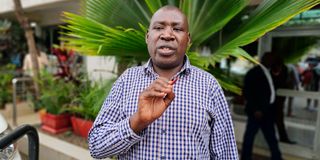
Stephen Oyamo, who coordinates community health services in Alego Usonga, Siaya County, during an interview on June 20, 2025. He says most CHPs fall within their 30s, 40s, and 50s, placing them in the reproductive age group or with school-going children, while only a few are in their 20s or 60s. Moraa Obiria/Nation Media Group
Men remain a minority among CHPs in the sub-county. Out of the 519 CHPs in Alego Usonga, only 78 are men. Stephen attributes this to the traditional focus on maternal and child health, which has historically been considered women’s work.
“But the trend is changing. As men increasingly face health issues like diabetes, more are stepping in,” he notes.
He explains why bicycles are widely accepted among women CHPs: “Given the vast distances and the number of households—sometimes up to 150, a bicycle is the most practical tool. Even women who initially did not know how to ride have learned to use them because they make the work manageable,” he explains.
Stephen adds that policy expects each CHP to visit up to 100 households per month. In practice, however, some CHPs cover up to 150 or even 200 households, depending on population density and the size of the area.
“We ensure that at least a third of households are visited monthly, with priority households, such as those with young children or expectant mothers, visited more frequently,” he says.
He emphasises that bicycles, combined with training and community support, have significantly improved coverage and effectiveness in delivering primary healthcare across Alego Usonga.
“We rely on CHPs to reach households directly and provide key health information across multiple areas, including maternal and child health, non-communicable diseases, neglected tropical diseases, and vitamin A supplementation. They even assist the elderly and those with chronic conditions,” he adds.
Back in Siaya, Mary wheels her bicycle out of the compound, her kit bag strapped tightly across her shoulder. She pauses, adjusts her reflective vest, and smiles faintly.
“We love our work. We save lives. But the real cost is in the hours we spend balancing it all. We keep moving because if we stop, our communities will suffer. And so, no matter how heavy it feels, we keep pedalling.”
With that, she mounts her bicycle and disappears down the dusty path, a lone figure pedalling between two worlds: the unpaid care of her household and the undervalued service of her nation.