Milking change: How Kajiado women are turning tradition into empowerment
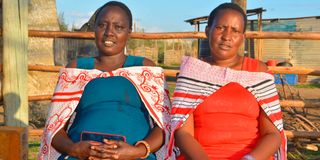
Margaret Sopiato Parsimei and her co-wife Mary Nairesiai Parsimei at their Kitengela home in Kajiado County on October 7, 2025.

What you need to know:
- Kajiado’s women are reshaping the dairy economy—from homestead milking to cooperatives—using milk money to educate children, build homes, and challenge gender roles while preserving a rich cultural heritage.
- In Kitengela, co-wives Margaret and Mary Parsimei are redefining economic empowerment through milk.
On the evening of October 7, 2025, as the golden rays of the setting sun bathes Kitengela’s open plains, two co-wives, Margaret Sopiato Parsimei and Mary Nairesiai Parsimei, are hard at work in their bustling homestead. The cowshed, filled with the earthy scent of fresh dung and the rhythmic sound of milk streaming into tins, is alive with activity.
A herd of over 100 cattle has just returned from grazing, and the women compete with calves for milk, their movements swift and sure, a display of both tradition and skill. Around them, children wait eagerly with cups in hand, while men watch from a distance, chatting quietly under the dimming light.
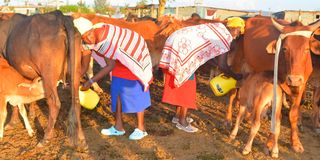
Margaret Sopiato Parsimei and her co-wife Mary Nairesiai Parsimei milk cows at their Kitengela home in Kajiado County on October 7, 2025.

In the Maasai culture, women are the custodians of milk—a vital source of food, income, and identity. They are responsible for milking, storing, and distributing it, as men herd and protect the cattle. Milk remains a staple in many homes, often mixed with blood or meat, and traditionally stored in calabashes cleaned using brushes made from roots or, at times, cow urine and charcoal from sacred trees—some now endangered by illegal logging.
Margaret and Mary milk their cows twice a day—early in the morning and again in the evening. Within an hour, they draw milk from about 20 lactating cows before serving their young children. In Maasai society, milk is more than nutrition—it is cultural currency, used in ceremonies and daily life alike.
For Margaret, 45, the first wife of Joshua Parsimei, a typical day begins before dawn. “My mother taught me to milk when I was barely 10 years old. It’s the duty of every Maasai woman,” she says. “Milk belongs to women—it’s our source of income.”
By 8am, she is done milking and ready to deliver about 30 litres of fresh milk to customers in Great Wall Estates, Mlolongo, Athi River, and Syokimau. At Sh100–110 a litre, she earns about Sh3,000 daily. Her husband, she says, has never milked. Whenever she is unwell or has just given birth, her co-wife or neighbours step in to help. The income from milk has transformed their home—providing food, paying school fees, and funding women’s savings groups.
“Milk has liberated many families,” she says proudly. “We women buy food, clothes, and educate our children. Most of the iron-sheet houses you now see have been built from milk money.”
She dismisses claims that economic independence makes women disrespectful to their husbands. “I consult my husband before investing. The cows are his, after all,” she laughs. “Sometimes he even borrows milk money to buy animal medicine.”
As she reflects on her journey, Margaret’s gaze softens. “My father didn’t allow me to continue school beyond class eight,” she says quietly. “But I’ve convinced my husband to support our children’s education. My firstborn son is now in college.”
According to the 2019 Kenya Population and Housing Census, Kajiado County’s illiteracy rate stands at around 30 per cent. Over 182,000 people never attended school, while another 111,000 dropped out early. Despite free primary education since 2003, only 48 per cent of Maasai girls enrol in school—and just 10 per cent make it to secondary level.
Mercy Njiriri, Kajiado’s acting director of adult and continuing education, notes that women form the majority of adult learners across the county’s 89 adult education centres.
Mary, 30, joined the family in 2015 as a second wife. Despite their 15-year age difference, the two women share a strong bond, milking side by side as traditional Maasai songs play softly from a pocket radio. Mary credits her co-wife for mentoring her.
“When I got married, Margaret gave me four of her lactating cows,” she recalls. “Milk has been my lifeline. It turned me from a beggar to a provider.”
Now a mother of three, she earns about Sh2,000 daily from milk sales and saves part of it for her children’s future. “Through my children, I will achieve the education I missed.”
Today, Kajiado women are increasingly joining dairy cooperatives to pool and sell milk. However, traditional practices persist. During the 2020–22 drought, about one million animals died, and 20 dairy cooperatives shut down because of declining production, leaving thousands of families depending on relief aid.
Fortunately, improved rainfall in recent years has revived the sector. County records show annual milk production reached 912,721 litres in 2024, a 50 per cent rise in two years. The Kajiado Women Cooperative, with 3,400 members, now collects 64,000 litres daily and runs a mini-processing plant in Kajiado town.
Chairperson Jane Saruni says: “The New KCC buys a litre at Sh47. We pay our members Sh44. With value addition, we’re getting better returns.”
She adds that the cooperative trains members in financial literacy and has introduced bank payments to improve security and savings culture. Still, many women outside cooperatives fall prey to brokers who buy milk at as little as Sh30 per litre.
Mary Seneta, former Kajiado Woman Representative, says: “Milking is an art every Maasai girl must learn. It remains the backbone of women’s empowerment. With value addition, we can transform even more lives.”
Elder Stephen Nkabash, 60, from Kajiado Central, agrees. “Milk feeds families, educates children, and builds homes,” he says. “A few lazy men may ask for milk money, but most support their wives’ efforts.”
He adds, half-jokingly: “If a woman becomes too assertive, a man can simply let the calves suck instead. Simple!”


