Ministry to introduce maternity uniforms for pregnant police officers, chiefs and commissioners
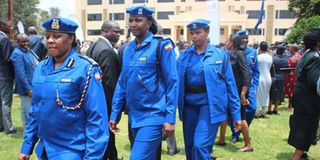
Female officers have welcomed maternity uniform reform but urge for longer maternity leave.

What you need to know:
- Female police officers in Kenya have long struggled with tight uniforms during pregnancy; the Interior Ministry has now approved special maternity wear to ensure comfort and dignity.
- Pregnant officers, chiefs, and administrators will soon wear specially designed maternity uniforms; CS says the reform will promote welfare and fairness in the security services.
- Policewomen in Kenya shared challenges of swollen feet, heavy gear, and tight trousers during pregnancy. .
In August 2022, Florence* stood at a crossroads that no woman should face alone. Pregnant with her second child and remembering the difficulties of her first pregnancy in 2017, the police constable nearly terminated the pregnancy she had not planned. The weight of her decision wasn't just personal—it was professional, shaped by a uniform system that had no place for women like her.
Florence nearly terminated her second pregnancy in August 2022. She had not planned on having another child so soon and remembered the difficulties of her first pregnancy in 2017. But knowing the risks of unsafe abortion, she carried the pregnancy to term, even as her work as a police officer made the journey unbearable.
Florence, a constable in Homa Bay County, joined the service in 2016 after training at Kiganjo. Attached to the Critical Infrastructure Police Unit, her duties include guarding government offices, banks, and other institutions—often while carrying a heavy firearm.

Tight uniform
"Female police officers wear trousers and belts, with jungle coats or sweaters. None of this is suitable for an expectant mother," she explains.
The reality of Florence's daily experience reveals the gap between service expectations and biological reality. During both pregnancies, she struggled to fit into the official trousers, forced to develop her own coping mechanisms.
"I would leave the trousers unbuttoned and loosen the belt, then cover my belly with a sweater or jungle coat. This is not recommended," she admits.
The challenges extended beyond clothing. At times, she was also assigned night duties despite the fatigue of pregnancy. Relief came only when a senior officer noticed her loose belt and reassigned her to lighter duties.
Florence's experience mirrors that of women throughout Kenya's security apparatus. Beatrice*, an officer with the Kenya Wildlife Service, knows this struggle intimately.
"I have three children, all born after joining KWS. My biggest challenge was swollen feet," she says.
While other women might wear open shoes during pregnancy, officers are required to wear boots, making every step painful. The rigid dress code becomes a source of daily discomfort for expecting mothers in the service.
Administrators face similar constraints. Marceline*, a chief in Homa Bay, explained that their uniforms mirror those of the police, with trousers as the standard. While some administrators switch to civilian clothes during pregnancy, appearing at public baraza in anything other than official uniform undermines their authority.
These frustrations surfaced during Jukwaa la Usalama meetings organised by the Interior Ministry, where women officers appealed for a maternity uniform. Their collective voice reached the highest levels of government, prompting Interior Cabinet Secretary Kipchumba Murkomen to promise reforms.
"We are in the process of making maternity uniforms. Female officers, chiefs, and national government administrators will wear them while on duty," he announced.
According to Murkomen, the uniforms will allow free movement and, for the first time, dresses will be permitted as official attire. The CS directed Inspector General of Police Douglas Kanja to oversee the design and distribution. Pregnant officers are to submit their names within a month.
For the first time, uniforms will also be issued at the county level, with proper measurements taken to ensure fit.
Florence, Beatrice, and Marceline welcomed the proposal but said more support is needed. The uniform, while significant, represents just one piece of a larger puzzle.
Florence argues that the standard three-month maternity leave is insufficient for the demanding nature of security work. "Sometimes officers are called for emergencies even while breastfeeding. If possible, leave should be more than four months," she says.
Marceline notes that many administrators use their annual leave to extend maternity time, effectively shortening their rest periods throughout the year.
Local leaders have praised the government move. Walter Opiyo, Homa Bay Bunge La Wenye Nchi leader, welcomed the initiative while calling for comprehensive reform.
"Providing maternity uniforms shows the government cares. But after that, it should also review officers' salaries," he said.
*Names changed to protect identities.


