Ol Kalou nominations expose barriers facing women in Nyandarua politics
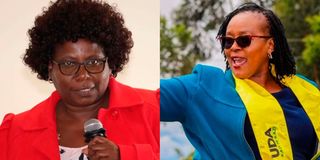
Beatrice Kamau of the Jubilee Party (left) and Mary Nyokabi of UDA.
What you need to know:
- Female aspirants in Ol Kalou reignite debate over gender equality and political leadership opportunities in Nyandarua.
- They cite money, stereotypes and intimidation as barriers to winning elective seats in Kenya today.
Ol Kalou Constituency has missed the opportunity to send its first woman to the National Assembly. The by-election slated for July 16—triggered by the death of its Member of Parliament (MP), David Kiaraho—is historic in one sense: For the first time, two women stepped forward to contest the seat.
Yet despite their qualifications, courage and community ties, both were edged out before the final ballot. Mary Nyokabi fell at the United Democratic Alliance (UDA) nomination stage, finishing fourth with 406 votes among 10 candidates. Beatrice Kamau, meanwhile, was pushed aside when the Jubilee Party opted to back Wilson Kigwa. Their exclusion reignited debate in Nyandarua County over whether Ol Kalou is ready for a woman MP, or whether the road to gender parity remains long and winding.
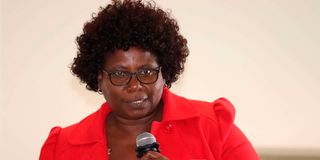
Beatrice Kamau, an Ol Kalou politician who was eliminated by the Jubilee Party on consensus.

Residents themselves are divided. Some insist the constituency is not yet ready, citing entrenched attitudes and the need for more sensitisation. Others argue that readiness is not the issue, but rather consistency, resources and timing.
Joyce Ng’ang’a, director at Serena Mind Network, is blunt: “Ol Kalou and Nyandarua are not ready for a woman MP. A lot of work needs to be done so that residents can change their mentality about women in leadership. Aspirants must also be closer to the voters; they cannot appear at the last minute and expect miracles.”
Her words reflect a broader truth in Kenyan politics: Women often face double scrutiny. They must prove competence while battling against stereotypes that question their legitimacy. Joyce adds that women already in leadership must meet community expectations to build confidence for those who follow. “We once had a woman MP here who alienated voters. She became a point of reference whenever a female aspirant emerged. That stigma lingers,” she says.
Yet others see hope. Vincent Waweru believes Ol Kalou is ready, pointing to Mary Nyokabi’s performance. “She was a newcomer, yet managed to defeat seasoned men with money and influence. She entered late, armed only with qualifications and commitment. That says something about the appetite for change,” he says.

Mary Nyokabi during the UDA nomination for the Ol Kalou Constituency on May 1, 2026.
Archbishop Josam Kariuki, the chair of the Nyandarua Interfaith Council, congratulates the two women for their courage. “Having female candidates for the first time is an achievement. They need consistency. We already have women excelling in church, and in private and public institutions,” he says. “In Nyandarua, gender stereotypes are minimal. The church was encouraged by how women conducted their campaigns. The time is ripe for leaders to be judged by ability, not gender.”
Still, Josam acknowledges that women must start early, spend more time with voters and be supported through sensitisation efforts.
Both candidates admit financial constraints weighed heavily on their campaigns. Campaigning in Kenya is expensive and often transactional, while women typically lack the networks and resources men enjoy. Beatrice, the Jubilee Party aspirant, concedes she was ill-prepared. “The by-election was abrupt. Eng Kigwa had been on the ground longer. I chose to support him and my party, but I will face him in next year’s general election,” she says.
She regrets the transactional nature of politics. “Voters increasingly expect handouts. It limits issues-based engagement. But I understand economic pressures are real, especially among the youth,” she notes.
Mary, the UDA aspirant, echoes the challenge: “I was preparing for the general election, not a by-election. I had less than two months. I learnt valuable lessons, but logistical constraints were immense. Mobilisation, agents, transport and communication are all costly. There were also cases of voter bribery, which distort the will of the people.”
Nyandarua woman representative Faith Gitau sees the candidacies as historic chapters in Ol Kalou’s story. She is, however, concerned about gender profiling orchestrated by senior politicians. “I have been a victim myself. Male leaders call women names because of their political decisions. Such intimidation scares women away from elective politics.”
Nevertheless, she believes the solution lies in more women presenting themselves to compete for elective seats. “After two terms as woman representative, I will vie for governor. It will create room for another woman leader and encourage more women to step up. Exposure at the county level prepares us for higher office.”
Kenya’s Constitution enshrines the two-thirds gender rule, yet implementation remains elusive. Women like Beatrice and Mary are forced to fight uphill battles in systems still skewed against them.
Mary is an environmental and public health professional. She studied environmental health at Kenyatta University and is pursuing a Master’s degree in Occupational Safety and Health at JKUAT. She resigned from the Kiambu government, where she served as chief public health and environment officer. She also founded Green Health and Safe Environs Limited, a consultancy specialising in waste management.
Beatrice’s journey spans teaching, banking and activism. She studied community development at Universidad San Juan De La Cruz and chairs Women Political Alliance Kenya, a civil society organisation advancing women’s leadership. She co-chairs Kenya’s Gender Sector Working Group on Women in Leadership and Decision-Making. As a human rights activist, she has long championed women’s participation in politics and economic empowerment.
Ol Kalou’s story is not isolated. Across Kenya, women remain underrepresented in Parliament and county assemblies.


