Patsy Ouma Karanja: The captain who decides if a pilot is fit to fly
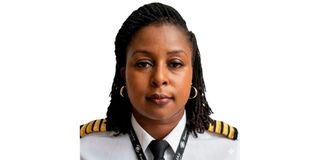
Patsy Ouma Karanja, the crew resource management trainer and type rating instructor, and synthetic flight instructor for Boeing 737 at RwandAir.

What you need to know:
- From uncertain beginnings, Patsy Karanja rose to train pilots and command one of aviation’s toughest roles.
- In a male-dominated industry, she is shaping the future of pilots across Africa.
Captain Patsy Ouma Karanja didn’t dream of the skies as a child. She laughs, recalling her childhood ambition: to be a pharmacist, imagining herself with a white coat and dispensary.
That dream stayed intact through boarding school at Mukumu Girls in Kakamega, through a high school stint in Machakos, and even through two years on a student exchange programme in the United States.
It wasn't until she came back to Kenya, finished her high school, and found herself in that restless in-between gap year that everything changed.


"I just told my parents, hey, I want to maybe try out to be a pilot," she says, almost casually, as if the decision that would define the next two decades of her life was something she arrived at over breakfast.
Her mother was the first to raise an eyebrow. Not out of cruelty, but out of the quiet worry that only a mother navigating a world of low expectations for women can feel. The field was more male-dominated then than it is right now. The representation was almost non-existent. What would this mean for her future? It took some convincing, but both her parents came around and let her spread her wings. She enrolled at Wilson Airport for a Private Pilot’s Licence.
Today, April 26, is World Pilots Day, and Captain Patsy is flying in quite the formation. She is a Boeing 737 Fleet Training Captain, a Line Training Captain, a Designated Pilot Examiner, a Type Rating Instructor, a Synthetic Flight Examiner, and a certified Crew Resource Management Trainer at RwandAir.
In simpler terms, she is the person who decides whether a pilot is fit to fly, and she oversees the training of cadets and 737 pilots. She has been doing this for over 20 years with a three-year pause in the middle that, as you will learn, was not a detour but a turning point.
Getting to where she is was never a straight line. After completing her Private Pilot's Licence at Wilson Airport, Patsy hit a wall that many aspiring pilots know too well: finances. Her father was approaching retirement, and the Commercial Pilot's Licence was too expensive. South Africa, where the plan had been to do her training, suddenly felt very far away.
So she did what she has always done when a door looks closed. She looked for another one.
She started walking from hangar to hangar at Wilson Airport, asking anyone who would listen if they would let her build flying hours for free. No pay. Just hours. The next hangar along from where she had done her PPL happened to be the Kenya Police Airwing.
She walked in and asked how she could fly their planes.
"It was a little bit shocking for everyone, I think, because they weren't expecting just a random person walking in asking for such an arrangement," she recalls with a laugh.
She was sent to the head of the airwing, who told her the route-in would require nine months at the Police College in Kiganjo, nine months of military-style training. Before committing, she was pointed toward a female officer who could give her a sense of what to expect. The woman gave her a careful overview.
Patsy listened. And then asked: "Where do I sign up?"
After that, she travelled home to Kisumu and told her father about the development over breakfast. He nearly choked on his food. He had been planning to scrape together money for South Africa, so the police service was a curveball of the highest order. “He had served as a civilian in the army and knew too well what those training colleges were like. But my mother, ever practical, simply said: ‘Maybe it will toughen you up.’ I had always been a little sheltered, and toughening up was exactly what happened,” she reminisces.
The nine months that followed were the hardest of her life. She does not dress that up. But when she came out the other side, she found herself facing a new problem: the officers around her hadn't flown in five years. The flying hours she had been promised were not materialising.
This called for her to regroup and pivot.
"I hadn't gone through nine months of intense training for that outcome," she says, simply.
She spotted an advertisement for Kenya Airways' ab initio cadet programme and applied. She got in, resigned from the police air wing just before her bond kicked in, and was sent to 43 Air School in South Africa for a year of commercial training. Then she joined Kenya Airways and flew for 15 good years.
That police training that had once looked like a waste of nine months became one of the most eye-catching lines on her CV.
"Up until today, it's a door opener and a conversation starter," she says. "I am so grateful I saw it through."
In 2020, after 15 years with Kenya Airways and serving in different ranks, Covid-19 happened and changed everything for almost everyone. For Patsy, it came with a specific, painful calculation. She was rated to fly cargo aircraft, which meant she would have been quarantined for two weeks at a stretch, come home for a day or two, and then go back. Her children were young, and the only viable option for them was homeschooling. She made the call: she retired from flying.
"I wasn't sure I was going to revisit this career," she says honestly. What she found in that season surprised her. Managing her children's education, sitting with them through the frustration of sums and reading and endless questions, something lit up in her. A patience she hadn't known she had. A genuine love for teaching.
"I felt like, if maybe I had done this before, maybe I would have considered being a trainer already," she says. "That passion really grew during that season."
By 2023, about three years after stepping away from the cockpit, she was ready to come back. The decision was partly practical because the longer you stay out of flying, the more expensive it becomes to revalidate your licence. But it was also a pull, a sense that she had unfinished business.
Coincidentally, RwandAir was looking for direct entry captains on the Boeing 737, the same aircraft she had been flying before she left. It was, as she puts it, "low-hanging fruit in the best way." She joined the airline on July 4, 2023. Today, not even three years later, she is the head of trainers on her fleet.
Globally, women account for just four to six per cent of commercial pilots. At the Rwandan carrier, the figure sits at 6.6 per cent, marginally above the industry average, and more than half of those women hold captain ranks. Patsy knows that number because she has lived inside it. "There are pockets of people who don't trust that you're capable of doing it the way a male counterpart would," she says, without anger, just matter-of-factness. "It's not only in Africa. It's everywhere else in the world."
But then she tells a story.
She was once flying, bound for Lagos on a mid-morning flight. Minutes after take-off, an alert flashed: hydraulic system failure. The fluid was draining fast. Lagos was a five-hour flight away, and they had to turn back to Nairobi, a high-altitude airport, in bumpy thermal conditions, carrying a full load of fuel and a cabin full of very expressive Nigerian passengers who, she says, were already asking the pastor if they were going to die. The fact that a woman was in the cockpit did not help the mood.
They held for a while to burn fuel, brought the aircraft down, landed cleanly, and taxied to the gate. Engineering confirmed: sheared hydraulic lines. Textbook emergency, handled by the book. The airline, following protocol, arranged for a replacement crew to continue the Lagos flight. The passengers refused. They said they were not going anywhere unless Patsy was flying them. "Maybe I managed to change a bunch of mind-sets that day," she says quietly. "That women can also see through an emergency and have it end successfully."
However, Patsy does not believe the numbers will change on their own. She has seen what happens when airlines decide to be deliberate about it and what happens when they don't.
“At RwandAir, I see the same intentionality at work. With every cadet intake, the ab initio programme that takes young people through their full pilot training, there is a conscious effort to include women. I can see an uptake of lady pilots in every intake," she says. "In the past two years, I've already trained about four or five ladies. So it's happening. Maybe it's a little quiet, but it's happening."
Her point to other airlines on the continent is simple: you have to decide to do it. It will not happen by accident. "It has to be very deliberate. Being intentional in the recruitment process, that's what separates the airlines that are moving the needle from those that aren't."
Across 54 African countries, she notes, only a handful are meaningfully pushing toward six to ten per cent women in their cockpits. The gap is not about a shortage of capable women but about whether an airline has decided to go find them.
These days, Patsy spends her weeks split between the office and the cockpit. She plans training schedules for 104 pilots, manages the administrative load of running a fleet training programme, and still flies half her flights are training flights. She is also navigating the disruptions that come with current Middle East tensions affecting her training facilities, which means constant rescheduling.
The industry is shifting, she explains, toward Competence Based Training and Assessment, a model that replaces the old, subjective approach where your result on any given day could depend on how grumpy your examiner woke up, toward an objective system built around observable behaviours, and she loves it.
"It removes the subjectivity and deals with what we are actually seeing," she says. "It's transparent. It's targeted. If you have a weakness, you know exactly what it is and what you need to work on." She also thinks a lot about the sophistication of modern aircraft and the danger of complacency that comes with automation. Right now, GPS spoofing and interference are disrupting aviation globally. For Patsy, that is a training problem: how do you build pilots who can fall back on the basics when everything they normally rely on disappears?
"We have to train for the worst-case scenario," she says.
"Resilience. Always going back to basics. Who knew we'd be dealing with GPS spoofing? But here we are."
For a girl standing somewhere in Nairobi, Kampala, or Kigali, watching a plane trace a white line across the sky and wondering if she can be a pilot one day, Patsy's message is short and direct.
"It is possible. It is doable. You should not limit your mind-set to thinking otherwise." She pauses. "And if there's a will, there's a way.”
She lists her greatest accomplishments without hesitation: her two daughters, her supportive husband who holds things together when she is away, the business she built from scratch during her years away from aviation and grew into something award-winning, and the return to flying, not just to the cockpit, but to the very top of her fleet's training structure.
When asked what she would change about the aviation industry if she could wave a magic wand, she does not hesitate.
"I wish it were less expensive. That it was as accessible as getting on a matatu or a boda boda." She leans into this. "But I believe we're getting there. Flying taxis are already here in Kigali. Drones. It's going to be interesting. I'm here for all of it."
On World Pilots Day, Captain Patsy is proof that belonging is sometimes something you have to kick the door down to claim.


