Prof Nzomo: Time to promote women’s rights and realise gender equality
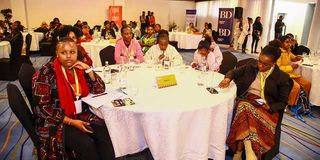
Participants during the NXT HER Summit at Mövenpick Hotel, Nairobi, on August 21, 2025, themed “Breaking Barriers – 30 Years On.” The summit drew its inspiration from the Beijing Declaration and Platform for Action of 1995. Wilfred Nyangaresi | Nation Media Group

What you need to know:
- Thirty years after Beijing, the NXTHer Summit united generations in Nairobi to demand urgent action for lasting gender equality.
- From masterclasses to plenary debates, advocates at NXTHer Summit celebrated progress, shared scars, and called for bold reforms.
On a chilly Thursday morning, the Nation Media Group (NMG) brought together young and older gender equality advocates from across the globe, the region, and Kenya for an intergenerational summit, NXTHer in Nairobi. The meeting sought to reflect on progress made since the adoption of the 1995 Beijing Declaration and Platform for Action.
The day opened with masterclasses on health, education and literacy, power and decision-making. These were facilitated by Family Planning 2030, Women in Tech Kenya, and the 50/50 Women on Boards Nairobi Chapter. The sessions provided a foundation for the broader reflections that followed in the plenary hall, where hundreds of advocates dressed in vibrant African prints converged to deliberate on the rights of women and girls.
Before entering the plenary, attendees walked through an exhibition space featuring products by women innovators and entrepreneurs. Items on display ranged from honey and African wear to baby clothes, wigs, and recycled creations made from glass, fabric, and plastics.


The Beijing Platform for Action remains one of the most comprehensive global blueprints for advancing women’s rights. It condenses commitments into 12 critical areas of concern, including poverty, education and training, health, violence against women, armed conflict, the economy, power and decision-making, institutional mechanisms for the advancement of women, human rights, the media, the environment, and the rights of the girl.
In his opening address, NMG Group Chief Executive Officer and Managing Director Geoffrey Odundo emphasised the media house’s commitment to advancing gender equality. “We curated this intergenerational summit as a platform to advance women’s rights and gender equality. Our hope is that the sessions will not only enrich your knowledge but also inspire new ideas, connections, and actions that will drive meaningful change beyond this summit,” he said.
“As a media group, we are committed to amplifying women’s voices, telling the stories of men and women, and challenging the narratives that perpetuate inequality. We have shifted from storytelling to story-shaping, ensuring that experiences shape opinions, drive interventions, and inspire lasting change.”
Mr Odundo noted that NMG’s Gender Desk, established in 2019, has produced more than 5,000 gender-focused stories across Kenya, Uganda, and Tanzania, influencing policy shifts and national conversations on gender-based violence, female genital mutilation, and women’s economic empowerment.
He reflected on Kenya’s progress, pointing to women’s representation in corporate leadership, which currently stands at 33 per cent, above the global average of 23 per cent. However, he acknowledged that challenges such as gender-based violence and women’s exclusion from economic opportunities remain persistent.
“I want to invite each of you to reflect on how you can break these barriers to generate equity in your own spheres of influence. Whether you are a business leader, policymaker, or creative, you have the power to drive change,” he said.
Dialogues
The summit continued with intergenerational dialogues on women’s rights, focusing on translating lessons from the past three decades into concrete actions for the future. Global gender equality leaders called for urgent steps to close the gaps that remain.
FP2030 Executive Director Dr Samukeliso Dube reflected on both the gains and setbacks in women’s empowerment, drawing from her personal history and global statistics.
“Each generation is often given its cup to drink. For some, it is sweet; for others, bitter. But the duty remains the same to carry the struggle forward,” she said, recalling her grandmother’s participation in South Africa’s 1956 women’s march, which paved the way for her rise to leadership.
Dr Dube underscored the transformative power of access to family planning and contraception, noting that it is not merely a health issue but a foundation for education, economic empowerment, and societal progress. “When women can decide if and when to have children, dreams are possible, economies thrive, and families are healthier.”
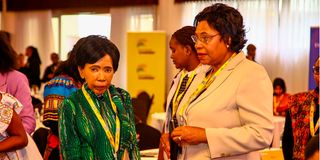
Prof Maria Nzomo (left) interacts with former Gender CS Prof Margaret Kobia during the NXT HER Summit at Mövenpick Hotel, Nairobi, on August 21, 2025.
She cited Kenya as an example, where access to contraception has contributed to a 10 per cent increase in women’s participation in paid work and a 14 per cent rise in control over their wages. Globally, closing the gender gap in access to family planning could raise Gross Domestic Product by 20 per cent, she said.
Yet challenges remain daunting, with 259 million women worldwide wanting to avoid pregnancy but lacking access to modern contraception, a figure larger than the combined populations of Kenya, South Africa, Tanzania and Sri Lanka, as she explained. In sub-Saharan Africa, contraceptive use is still below 20 per cent, while maternal mortality rates remain among the highest in the world, she said.
“These are not abstract figures,” Dr Dube cautioned. “They represent the lives of young girls forced out of school, of women dying in childbirth, and of families trapped in cycles of poverty.”
She faulted cultural and political barriers that restrict reproductive health rights, including harmful appeals to “family values” that deny women access to essential services. “What kind of family value allows a child to be married off, or a teenager to be forced into motherhood?”
Her advocacy is deeply personal, driven by the resolve to ensure no woman endures neglect or silence. “I have a 19-year-old daughter. Every day I write a letter to my daughter’s future self, imagining the world I want her to inherit,” she shared. “It must be a world better than this one, a world where access to family planning is not a privilege but a right.”
Transformative Leadership Centre, Executive Director, Prof Maria Nzomo reminded advocates that while significant progress has been made since the Beijing Conference in 1995, the journey to full equality remains slow and fraught with obstacles.
She described these milestones as generational contracts between women who fought for the right to vote, to learn, and to lead, and future generations who must inherit a more equal world.
“Thirty years later, too many women’s voices remain silenced, too many lives violated and denied,” she said. “We must not be defined by speeches, but by the choices we make when the microphones are turned off.”
Prof Nzomo highlighted advances made over the past three decades. In education, more girls are in school than ever before, with young women increasingly pursuing science, technology, engineering, and mathematics. Literacy gaps have narrowed, though rural girls still face significant barriers to quality education and digital skills, she said.
In health, gains have been made in maternal health, HIV prevention, and access to safe maternity care, she said. She also noted that women have broken historic glass ceilings in politics, academia, and international organisations. She cited African trailblazers such as Nobel Laureate Wangari Maathai as proof that women can shape global debates on climate change, peace, and justice. However, Prof Nzomo stressed that numbers alone are insufficient. “Sitting at the table without influence is not victory. We must nurture transformational leaders who can reshape patriarchal decision-making structures,” she said.
The role of the media emerged as a central theme in her remarks. She highlighted its ability to amplify women’s voices, recalling the 2013 social media campaign that secured justice for a defiled girl in Kenya and the 2024 protests against femicide, where digital activism forced authorities to act. However, she also criticised the media for sensationalising women leaders, focusing on their appearance rather than their substance.
Gender-sensitive reporting
“The media is still rooted in patriarchy,” she observed, urging gender-sensitive reporting that celebrates women’s contributions.
Looking ahead, Prof Nzomo called for a decisive shift from lamenting inequalities to implementing solutions. She urged action to dismantle stereotypes in education, ensure universal digital literacy, strengthen maternal healthcare, mentor the next generation of women leaders, and hold media and political institutions accountable.
“Our future depends on rewriting the rules, not just occupying seats at the table,” she concluded. “The next 30 years must be about action, action that ensures women’s equality is no longer negotiable, but a lived reality for all.”


