Questions over Budget omission of funding for women's political inclusion and participation
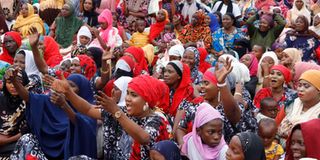
Women celebrate the election of Kwale's first woman governor Fatuma Achani in Tiwi Magodzoni , Kwale County, on August 14, 2022.

What you need to know:
- Women leaders in Kajiado say lack of public funding continues undermining female political participation and leadership ambitions.
- Activists warn donor funding cuts are crippling civic education and leadership programmes targeting aspiring women politicians across counties.
Elizabeth Kaguta has spent years doing work that the government says it supports but in practice does not. Across Kajiado County, the Maendeleo ya Wanawake leader trains women who aspire to elective office, equipping them with campaign strategies, leadership skills, and an understanding of what awaits them should they make it to Parliament or the county assembly.
The sessions are often held in community halls and sustained through donor support rather than public investment. So when Treasury Cabinet Secretary John Mbadi delivered the 2026/27 Budget and spoke about promoting meaningful participation of women in decision-making, Elizabeth listened intently.
She was waiting for something more tangible. “I did not hear of any budget for preparing women for leadership,” she says.


For Elizabeth, the omission reflects a broader contradiction at the heart of Kenya's gender equality agenda.
No public funding
Women are encouraged to participate in politics, yet no public funding is dedicated to helping them navigate a political landscape that remains structurally unequal. The gap is particularly visible in counties, such as Kajiado, where civic education and leadership training for women often depend on the goodwill of development partners.
“We are doing civic education, but it is not easy,” she says.
She notes that the nongovernmental organisation had been supporting the programmes. However, after USAid withdrew funding and terminated much of its foreign assistance in 2025, the funding pipeline dried up.
Recently, she organised a women's empowerment forum in Kajiado Town, bringing together participants from the county's five constituencies: Kajiado Central, Kajiado East, Kajiado North, Kajiado South and Kajiado West.
Elizabeth says the forum, which brought together five women from each constituency, was only made possible through financial support from Governor Joseph ole Lenku. The discussions ranged from gender-based violence to leadership and political participation.
The governor's intervention demonstrates what could be achieved if there were dedicated public funding and political goodwill to support women's journey to leadership.
Inclusion and political participation fund
The idea of such funding is not new. On December 9, 2022, President William Ruto set in motion efforts to address the longstanding challenge of a male-dominated Parliament. His memorandum to the speakers of the National Assembly and the Senate led to the formation of a 23-member multi-sectoral working group on the realisation of the not more than two-thirds gender principle by then Gender Cabinet Secretary Aisha Jumwa.
Among Dr Ruto’s proposals was the creation of a women's inclusion and political participation fund to finance education and training, mentorship, and capacity-building programmes for women seeking elective positions. The proposal was later adopted as one of the taskforce's key recommendations. The team proposed amending the Political Parties Act (Cap 7d) to establish the fund as an institutional framework for equipping more women to successfully contest legislative seats.
The taskforce argued that the initiative had the potential to reduce, and eventually eliminate, the need for top-up nominations by increasing the number of women elected directly to office. “The Bill seeks to capture the proper spirit of affirmative action and promote the essence of the greater gender inclusion agenda,” the team said in its report.
“It is expected that the provisions of the Fund will incentivise and equip more women to run for office, which, in a few election cycles, ought to bring the number of women contesting and winning elections closer to that of men. Notably, the Gender Principle is a mathematical ratio process. The more women get elected, the fewer the requirements there will be for top-up seats.”
Amendment to political party legislation
The taskforce handed its report to Aisha on February 23, 2024. However, the most recent amendment to political party legislation, the Political Parties (Amendment) (No. 2) Bill, 2024, sponsored by Senate Majority Leader Aaron Cheruiyot, contains no provision establishing the fund.
The Bill was published in the Kenya Gazette Supplement No. 96 on May 7, 2024, and passed by the Senate with amendments on December 5, 2024. For women such as Elizabeth, that absence is more than a legislative omission.
It means the burden of preparing women for political leadership continues to fall on donors, civil society organisations and the occasional goodwill of local leaders rather than on a sustained national commitment.