Rajab Sofia: A lifelong advocate for justice and constitutionalism
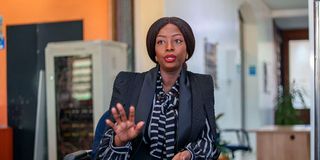
Sofia Rajab, a candidate for the Law Society of Kenya Council general member position, during the interview on January 16, 2025.

What you need to know:
- Sofia hails from Mariakani in Kilifi County, where she grew up witnessing the effects of marginalisation and discrimination in access to education and opportunity.
- These experiences, she says, shaped her passion for children's rights, reproductive rights, and gender equality.
For over 16 years, Sofia Rajab has walked the corridors of justice in Kenya—not just as a practising advocate, but as an activist committed to advancing human rights, gender equality and the rule of law.
Now vying for the position of General Member of the Law Society of Kenya (LSK) Council, she brings a rare combination of legal expertise, lived experience and unwavering dedication to the profession.
"I believe in LSK's mission and vision, not just for our members but for the nation. I feel particularly qualified to serve as general member because of the work and experiences I have gathered, and my passion to serve both my membership and the country," she says.


Sofia's journey in law began in 2009 after completing her studies at Nelson Mandela University in South Africa.
She started as an intern at the Kenya National Commission on Human Rights, advocating for constitutionalism, prison reform, and civil and political rights in a country still reeling from post-election violence.
Her work quickly expanded beyond Kenya's borders. She has engaged with both the African and United Nations human rights systems, focusing on transitional justice, conflict-related sexual violence and accountability for human rights violations. Her expertise has been sought in various forums, including the African Commission on Human and Peoples' Rights, the African Committee of Experts on the Rights and Welfare of the Child, and the Pan-African Parliament, as well as in treaty monitoring for the Universal Periodic Review.
Discrimination
Sofia hails from Mariakani in Kilifi County, where she grew up witnessing the effects of marginalisation and discrimination in access to education and opportunity. These experiences, she says, shaped her passion for children's rights, reproductive rights, and gender equality.
"I started as a peer educator in high school, teaching other children about safe sex and dignified childhoods," she recalls. "Even then, I was beginning my work in advocacy, though I didn't know it at the time."
Her legal career has been marked by a readiness to step into challenging moments. From providing frontline support for protesters during the 2024 maandamano protests to mobilising lawyers during the "End Femicide" demonstrations, she has consistently positioned herself at the intersection of law and social justice—often risking personal safety to protect citizens and uphold constitutional values.
It is the kind of commitment she plans to bring to LSK.
One of her defining areas of advocacy has been the rights of women and girls, particularly concerning female genital mutilation (FGM). She is currently challenging the constitutionality of arrests and prosecutions of FGM victims at the Narok High Court.
"I've never litigated against the government before," she explains, "but in this case, I felt it was necessary—not only to voice a legitimate grievance but to act as a buffer for my clients."
Her efforts have already yielded a preliminary victory: the court granted interim orders to prevent forced genital examinations.
"At the end of this month, we return to court for the government's response," she says, her tone resolute.
Within LSK, Sofia has been instrumental in shaping gender policies. Serving on the society's Gender Committee, she helped develop the anti-bullying and anti-sexual harassment policy, creating safer spaces for advocates and challenging entrenched norms in the legal profession.
Also read: From Kanu’s fall to Gen Z’s rise: Elections, legitimacy and the fight for the rule of law
Looking ahead, she has outlined three key priorities if elected to the LSK Council.
First, she aims to ensure a dignified wage for advocates by pushing for the review and implementation of the
Advocates Remuneration Order. This measure, she says, is long overdue and critical for thousands of struggling lawyers, particularly those practising outside Nairobi.
Second, she is committed to maintaining professional standards through strict adherence to ethics, professional conduct and a functional legal infrastructure that safeguards both advocates and the public.
Finally, she emphasises upholding the rule of law, positioning LSK as a steadfast guardian of constitutionalism and a counterweight against authoritarian tendencies in governance.
"I believe in a progressive LSK that fights for the nation, for the public's interest, and for the Constitution," Sofia affirms. "I am that person, and I am ready to serve."
She is equally passionate about supporting young advocates. She wants to ensure pupils and junior lawyers are not only adequately remunerated but also mentored into a profession that often feels impenetrable to newcomers.
"Many young advocates only see the standard areas of practice. But law is vast—maritime, environmental, intellectual property, and even emerging areas like AI in law. They deserve exposure, guidance and opportunity," she says.
Pay, she notes, is a critical issue, with many young lawyers earning as little as Sh10,000 to Sh15,000 per month.
"It's unsustainable," she says. "The Advocates Remuneration Order has not been reviewed in over 10 years. We must fight for a liveable wage and enforce a minimum standard of remuneration. Advocates cannot survive otherwise."
At the end of her two-year term, if elected, her success will be measured both qualitatively and quantitatively: by the number of initiatives completed, cases handled, and regulations passed—and, most importantly, by how advocates feel empowered, heard and supported in their practice.
"The Law Society is a reflection of the profession," she concludes. "If we uphold professionalism, the rule of law, and justice, we strengthen not only our members but the nation itself. My slogan is simple: fight for my members, fight for the nation. That's not just a slogan—it's my commitment."