Salome Matakwei’s new life: How widow of former SLDF commander is championing women's rights in Mt Elgon
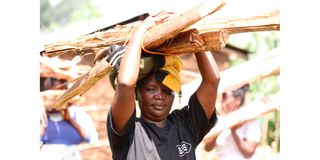
Salome Matakwei, widow of Mt Elgon militia leader Wycliffe Matakwei, carries firewood at her home in Cheptais, Mt Elgon, on May 25, 2026. Salome is now a human rights activist.

What you need to know:
- After enduring stigma and exclusion, Salome Matakwei transformed personal tragedy into advocacy for vulnerable widows.
- The mother of five now champions justice, legal aid and economic empowerment for women in Mt Elgon.
Salome Ndiwa Matakwei was devastated when her husband was gunned down by security forces in Mt Elgon in 2008. Her husband, Wycliffe Matakwei, was the commander of the Sabaot Land Defence Force (SLDF), a militia group formed in 2005 that claimed to be fighting for the land rights of the Sabaot community and resisting government evictions and land redistribution under the Chebyuk settlement scheme.
At the time, her immediate concern was how she would care for the five young children her husband had left behind, having been a housewife throughout their marriage. She had little idea of the additional challenges that awaited her in the aftermath of his death.
As she would soon discover, life for her and her children would be far from easy. The mother of five says she endured severe discrimination and stigma from both relatives and members of the community following her husband's killing.


According to Salome, she was ostracised and accused of having been an accomplice to her husband’s alleged role in atrocities committed during the SLDF insurgency.
“During the SLDF insurgency, many people were killed, and the community associated me with the atrocities that were committed. I knew nothing about them. I was simply the wife of Matakwei, who happened to be the leader of the group,” Salome told the Nation during an interview at her home in Cheptais.
She recalls that tensions were so high that police officers were assigned to protect her at home until her husband was buried. Despite the hostility, she refused to leave her home or succumb to pressure from those seeking to expel her from the community.
“I decided that I would not accept the discrimination. I was not involved in whatever happened to the locals and could not carry a burden that was not mine,” she said.
The discrimination and exclusion she experienced ultimately inspired her to become a human rights activist. Today, Salome is among the leading women human rights defenders in Mt Elgon, championing the rights of widows and vulnerable women.
Her work focuses on addressing challenges such as discrimination, property disinheritance and physical abuse experienced by widows. Through legal advocacy, community education and direct support, she helps women navigate some of the most difficult periods of their lives.
A trained paralegal, Salome provides legal assistance to widows facing succession disputes and property-grabbing cases. She also serves as chairperson of the Cheptais Network of Widows, a group with more than 300 members.
“Through the group, we help widows achieve economic empowerment through table banking and support those with succession cases in court by providing legal aid,” she says.
She notes that many widows in the area struggle with poverty, making it difficult to educate their children and meet basic needs. Disinheritance remains another widespread challenge.
Support
Beyond supporting widows, Salome also assists women and girls who have survived sexual and gender-based violence (SGBV). SGBV remains a major concern in Mt Elgon. According to the Kenya Demographic and Health Survey, Bungoma County, where Mt Elgon is located, recorded a physical violence prevalence of 62 per cent and an intimate partner sexual violence rate of 30 per cent among women.
Intimate partner violence remains the most common form of SGBV in the region, while cases of defilement and teenage pregnancy are frequently reported, particularly in remote areas previously affected by conflict.
Salome is among the beneficiaries of the “Let It Not Happen Again: Safeguarding the Rights of GBV Survivors Through Access to Justice” initiative, jointly implemented by UN Women and the CSO Network and funded by the Italian Agency for Development Cooperation.
The multi-year programme seeks to address systemic barriers that prevent women and girls, particularly survivors of gender-based violence, from accessing timely, affordable and gender-responsive justice. It provides legal aid, psychosocial support and advocacy services to help survivors pursue justice and break cycles of violence.
The initiative also seeks to transform harmful social norms and strengthen grassroots human rights organisations so that they better support survivors through legal processes. Salome says the programme has equipped her and other human rights defenders with vital skills to support survivors of gender-based violence.
“Through the training, we have learned about referral pathways available to GBV survivors. We have also been trained on preserving evidence, helping survivors access treatment and reporting cases to the police,” she said.
Salome's husband was killed during an ambush by security officers in Kopsiro, Mt Elgon, during the government security operation known as Operation Okoa Maisha, which was launched to suppress the SLDF insurgency.
The conflict largely involved two major clans within the Sabaot community—the Mosop, also known as Ndorobo, and the Soy—and was rooted in longstanding disputes over land allocation under the Chebyuk settlement scheme.
Today, Salome's journey from a stigmatised widow to a respected human rights defender illustrates how personal tragedy can be transformed into a powerful force for justice, advocacy and community change.


