Dear widows, mourn with one eye open
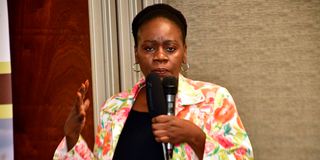
Faith Alubbe, a prominent advocate for women's land and property rights, at Jacaranda Hotel in Nairobi on July 19, 2024. She says for someone to be a widow, she was a spouse, and for someone to be a spouse, there was official marriage.

What you need to know:
- Widows face inheritance battles as activists and legal experts fight property grabbing across communities.
- Community watchdog groups are helping bereaved women safeguard land rights during vulnerable mourning periods.
For years, Rahab Wangari has stood beside women facing some of life’s most difficult moments. A renowned paralegal and human rights defender in Githunguri, Kiambu County, she has become a trusted ally for survivors of gender-based violence and widows fighting to protect their rights.
Her reputation is such that local chiefs often refer women directly to her. “They even give them my number,” she says with a laugh. “I sometimes wonder how they can send them to me when they are the ones with the mandate to resolve some of these issues.”
Much of Rahab’s work revolves around land and inheritance disputes, cases that frequently place her at odds with powerful individuals and expose her to threats. “I have handled cases where defending a widow’s rights has led to death threats,” she says.


One case remains firmly etched in her memory. A second wife had been completely excluded from her late husband’s succession process. While the first wife and her children were actively pursuing inheritance arrangements, the widow sat quietly, overwhelmed by grief. “The second wife was just there crying while the first wife and her children were busy with the succession process,” Rahab recalls.
The matter eventually went to court, where the succession proceedings were revoked, restoring the widow’s rights. The experience reinforced a lesson Rahab now shares whenever she meets widows. “We encourage women to mourn with one eye open,” she says. “It is good to mourn, but mourn with one eye open because everything can disappear while you are still crying.”
Her intervention angered some family members. “The children threatened to teach me a lesson for helping the second wife,” she says. “I told them, ‘You can threaten me all you want, but we know her rights.’ Eventually, they stopped.”
Across Kiambu County, similar efforts are underway to shield widows from disinheritance. In Lari, women have formed a community-based watchdog group dedicated to protecting widows during the critical days and weeks following the death of a spouse.
Gachambi Njuki, a member of the women-led group, said in an earlier interview that they move quickly whenever news of a husband’s death reaches them. “Our mission is to ensure that a widow does not lose everything while she is grieving,” she said.
The group often visits bereaved families and remains present throughout the mourning period to deter attempts to seize land documents, title deeds and other property. “We go there, camp there, and make sure she cries with one eye while the other remains alert,” Gachambi said. “Otherwise, you will stop crying when everything has already been taken.”
According to her, the approach has saved many women from losing their property. “We have helped many widows keep their property documents safe, and several have successfully completed the succession process because of that support,” she said.
Despite these successes, Gachambi says one challenge continues to complicate inheritance disputes: unregistered marriages. “I urge all married women to register their marriages,” she said. “Even if it is a customary marriage, make sure it is legally recognised.”
Without proper documentation, widows often face an uphill battle proving their relationship to the deceased and securing their rightful share of family property. “Women are disowned when their husbands die,” she said. “And when your marriage is not registered, that battle for land will really make you cry.”
Land transfer
But can a widow transfer her husband’s land to herself? Legal experts explain that a widow’s rights to matrimonial property largely depend on whether the marriage was legally recognised. “For someone to be called a widow, it means she was a spouse. For someone to be a spouse, it means their marriage was official,” explained Faith Alubbe in an earlier interview.
According to the Marriage Act 2014, marriage is the voluntary union of a man and a woman, whether monogamous or polygamous, and may be recognised through five forms: civil, religious, customary, Hindu and Islamic marriages.
Meanwhile, the Matrimonial Property Act 2013 defines matrimonial property as matrimonial homes, household goods and effects, as well as movable and immovable property jointly owned and acquired during the subsistence of the marriage.
The law defines a matrimonial home as any property owned or leased by one or both spouses and occupied or used as a family home, including any attached property. However, trust property, including property held under customary trusts, does not form part of matrimonial property.
The law also recognises prenuptial agreements that determine property rights between spouses. Either spouse may apply to court to have such an agreement set aside if it was obtained through fraud, coercion or is found to be manifestly unjust. “A wife remains in possession of matrimonial property upon her husband’s death through the process of succession,” Faith added.
“The process is usually straightforward where there are no disputes. The widow obtains a letter from the chief confirming that the deceased lived in the area and that they were recognised as husband and wife. She also requires documents such as the death certificate and burial permit before applying to court to be appointed the sole administrator of the estate.”
The process becomes more complicated for women who were cohabiting without formalising their union. “In a come-we-stay arrangement, there is often no documentation proving the parties were husband and wife. When the partner dies, the woman must first seek a court declaration under the presumption of marriage doctrine,” Faith explained. “Once the court grants the presumption of marriage decree, she can proceed with the succession process as a widow.”
Federation of Women Lawyers Kenya senior legal counsel Dennis Otieno outlined the process for widows whose husbands die without leaving a will. “In cases of intestate succession, the widow will need a beneficiaries’ letter prepared by the chief, a copy of the death certificate, recent searches for land and motor vehicles, bank account details and copies of share certificates, among other relevant documents,” he said.


