Sarah Mullally breaks 1,400-year barrier to become first woman archbishop of Canterbury
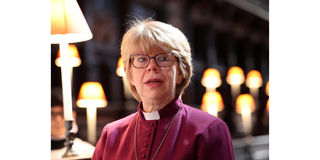
Sarah Mullally, the Anglican Church Archbishop of Canterbury.

What you need to know:
- The naming of Sarah Mullally as the first woman to lead the Anglican Communion is a watershed moment in the church’s history of male dominance.
- Mullally embodies the challenge faced by women who must defy conventions, confront bias, and lead with grace in institutions long defined by patriarchy.
The October 3 appointment of Sarah Mullally as the next Archbishop of Canterbury—the global spiritual leader of the Anglican Church—marks a watershed moment for this institution and for women in all leadership spheres.
Her ascension is significant given that the church, founded in 597 AD, has existed for 1,400 years. Dame Mullally will be the 106th person to hold that office. That it has taken this long for women to rise to this position indicates the patriarchal character and structure of the church.
Mullally's progression shatters the famed glass ceiling of sexism and is cause for celebration. But it is also a solemn moment for reflection. Will this be the beginning of lasting change or a one-off event? The answer partly lies in the current presence of women in the church's leadership generally.


A quick search shows only four other women Anglican archbishops in the world. Kay Goldsworthy of Australia was appointed Archbishop of Perth and Metropolitan of Western Australia in 2017, making her the first woman to hold such a position globally. Melissa Skelton served as Archbishop of New Westminster, Metropolitan of British Columbia and Yukon (Canada) from 2018 to 2021.
Anne Germond is currently Archbishop of Algoma, Metropolitan of Ontario (Canada), having assumed office in 2021. Lynne McNaughton has been Archbishop of Kootenay, Metropolitan of British Columbia and Yukon (Canada) since 2021.
The list means that the echelons of power in the church remain skewed in men's favour. Against the backdrop of 883 bishops in the church, the number of women is an insignificant droplet in an ocean of men. The list also shows that Africa has yet to have a female Anglican archbishop.
But there are diocesan bishops—only six on a continent of 54 countries. Two of these bishops are in Kenya: Dr Emily Onyango, Assistant Bishop in the Diocese of Bondo since 2021, and Rose Okeno, Bishop of the Diocese of Butere since 2021.
The others are Dalcy Badeli Dlamini of Eswatini, appointed in 2021; Dr Vicentia Kgabe of Lesotho, in office since 2021; Elizabeth Awut Ngor of Diocese of Rumbek, South Sudan, bishop from 2018; and Filomena Tete Estevão of the Diocese of Bom Pasteur in Angola who took office in 2023.
Women becoming Anglican bishops is thus a phenomenon that has only gained traction in the last decade. Their rarity is perhaps why the bishops have established their own grouping code-named “Africa Six”, which held its fifth gathering last year in Limuru around the theme of “Embarking on a Journey of Faith: Defying Conventions and Leading with Grace”.
Heavy burden
This theme reflects recognition of the weight they carry—not only surviving in a male-dominated sphere but also clearing the path for other women. This is the theoretical idea of symbolic consequences: they are given the burden of representing their category, not just themselves. This is compounded by extreme expectations where they are measured using two yardsticks—one on how they perform their official roles and the other on how they live up to behaviours expected of women.
They are condemned for failures any other person would have experienced, but their shortcomings are also blamed on their gender. Moreover, greater visibility earns them harsher judgement for moral slippages than would be accorded men in similar situations. Beyond this, women as a minority also suffer the impostor syndrome—feelings of self-doubt and inadequacy—as well as condescending treatment by male professional colleagues.
Zuzanna Staniszewska's article (Daily Nation, September 26, 2025) pointed out an offshoot of this called the superwoman impostor syndrome, characterised by trying to achieve unrealistic expectations such as being “ever-competent, ever-ambitious and ever-in-control”. Before her appointment, Mullally was vocal about the cover-up of sexual violations in the church that led to her predecessor’s resignation.
There is, therefore, a valid expectation that safeguarding against sexual violence will be one of her priorities. Considering that she must retire at 70 years—six years away—her ability to make radical changes will be limited by resistance from conservative colleagues who believe that women should not exercise authority over men.
She will also face opposition for her liberal views on same-sex marriages, although she maintains that marriage is a union between a man and a woman. How Mullally will navigate the terrain is yet to be seen. But going by the reactions of conservative bishops who see her ascension as an affront to the church's norms, the road ahead is less than rosy.
The author is a lecturer in Gender and Development Studies at South Eastern Kenya University ([email protected]).


