Suffering in silence: How Kenya's healthcare system abandons older women
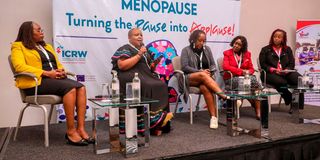
Women's Health Cafe representatives discuss menopause and women's rights at Radisson Blu Hotel, Nairobi, on August 20, 2025. The panellists are (from left) Ruth Musembi, Elsie Wandera, Nimo Githahu, Wairimu Karuri, and Mukami Karanja.

What you need to know:
- Justice Njoki Ndung’u’s story highlights urgent need for affordable menopause care and policy reform in Kenya.
- Health leaders urge menopause awareness, hormone therapy inclusion, and increased funding for women’s reproductive health needs.
Society has yet to allow girls and young women to menstruate in peace, despite the painful cramps, mood swings, and reduced productivity they endure. The government, too, has made little effort to make menstrual products affordable.
When menstruation ends, women enter another phase (menopause) marked by cracking bones, frozen shoulders, hot flashes, brain fog, and mood swings. Yet once again, they face stigma from society and neglect from the government.
At a menopause conference on August 20, multiple speakers, including sexologists, psychologists, psychotherapists, gynaecologists, psychiatrists, women with lived experiences, and an official from the Ministry of Health, agreed that menopausal health is grossly neglected, with a 13-times funding deficit for women’s health.


Justice Njoki Ndung’u of the Supreme Court of Kenya shared her struggle with “brain fog,” a common menopausal symptom.
“I was convinced I either had the onset of Alzheimer’s or early dementia. I went through MRI (Magnetic Resonance Imaging), Cat scans, psychometric tests and blood tests. Finally, three doctors: a neurologist, a psychiatrist and another doctor, all looking at my brain and behaviour said it was menopause: ‘There is nothing wrong with your brain,’” she said.
Yet, when she returned to Kenya in search of treatment, she found limited options.
“Most gynaecologists here focus on childbirth. For older women, reproductive health care is scarce. Africa does not benefit from the latest medical protocols or medicines that could ease our symptoms. Where they exist, they are too expensive,” she said.
Njoki likened the situation to Kenya’s long battle for affordable sanitary pads, warning that menopause care must be approached with the same urgency.
“It’s in the same vein that we engaged policymakers when discussing the cost of sanitary towels, and Kenya became the first country to zero-rate them so that they could be affordable for women and girls who menstruate,” she said.
“I think we have rolled back a little on that, there is now some taxation on sanitary products, but that is the kind of engagement we also need to have around menopause.”
Dr Edward Serem, head of reproductive, maternal, new-born, child and adolescent health at the Ministry of Health, admitted the government has fallen short.
“Only four per cent of health budgets go towards women’s health. That is shockingly low. We are facing a 1,300 per cent gap compared to what is required to meet actual needs. Unless we invest, women will continue to suffer in silence,” he said.
Dr Serem described menopause as not only a women’s issue but “a public health imperative, an economic issue, and a human rights issue”. He warned that untreated symptoms can lead to osteoporosis, cardiovascular diseases, diabetes, and depression
He pledged to constitute a committee to drive policy on menopause.
“Healthcare professionals are not well prepared to handle menopause. We must train them, incorporate menopause into curricula and sensitise communities,” he said.
Prof Joachim Osur, the vice chancellor of Amref University and a sexologist, criticised health systems and insurers for dismissing menopause as “not a disease”.
“When women come with these problems, insurance doesn’t pay. At the primary healthcare level, most workers don’t even know what hormone replacement therapy is,” he said.
Prof Osur urged routine data collection on menopause to inform policy. He also called for the inclusion of hormone replacement therapy drugs and other medicines that help women manage menopause symptoms, in Kenya’s essential medicines list.
“When men lack erections, multiple drugs are available. But when women suffer pain from dryness or lack of sexual desire, we have nothing to give. We must end this injustice,” he said.


