The coin revolution: How Isiolo women are breaking free from financial dependency
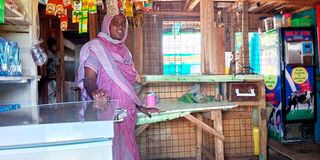
Batula Hussein inside her shop in the Kambi Garba area of Isiolo North. She's a member of the Zawadi women's group who has benefited significantly from the VSLA model.

What you need to know:
- Pastoralist women in Isiolo empower themselves economically through communal savings, defying tradition and patriarchy.
- Supportive husbands, coupled with simple financial tools, are unlocking women’s economic potential in northern Kenya communities.
The metallic clink of coins dropping into a locked cash box echoes through the room as women carefully count their weekly savings. Passbooks are meticulously updated, recording each contribution with precision. This ritual, repeated in homes across Isiolo County, represents more than just money changing hands—it's a quiet revolution transforming the economic landscape for pastoralist women.
"I developed interest in this model after we underwent training by one Kuresha Bille in 2021 and learnt of the benefits those who had joined before were enjoying," says 30-year-old Batula Hussein, a member of the Zawadi women's group, her face brightening as she recounts her journey.
The model she is referring to is Village Savings and Loan Associations (VSLA) is a community-led financial model that offers women a platform to save and access credit from the group's accumulated savings made by purchasing shares, whose price is determined by the members at the beginning of every cycle.

From struggle to success
About 300 metres past a police roadblock within the diversion to Isiolo Referral Hospital towards Samburu side and exactly behind Newlife Missionaries Integrated School along the Isiolo-Moyale highway is Batula's home.
A wooden gate to the left, a shop nestled in the centre and a butchery to the right welcome visitors to her home resting on a 50 by 100 plot carpeted in green grass, a rare occurrence in the arid and semi-arid region, thanks to the recent downfall within Kambi Garba area in Burat Ward.
As we approach her two-bedroom timber house, two children can be spotted feeding about 10 layers (hens) at the far end of the plot where a pit latrine has been dug. Her husband, Abdullahi Ali, joins the conversation, sitting on a different sofa, ostensibly to keep track of the interview.
From running two enterprises to venturing into poultry keeping as well as purchasing a motorbike, all with a daily cumulative income of at least Sh2,000, Batula is living a dream she never thought possible.
At the time she joined the VSLA, she was selling vegetables at a makeshift kiosk along the highway while her husband relied on occasional contractual jobs as a truck driver whose income couldn't sustain the family, forcing her to often rely on relatives for the weekly savings.
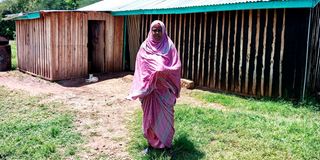
Batula Hussein outside her house built using savings from her Women's Group.
"I used to save between Sh200 and Sh400 weekly and got Sh15,000 during that year's share-out and used the money to start off construction of this house. We were at the time living in a house that had been extended from our parents'," she recalls.
She saved Sh48,000 and Sh50,000 in the subsequent years, with the former going towards expansion of the one room they had constructed in the previous year. A Sh30,000 loan from the savings group enabled them to construct the shop at her home and a kitchen.
"After the first share-out, my husband and I saw first-hand the benefits of saving. His support has been immense since that time, easing the burden for me," an elated Batula says.
Breaking cultural barriers
Abdullahi, Batula's husband, says his wife joining the group had not only taught him the importance of saving but significantly improved their lives by offering them multiple sources of income.
"We used to spend money recklessly but not anymore. We have cut down on our expenses because we get food and milk from the shop. The income from the shop and butchery is enough to take care of other needs including education for our children," he says.
Hailing from the Somali community where patriarchy remains deeply ingrained, limiting women's access to and control over resources, Abdullahi deliberately chose to go against the grain.
Limited access to resources and participation in economic decisions that impact their lives, as well as men's portrayal as the sole breadwinner, not only reinforces women's dependency but also gives men financial power of dictating how resources will be used.
Read more: Why every woman should belong to a chama
"I am not in any competition with my wife. I know when she is empowered, my children will have a good life," he says, adding that Batula had become a key economic player in the family. "We make our financial decisions together including the amount of loan to pick and how to use funds at our disposal."
Only 32.1 per cent of the working population in Isiolo County are women, according to data from the Kenya National Bureau of Statistics (KNBS), with a survey by the British High Commission (Nairobi) conducted between July 2022 and March 2023, showing women make up to 66 per cent of the informal workforce in Kenya.
Beyond basic needs
Half-a-kilometre from Batula's home within Kambi Garba area is Fatuma Idd, 58, of Daya women group who, besides being able to educate her son in college, has also fenced off her land and connected water using her savings from the women's initiative.
Fatuma received Sh30,000 during her group's last year share-out of Sh1.2 million where the highest saver got Sh51,000. The group has 24 members.
She says she no longer regrets exclusion from formal financial systems (banks) as she now can easily access credit without going through bureaucratic processes as required by banks.
"I do not have to travel to town to access financial services. I only make a loan request and share with the members the reason for the credit whose processing does not take long," she says, adding that she no longer entirely relies on her husband for every need.
Read more: Chamas putting a big smile on women’s faces
One of her colleagues who had visited her on the interview day, though cautious, revealed setbacks as a result of slothful reception of the model by men, the majority who fear it could threaten their financial autonomy at their homes.
"We faced a lot of resistance at the onset but men have over time appreciated the benefits, realising that the meetings we attend are not for mere gossiping but economic empowerment," she shares.
Group's secretary Fatuma Ali shares that of all the 24 members, only three had opened bank accounts following expansion of their businesses.
"Many of us never handled money. Lacking formal jobs and economic opportunities, we entirely relied on men to take care of every need, limiting our access to and controlling resources," she says.
Loan default, she says, is difficult as members are offered flexible payment terms which are extended based on validity of reasons offered for the delays. "Members have three months to clear a Sh10,000 loan and six months to pay Sh20,000 loan."
A member of another group was recently ordered to quit VSLA by her husband on allegations of not being transparent with her savings.
Building dreams, brick by brick
A 20-minute drive from Kambi Garba along Isiolo-Moyale highway leads to Antanas Ekwam's home within Manyatta Kona in Ngaremara ward, about five kilometres to Archers Post-within Isiolo-Samburu border.
A member of Egero Emuria Women Group, the Turkana woman, who is an ECDE teacher at Daaba Primary School, is happy a construction she started with her savings several months ago is taking shape.
Her journey with the group of 32 members started in 2020 immediately after they were trained on the basics of the financial model by a conservationist Joycephine Ekiru. She was among the group's 10 pioneer women.
"We were all in a table-banking group before we transited to this model. My breakthrough came after our first share-out where we invited our husbands to witness the fruits of our savings," she recalls, revealing that she handed her Sh30,000 savings to her husband who purchased a cow.
The gesture, she says, made her husband commit to support her subsequently, allowing her to continually increase her weekly savings and participate with two different groups, at least Sh2,000 weekly for both.
In the last two years, she saved a total of Sh400,000, half of it going towards purchase of building materials for two rented shops that are almost complete.
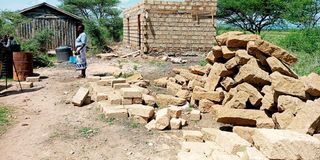
Antanas Ekwam’s ongoing construction of rental shops at Manyatta Kona in Ngaremara Ward which has been facilitated by savings with Village Savings and Loaning Association.
"I bought the materials in 2023 and have lied here for a whole year until last December when I received Sh200,000 from two share-outs, allowing me to start off the construction. I am confident I will complete the roofing after the share-out at the end of the year," she says.
She is hopeful that once complete, the rentals along the highway that links Upper Eastern to the North will be occupied, earning her extra income. Her group shared out Sh1.3 million last year.
Apart from her salary, she also earns income from a shop within her home.
The 44-year-old says success of these initiatives locally has earned them respect and social status, building their public confidence which has encouraged them to speak about issues that affect them and the larger community.
"Early this year, our group helped reconcile a warring couple and the gesture has earned a lot of respect from the community."
How the system works
Kuresha Bille, who facilitates the women's groups, says after training them on basic financial skills and record keeping, the members are helped to undertake elections where chairperson, treasurer, secretary and two money counters are picked.
"We advise them to be in groups with members they trust and to pick leaders with integrity so that there is a sense of ownership. We undertake monthly visits to check on the members' passbooks, loan history and absenteeism," she says.
She reveals that members borrow up to three times the amount they have saved, and credit amount is capped to ensure funds are available for other members to borrow.
"Members determine the share price, loan interest rate, repayment timelines, fines and social fund contributions, and each have a passbook to note and track their individual savings and loan history," Kuresha reveals.
The passbooks and weekly contributions are locked inside the cash box that has three locks and which is only opened during meetings where at least two-thirds of the members are present.
This approach, she says, offers women a space to air their opinions, make decisions and contribute to the growth of the local economies which has made them become more visible within their communities, thereby ending historical marginalisation.
"Women are no longer viewed as a weaker sex, but agents of change for contributing to the financial growth of their families."
Community transformation
A local elder, John Ekai, says the community's financial literacy had significantly improved in the last few years following the introduction of these financial groups in Ngaremara Ward.
"Our people, men included, are more conscious of savings but women have reaped more because even without collateral, they are able to access loans and start income generative initiatives for economic empowerment," Ekai says.
The elder further says the empowerment had portrayed women's potential as economic enablers, earning respect from their husbands who are increasingly seeing them as helpers and not beggars.
"Men have over time seen the benefits of saving and their inclusion by the women has made this approach among the sustainable ways of breaking the existing economic barriers and the cycle of poverty," he notes.
Joycephine Ekiru, who has trained more than 30 groups in Ngaremara Ward, reveals that last year, all the groups had a cumulative share-out of Sh35 million, all that was injected into the local economy.
"The groups have between 15-30 members and each had an average share-out of at least Sh1 million. Majority of these women used to burn charcoal to eke a living but have started small businesses, whose income has enabled them to support their families," she says.
Policy support and gaps
Isiolo County gender officer Abdirizack Guyo says the Governor Abdi Ibrahim Hassan's administration was working closely with local non-governmental organisations to train women on financial literacy and issue them with cash boxes for safety of their contributions.
There are, however, knowledge gaps because the majority of the women involved in such initiatives, estimated to be over 7,000 across the county, have not received training on financial literacy and record keeping. More than 1 million women are engaged in similar financial groups across the country.
The department, he says, was encouraging women to shun being in many groups to ensure minimal cases of picking a loan in one group to service a debt owed to a different group.
"We have discovered that the majority of the groups are not registered with the social services which makes it hard for them to benefit from government's initiatives such as Women Enterprise Fund," Abdirizack says.
He says they were also monitoring progress of the select groups that have been trained by the county government on a monthly basis but did not share indicators that they use to determine success of any group.
An existing county gender policy 2021-2025 and expected operationalisation of youth, women and persons living with disability enterprise fund, he says, would promote financial inclusion of women who will be able to access funding to start and expand existing businesses.
An Act developed by the former regime and which was amended in 2021 after the Controller of Budget halted the disbursement of Sh43 million to more than 1,000 beneficiaries due to discrepancies in administrative fees is yet to be operationalised.
This means the targeted groups will wait longer to benefit from the revolving fund whose initial idea was to offer zero-interest loans of between Sh50,000-Sh200,000 and Sh100,000-Sh500,000 for individuals and groups respectively, payable in two years.
But amid inadequate support, pastoralist women in the two wards, once confined to traditional roles of caregiving, looking after livestock, fetching water and firewood, are now getting into the economic spotlight and stimulating local economies.
Data from National Gender and Equality Commission show that women in Kenya spend an average of 4.7 hours daily on unpaid care work compared to 1.7 hours for men, limiting their opportunities for economic progression.
Banking on Trust
Financial analyst Peter Ngechu says this grassroots financial approach has contributed to increased access to financial services for marginalised communities as it was more attractive than the formal banking systems.
"This approach is attractive for people with informal sources of income as one is not required to provide proof of income to access credit and is managed by the members which helps build trust and create a sense of ownership," Mr Ngechu says.
The interest on loan for the banks in Kenya ranges between 12-20 per cent per annum while that for these community groups between 5-10 per cent per loan cycle.
One must present physical collateral such as logbook, title deed, payslip and guarantors' details before accessing a loan facility at a bank, while loans in these women's groups are offered based on trust. The application process for banks is cumbersome and disbursement slower compared to community-based initiatives.
The analyst notes that banks have fixed payment terms while these women's groups offer flexible terms based on members' verbal agreements that are entered in the group's records.
"You cannot access a loan from a bank without multiple documents including KRA PIN, ID, bank account and Credit Reference Bureau Clearance but for these groups, only Identity card and active membership is needed," he explains.
He further terms the approach as ideal in promotion of financial inclusion of pastoralist women by encouraging a savings habit and offering flexible and affordable credit.
As the sun sets over Isiolo's arid landscape, these women continue to gather in small groups, their coins and notes steadily accumulating in locked boxes—each contribution writing a new chapter in their journey towards financial independence.
This story is published with support from the Aga Khan’s Graduate School of Media and Communications under the Advancing Gender Equality in Media and Communications project.


