The day Raila’s hope of witnessing a historic gender milestone was dashed
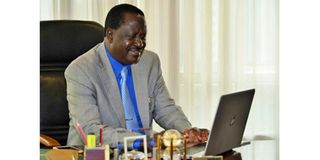
ODM leader Raila Odinga in his Nairobi office. Raila and other political leaders rallied MPs behind the Duale Bill in 2018, but inadequate attendance and opposition doomed the proposed constitutional changes on women’s representation.

What you need to know:
- Raila Odinga and other political leaders rallied MPs behind the Duale Bill in 2018, but inadequate attendance and opposition doomed the proposed constitutional changes on women’s representation.
- Despite intense lobbying by political leaders and women MPs, the Constitution Amendment Bill seeking to enforce the two-thirds gender principle failed, leaving Parliament short of constitutional gender equity requirements.
On the afternoon of November 28, 2018, former prime minister Raila Odinga walked into the National Assembly Speaker’s gallery, accompanied by Wiper leader Kalonzo Musyoka, hoping to witness a historic gender milestone.
At that moment, Members of Parliament (MPs) were preparing to vote on a bill Raila and others had only days earlier described as crucial: The Constitution (Amendment) Bill, 2018, popularly known as the Duale Bill, after its sponsor, then Majority Leader Aden Duale.
The bill sought to amend Articles 97 and 98 of the Constitution on the membership of the National Assembly, to bring the House into compliance with the two‑thirds gender principle. It proposed allocating special seats proportionate to the number of seats won by each political party, with the number determined after every general election.


Sunset clause
A 20‑year sunset clause was included, with the option of a single 10‑year extension, on the expectation that significant gains in gender parity would have been achieved by then. Less than a week before the vote, Raila, as ODM leader, and President Uhuru Kenyatta, heading Jubilee, convened a crisis meeting with their MPs to lobby for the bill’s passage. At the time, Jubilee held 140 seats and ODM 62, making them the two largest parties in the House.
When Duale rose to speak, it was expected he would present the bill for its Second Reading. Instead, he requested a deferment. “In making this request, after consulting the House leadership and the Whips, I am conscious of the fact that should we proceed to attempt the vote, we will not have the numbers,” he said.
“Upon counting the Members present, if it is discovered that we are less than the requisite threshold of 233 Members as required under Article 256(d) of the Constitution, we will risk losing the Bill.”
He warned that failure would mean republishing the bill in the next session, waiting 14 days plus a 90‑day maturity period, and undergoing fresh public participation, pushing consideration to June 2019 at the earliest.
Deferred
Deferring, he argued, would save the bill and allow the House to resume with the Second Reading, Committee stage, and Third Reading in February, 2019. Then Speaker Justin Muturi confirmed that only 212 MPs were present, short of the 233 required. Even among those present, opposition and reservations persisted.
Kikuyu MP Kimani Ichung’wah noted that nominated MP David Sankok, representing persons with disabilities, believed elective positions should be exempt from the two‑thirds gender rule. Then Kandara MP Alice Wahome acknowledged the efforts of Raila, Kalonzo, and Duale in pushing for the bill, saying they had taken “a very serious approach.”
“The female Members of Parliament worked overnight. We burnt the midnight oil last night. We had dinner in support of this Bill. The numbers that have turned up today will increase the votes we need by taking out the matter today,” she said, displeased, however, with the line of discussion advanced by Ichung’wah and Sankok.
Just 174 MPs
Meanwhile, Junet Mohamed, who at the time was the Minority Whip and Suna East MP, stressed the urgency of the bill. “We have discussed, talked, lobbied and prayed for it. This is a Bill we need to dispose of. I have not seen this House as full as this recently. We have whipped Members,” he said.
“Look at my numbers; they have never come like this. The National Super Alliance Members are 135. Almost over 100 Members are here. They have come.”
Despite the lobbying, the vote was deferred to February 2019. When the matter returned, attendance was even more disappointing. The number had dropped to just 174 MPs. The bill collapsed, becoming another chapter in the long history of failed attempts to entrench gender equity in Parliament.
Sixteen years on, the bill has yet to be passed. As the country marks the first year since Raila’s death, there is still nothing to show for his push to enshrine women’s fair representation in elective office.