The end of communal child: Who’s teaching our teens about sex?
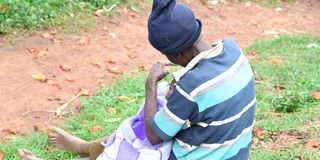
A teenage mother with her baby. Teen sex can have far-reaching consequences for teenage mothers and their babies.

What you need to know:
- With family guidance fading, teenagers are turning to peers and the Internet for sex knowledge, often with risky consequences.
- New community-led talks in schools and churches offer hope for honest, structured sexuality education in urban Kenya.
Last year, I interviewed Anne Mwema*, a 17-year-old girl from Nairobi’s Mathare settlement who entered marriage at just 13, to her teenage boyfriend.
Her early entry into sex and marriage was driven purely by survival. “I don’t know who my parents are. I lived with my grandmother, who told me my mother abandoned me when I was a baby and disappeared, never to be seen again,” Anne shared.
“She had eight other grandchildren to care of and survived by doing laundry. Life was tough. We would spend an entire day with just water. So, when a boda boda rider approached me, I didn’t think twice. One month later, I was pregnant, and that’s how I became his wife.”


However, Anne says that afterwards, her husband, then aged 17, began to panic, admitting he didn’t know how to take care of a wife and felt he was too young to be a father. “He started drinking and became abusive. Eventually, he chased me away. I had to return to my grandmother and join her in doing laundry to provide for my daughter,” she explained.
This is not an isolated case. The reality that children are engaging in consensual sex and, in some cases, even getting married is no longer surprising in Kenya. Presently, three teenagers have filed a case at the High Court in Nairobi challenging the Sexual Offences Act (2006), arguing that it fails to recognise consensual sex between individuals under 18.
A 2024 study uncovered a worrying shift in young Kenyans’ attitudes towards sex. The research, conducted by Shujaaz Inc. and the MTV Staying Alive Foundation, surveyed 15–24-year-olds in Nairobi, Mombasa, Kisumu, Narok, Meru, and Nakuru counties. The Gates Foundation, Co-Impact, Echidna Giving, Imaginable Futures, and the Wellspring Foundation funded it.
The research explored education, sex and HIV, money and work, relationships, and gender-based violence. It found that young people are moving away from traditional norms, such as the belief that they should avoid premarital sex or remain ‘pure’. Instead, sex before marriage, as well as sex with multiple partners, was perceived as increasingly normal and even commonplace among their generation.
At the same time, they recognised that early sexual activity was still frowned upon by parents, elders, and much of the wider community that placed importance on keeping such behaviour discreet. Faced with this harsh reality, is there a reset mode? Is there a better way of revealing to young people the realities of sexuality before they begin to explore and gamble with their lives?
Samuel Okoth, a social science analyst involved in the study, warns that Kenya’s societal fabric is fraying under the pressures of modernisation, digitisation and shifting family responsibilities, with profound consequences for how young women and men learn about sexuality. He says the responsibility for sexuality education, once firmly rooted in family and community structures, has been abandoned.
“Parents are transferring responsibility to schools, imagining the discussion is happening there,” he explains. “Meanwhile, teachers believe it’s being handled at home. The ball has been dropped somewhere.”
In the past, the social science analyst recalls, children learned about life’s milestones from members of the extended family, such as aunts, uncles, and respected elders. Topics such as gender roles, sexual responsibility, and relationship boundaries were introduced in culturally grounded and age-appropriate ways.
“Back then, a child was a communal child,” he says. “If you saw something wrong, you intervened, even if it wasn’t your child.”
Today, he argues, that protective net has unravelled and children have turned to the Internet for sexual knowledge. “But what are they learning online and does it align with our cultural ethos?” he asks.
Additional risks
In cases like Anne’s, where poverty and neglect are additional risk factors, he says the community should step in to offer support and protection. Nevertheless, he sees promise in structured, communal-style sexuality programmes tailored to urban settings. He cites a school in Kajiado where monthly “boy-child talks” pair children with non-parent adults to discuss sexuality in small groups, reducing embarrassment and encouraging openness.
“Parents come to school, but instead of talking to their children about sexuality, they swap,” he says. “I’m not speaking to my child directly; another parent is. That removes the awkwardness of ‘my dad is talking to me about sex.’ The children know their parents are talking to other children too. Sometimes they’re placed in groups of 10, and one parent rotates among them. If we had more setups like that, these conversations would be easier.”
He says some churches run a similar holiday session. He envisions multi-day retreats where trained elders lead age-specific discussions on sexual and reproductive health. “There’s another church that does this during every holiday, bringing teenagers together and inviting speakers to talk about sexuality and what it means to be a man or a woman. I think such setups can work in an urban setting, instead of trying to find villages or taking children to villages that might not even exist anymore,” he says.
*Name changed to protect her privacy.


