The Irish nun who turned Kenya's slum into an educational powerhouse

What you need to know:
- Sr Mary Killeen, an Irish nun, transformed Kenya's Mukuru slums over 50 years by building state-of-the-art schools that have educated 170,000 children.
- Her mission began after 12 street boys surrounded her in 1984, not to rob her but to ask for help feeding their siblings.
- From six informal schools to a comprehensive network of educational and social services, the "Mother of Mukuru" continues her advocacy for women and girls.
The air is thick with dust as children file through the gates of Sancta Maria Primary School. The modern building stands in stark contrast to the surrounding maze of corrugated iron structures that make up Mukuru, a slum in Nairobi. Inside, an Irish nun watches over them with gentle eyes that have witnessed nearly five decades of transformation.
“The greatest reward is to see deprived children get an opportunity to explore their God-given talents and to live with some degree of dignity and respect,” says Sister Mary Killeen, her Irish lilt still pronounced despite her 50 years in Kenya.
Born Mary Brigid Killeen at Rotunda in Dublin, Ireland, she was the fourth child and first daughter in a family of eight. Raised in Phibsborough, she attended St Peter's for primary education and Mount Carmel, Kings Inns Street for secondary school before joining the Sisters of Mercy in January 1965 at 20.


“After novitiate, I taught in Carysfort National School and in the national school in Goldenbridge,” she recalls. “These nine years of teaching in Ireland were great experiences. They developed me, and helped me a lot with future work in Mukuru.”
At 30, her life took an unexpected turn. The board of Sisters of Mercy, Ireland, asked her to come to Kenya in November 1975. She was posted to head a primary school in Nairobi called Our Lady of Mercy. The pivotal moment that would define her mission came in 1984. Walking home from school, Sr Mary was surrounded by about 12 street boys. “I was terrified. Please, do not take my clothes and handbag,” she pleaded. “It's the day I will never forget in my life.”
Instead, the boys had a different request. “I was scared, but they said they were friendly. We need to feed our siblings. Some of us are in streets, our sisters were raped and neglected. Please, help us,” she quotes them as having told her. One of them, known as Karanja who eked out a living playing ‘wandindi’ (a locally made one-stringed musical instrument), touched her arm as they spoke.
That encounter sparked something in Sr Mary. She approached the management of Our Lady of Mercy about helping street children and those who weren’t attending school. The school accepted her proposal and she acquired land and established a school at Mukuru-Kayaba in South B, Starehe, in May 1985. “I directed this school and hired teachers to teach there as I was still the headmistress of Our Lady of Mercy. I was transferred to Mukuru full time in 1990.”
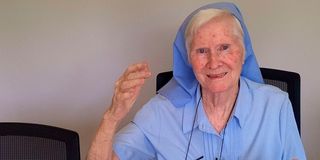
Sr Mary Killeen during the interview on February 28, 2025 at Mukuru Promotion Centre.
Her first structure was made of iron sheets, Mukuru Primary School, which would later become Sancta Maria Primary. The name has a poignant origin. “We came up with the name derived from Biblical Mary, Mother of Jesus, and a girl called Mary from Mukuru Primary who was a hero during a night fire at Nairobi Girls’ High School,” she explains.
“This old girl named Mary from Mukuru who joined Nairobi Girls in Form One woke up to a rude shock after a dormitory went on fire. She called the other girls who were asleep and saved 10 girls from the raging flames, but, unfortunately, she succumbed to burn wounds. That's why we called the school Sancta Maria.”
In 1991, Sr Mary opened Lunga Lunga Primary School in Mukuru-Lunga Lunga. The name was later changed to St Elizabeth, inspired by a biblical connection.
“You, Mary from Mukuru, have visited Elizabeth at Lunga Lunga. Then, let us name the school St Elizabeth Primary, instead of Lunga Lunga Primary,” she recalls.
Her third school, St Bakhita Primary, was established on Likoni Road in Nairobi's Industrial Area at the suggestion of Cardinal Maurice Otunga, who wanted it named after a Sudanese slave rescued by Italian soldiers. “The slave was saved. Italians, who usually visited her and asked her to pray for them, noted that their prayers were powerful—they were answered. Her name was Bakhita,” Sr Mary says.
St Catherine became her fourth school, named after Catherine McAuley, founder of the Sisters of Mercy. “The school parents suggested we name the school after Sr Catherine, and the government registered it as St Catherine Primary School. It is situated opposite Mater Misericodiae Hospital in South B, Starehe.”
She established the Reuben Centre in 1986, which was later handed over to a Japanese NGO, African Education Fund (AEF). When the AEF withdrew after six years, the centre faced closure, but Sr Mary's determination kept it going. In 1998, the first Teachers Service Commission teachers were employed, and the school was registered as a government facility, offering vocational classes in carpentry, dressmaking, and tailoring.
In 2000, Brother Bob Aron became the first Christian brother manager of the Ruben Centre. He initiated significant developments, including drainage, a playing field, toilets, and a police post that improved security and built community confidence. “Today, the police post has become a fully commissioned police station. Security services have been brought closer to our homes, thanks to the Irish Nun,” says Bosco Mutuku Mulwa, a resident.
After nearly a decade, the nun was transferred to lead another charitable organisation in Kibera. By then, she had helped establish six informal schools benefiting more than 11,000 children. But in February 2013, she was asked to return to Mukuru. “The project was run down and at risk of closure. Almost all of the buildings were temporary or semi-permanent, mostly built from iron sheets, with a wooden structure and cement floors,” she says, citing poor management.
Upon her return, she transformed the mabati schools into state-of-the-art facilities using funds donated by members of Parliament from Germany. Her work gained international recognition when Austrian State Television, ORF, produced a 50-minute documentary titled “Sr Mary of Nairobi” in February 2017.
Gernot Lercher, the documentary's producer, noted, “From the first moment of meeting Sr Mary, I was deeply impressed by her relentless and brave efforts in improving the difficult conditions of millions of slum-dwellers in Nairobi. The word 'impossible' obviously doesn't exist in her vocabulary. I would even call her the 'Mother of Mukuru,' one of the largest slums in Nairobi.”
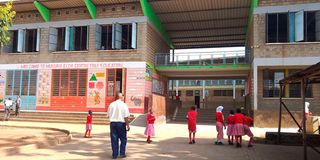
Mukuru Primary School in Mukuru-Kayaba slum in Nairobi's South B, in this photo dated March 4, 2025.
Under her leadership, the Mukuru Promotion Centre (MPC) has four public primary schools with 5,600 learners, all receiving free lunch daily. Some children take home part of their food to feed younger siblings because of high poverty, exacerbated by joblessness due to Covid-19.
The MPC, initially under the Irish Sisters of Mercy but now managed by Sisters of Mercy - Kenya, runs several other essential programmes: St Catherine Clinic, where community members pay just Sh40 for medical services; Mary Immaculate Rehabilitation Centre; St Michael Secondary; and Songa Mbele na Masomo for children with special needs.
Sr Mary has overseen the education of over 170,000 people. Among her notable alumni is Dr Sammy Kimoche of Kenyatta National Hospital. “Dr Kimoche is one among other past pupils of Mukuru. He got a sponsorship to fly to South America for his master's degree. We have masons, cooks, and plumbers who have graduated from our vocational centre. The list is endless,” she says with pride.
In 2016, she represented Nairobi's slum population in addressing Pope Francis during his visit. Her work was also recognised with the Presidential Distinguished Services Award from Ireland's President Michael Daniel Higgins. “I wasn't expecting the Presidential Distinguished Services Award at all,” she admits.
“I felt the award was an acknowledgement of all those who contribute, and of the huge poverty of residents of Nairobi.”
John Slattery, the chairman of Africa Direct that partners with Sr Mary, says, “Walking through the extensive Mukuru slums with her is akin to accompanying a football star. She is well known and popular with everyone.”
Despite her successes, she still faces challenges, including an illegal dumpsite near St Michael Secondary that threatens the health of more than 1,800 learners at St Bakhita Primary.
“I have raised concern about the illegal dumpsite since the leadership of Governor Mike Sonko and wrote to the national government. Local chiefs and the area DCC had a meeting with stakeholders, but it seems authorities are burying their heads in the sand.”
She also points to pollution of the Ngong’ River and grabbing of riparian land as issues hurting the schools. Sr Mary manages a children protection department in conjunction with social services and local administrators. She stands firmly against female genital mutilation and rape, encouraging women to venture into opportunities previously dominated by men. “It is shocking for predators to prey on young Mukuru girls. I have an incident where a young girl was offered chips and chicken when her parent was away. She was raped and is now out of school. It's terrible here in the slums.”
Donation
Sr Mary's donors are primarily Irish – from her siblings to large companies, to the Irish Embassy. “The people who support me are mostly people who have visited Kenya and seen the work. They are not usually big organisations, but groups of ordinary people who come together to support us.”
As she prepares to mark 50 years of community service next year, she offers wisdom for those looking to make a difference: “People do not plan to fail. They fail to plan. They do not keep data. They want to fund-raise. Some evaluate others, instead of committing to themselves and working on targets.”
Her closing message to women is: “Take charge if you have heart and care for children and say no to dumping and pollution of the Ngong’ River if we want to prove to the international community we are really true crusaders in the climate change advocacy. God bless women.”


